Active Listening Techniques for Sales Calls That Win
Master active listening techniques for sales calls that win. Learn proven strategies to enhance your conversations and close more deals.
Published: June 26, 2026
Author: OffBook Editorial Team

Active listening in sales is defined as the deliberate, tactical practice of processing what a prospect says, including the emotion behind it, to guide the conversation toward a genuine close. Most sales reps hear words. Top performers extract meaning. The gap between those two behaviors explains more lost deals than any pricing objection ever will. Research drawn from over 100,000 sales calls shows that interactivity rhythm matters more than raw talk time, and experts like Jeff Shore and David Gee have built entire frameworks around the idea that active listening is a learned discipline, not a personality trait. This article gives you the specific active listening techniques for sales calls that actually move the needle.
1. What are the top active listening techniques for sales calls?
The most effective active listening techniques for sales calls share one quality: they create space for the prospect to reveal more than they planned to share. Each technique below is specific, repeatable, and grounded in how real conversations work.
- Hold the 3-second pause. After a prospect finishes speaking, wait three full seconds before responding. This is called the Pause of Power, and it signals that you are processing, not just waiting for your turn. Prospects almost always fill the silence with a more honest, more detailed answer.
- Use tactical labeling. Name the emotion you hear. “It sounds like you’ve been burned by a vendor before” is more powerful than any clarifying question. Labeling triggers oxytocin release and lowers the prospect’s stress response, making them more open.
- Ask one question at a time. Stacking questions causes prospects to answer only the easiest one and ignore the rest. Ask a single, clear question. Wait for the full answer. Then ask the next one.
- Mirror their language. Repeat the last two or three words a prospect uses, framed as a question. If they say “we’re under a lot of pressure,” you say “a lot of pressure?” Mirroring builds rapport by making prospects feel heard without you having to interpret or redirect.
- Shorten your introduction. Top performers cut their intro from 60–90 seconds down to 20–30 seconds. The faster you stop talking about yourself, the faster you learn what the prospect actually needs.
- Take notes visibly. Writing down what a prospect says, and telling them you are doing it, signals that their words matter. It also forces you to listen more carefully because you have to capture the substance.
Pro Tip: Set a timer on your next call and track how many seconds pass before you respond to each prospect statement. Most reps respond in under one second. Aim for three.
2. Why rhythmic interactivity beats talk-to-listen ratios

The sales industry has fixated on talk-to-listen ratios for years. The real signal is something more specific: how often the conversation switches between speakers.
Top performers average 15–16 questions per call, with roughly 30–45 seconds of listening per answer. That pattern creates a rhythm of short exchanges rather than long monologues from either side. Two reps can have identical talk-time percentages and produce completely different outcomes based on whether the conversation flows or stalls.
| Conversation pattern | Speaker switches | Outcome signal |
|---|---|---|
| High interactivity | Frequent, short exchanges | Higher win rates |
| Low interactivity | Long rep monologues | Lower engagement |
| Stacked questions | Prospect answers one, ignores rest | Incomplete discovery |
| Single sequential questions | Full answers per question | Better qualification data |
The practical implication is direct. A disciplined talk-to-listen rhythm is not about hitting a percentage target. It is about keeping the conversation moving with frequent, purposeful exchanges. SPIN Selling, developed by Neil Rackham, supports this with its emphasis on fewer, higher-quality questions over rapid-fire interrogation. Rhythm creates the feeling of a conversation. Monologues create the feeling of a pitch.
3. Mindset shifts that make active listening a real skill
Active listening is a learned discipline, not a personality trait. Jeff Shore’s research shows that most salespeople fail at listening because they listen to respond rather than listening to understand. The fix is mental before it is tactical.
The most damaging habit is preparing your next reply while the prospect is still talking. You catch keywords, miss context, and respond to what you expected to hear rather than what was actually said. The result is a rep who sounds rehearsed and a prospect who feels unheard.
Practical habits that build genuine listening discipline:
- Eliminate parallel processing. Close your email. Put your phone face down. Treat the call as the only thing happening.
- Use reflective listening. Before answering, summarize what you heard. “So if I’m understanding correctly, the main issue is X.” This confirms accuracy and shows attention.
- Listen for hesitation. A pause before answering, a qualifier like “I guess,” or a shift in tone all signal uncertainty or concern. These are the moments worth exploring.
- Build in feedback loops. After each call, review one moment where you interrupted or redirected too quickly. Identify what the prospect might have said if you had waited.
Pro Tip: Before your next call, read the pre-call preparation checklist so you walk in with enough context to actually listen instead of scrambling to understand the basics.
4. How emotional intelligence deepens what you hear
Tactical listening focuses on the emotional “why” behind what a prospect says, not just the literal “what.” FBI negotiation data cited by 3 Second Selling shows that listening for emotional subtext builds 4x more rapport than basic active listening alone. That gap is significant enough to change close rates.
Prospects speak in corporate language. They say “we’re evaluating options” when they mean “we’ve been burned before and we’re scared to commit.” They say “budget is tight” when they mean “I can’t justify this to my CFO without more proof.” Your job is to hear the second sentence, not just the first.
Techniques that surface emotional subtext:
- Label the feeling, not the fact. “It sounds like this has been a frustrating process” opens more than “So you’ve tried other solutions?”
- Ask clarifying follow-ups. “When you say X, what does that look like for your team?” pulls the abstract into the specific.
- Watch for body language signals. On video calls, a prospect who leans back, crosses their arms, or looks away is signaling discomfort. Name it. “You seem hesitant about that part.”
- Mirror to confirm. Repeat their exact words back as a question. It validates without leading.
“The best salespeople I’ve watched don’t just listen to the words. They listen to the space around the words, the hesitation, the qualifier, the thing the prospect almost said but didn’t.”
Mirroring works because it aligns your tone, pace, and word choice with the prospect’s. That alignment triggers familiarity. Familiarity triggers trust. Trust is what closes deals.
Key takeaways
Active listening in sales calls is a tactical discipline built on rhythmic exchanges, emotional labeling, and deliberate silence, not passive hearing or talk-time percentages.
| Point | Details |
|---|---|
| Rhythm over ratio | Frequent short exchanges win more than hitting a talk-time percentage target. |
| Pause before responding | A 3-second pause after a prospect speaks surfaces deeper, more honest answers. |
| One question at a time | Stacking questions cuts answer quality; single sequential questions improve discovery. |
| Label emotions explicitly | Naming what a prospect feels lowers their stress and builds trust faster than any question. |
| Listening is a discipline | Reps who stop rehearsing replies and focus fully on the speaker close more deals. |
What I’ve learned from watching reps actually listen
I’ve sat in on hundreds of sales calls across B2B SaaS teams, and the pattern is consistent. The reps who struggle are not the ones who don’t know their product. They are the ones who treat the call as a performance rather than a conversation.
The hardest habit to break is the urge to fill silence. A three-second pause feels like an eternity when you are the one holding it. But I have watched prospects completely reverse their stated objection in that silence, volunteering information the rep would never have thought to ask for. That is not a soft skill. That is a tactical edge.
Rhythmic interactivity changed how I evaluate call quality entirely. I stopped looking at talk-time percentages and started counting speaker switches. A call with 20 short exchanges is almost always more productive than one with five long turns, even if the total talk time is identical. The rep performance improvement guide from Offbook captures this well: discipline in the moment, not just preparation before it, is what separates good calls from great ones.
My advice is simple. Pick one technique from this article and practice it on your next three calls. Just one. The pause, the label, or the single question. Trying to apply all of them at once produces the same problem as not listening at all: you are too focused on your own behavior to hear what the prospect is actually saying.
— Neil
Real-time coaching that reinforces listening habits
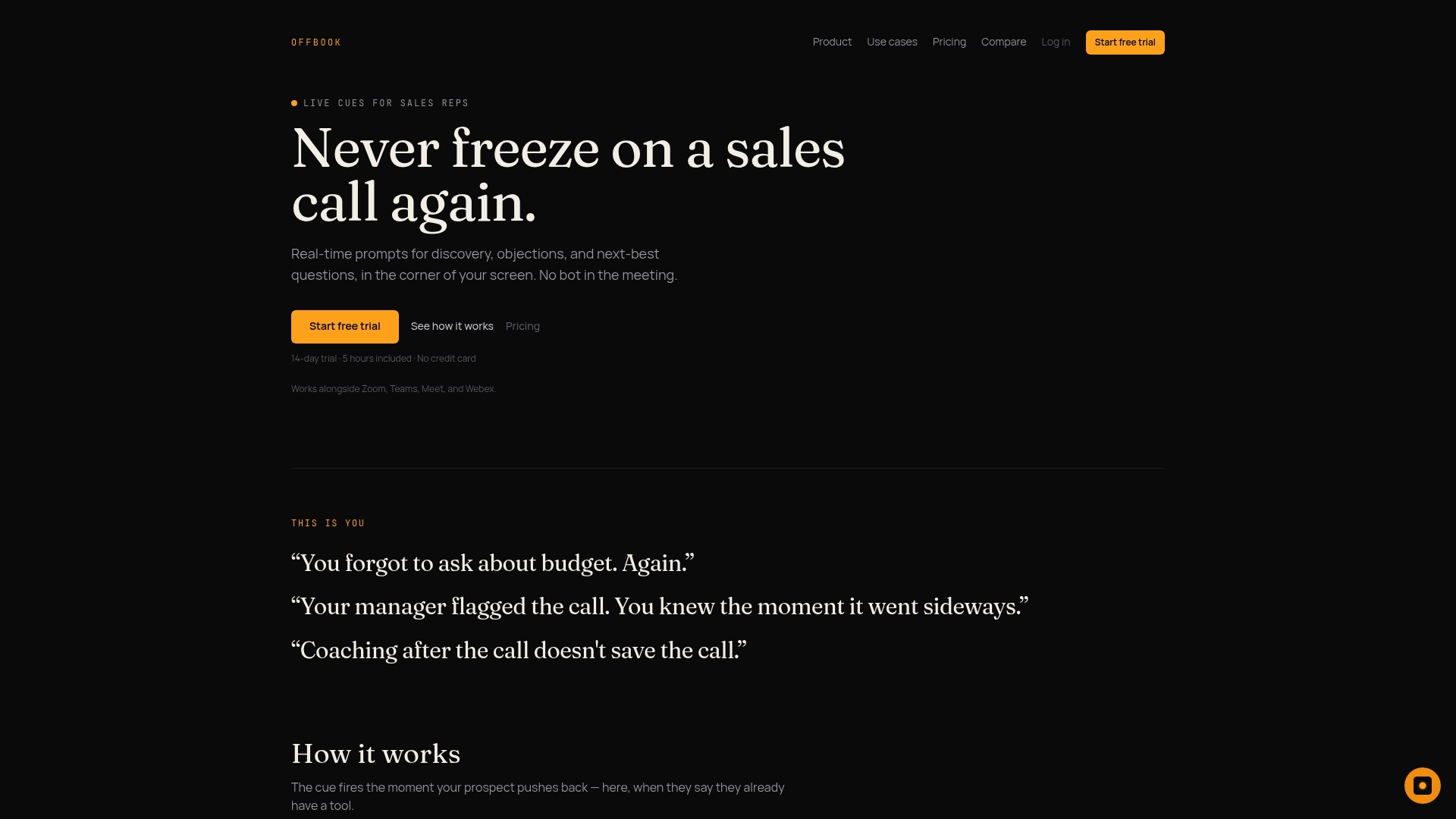
Reading about active listening techniques is useful. Applying them under pressure, on a live call, with a real prospect, is where most reps fall short. Offbook is built for exactly that moment. It surfaces live AI cues on-screen during your video calls, prompting you with the right question to ask next, the objection to address, and the qualification gap to close, all without a bot joining the meeting. For founders and early-stage B2B SaaS teams running calls on frameworks like MEDDIC or MEDDPICC, Offbook keeps you present and disciplined when it counts most. If you want to put these techniques into practice on your next call, Offbook’s AI sales coaching is where to start.
FAQ
What is the ideal talk-to-listen ratio for sales calls?
There is no single ideal ratio. Research from over 100,000 sales calls shows that interactivity rhythm, meaning frequent short exchanges, predicts win rates more reliably than any specific talk-time percentage.
How does tactical labeling work in a sales conversation?
Tactical labeling means naming the emotion you hear in a prospect’s words. Saying “it sounds like you’re under a lot of pressure on this” triggers oxytocin and lowers the prospect’s stress, making them more willing to share the real concern.
Why do salespeople think they’re listening when they aren’t?
Most reps listen to respond rather than to understand. Jeff Shore’s research shows that mentally preparing your next reply while the prospect is still talking causes you to miss critical subtext and emotional signals.
How many questions should a rep ask per sales call?
Top performers ask around 15–16 questions per call, one at a time, and listen for 30–45 seconds per answer. Stacking multiple questions in one turn reduces the quality and completeness of the answers you receive.
What is the Pause of Power in sales?
The Pause of Power is a deliberate 3-second silence held after a prospect finishes speaking. It signals that you are processing their words, and it consistently prompts prospects to add more detail or reveal a deeper concern they had not planned to share.