Build a Sales Call Quality Scoring System That Works
Discover how to build a sales call quality scoring system that proves your reps can close more deals and boost team performance efficiently.
Published: May 27, 2026
Author: OffBook Editorial Team

Most sales leaders know their reps are leaving deals on the table during calls. The harder problem is proving it, consistently, across every conversation. A sales call quality scoring system gives you that proof. It replaces gut-feel evaluations with defined criteria, weighted scores, and repeatable processes that your entire team can trust. Traditional quality assurance in sales reviews only a fraction of calls, which means most coaching opportunities disappear before anyone notices them. This guide walks you through building, running, and refining a scoring system that actually changes rep behavior and moves your numbers.
Table of Contents
Key Takeaways
| Point | Details |
|---|---|
| Keep scorecards focused | Limit criteria to 5–8 high-impact behaviors to prevent evaluator fatigue and drive adoption. |
| Weight by outcome impact | Discovery and closing criteria should carry 30–40% of total score weight to reflect their deal impact. |
| Automate for full coverage | AI-enabled scoring covers 100% of calls versus the 2–5% manual review can realistically reach. |
| Calibrate continuously | Monthly calibration sessions keep human and AI scores aligned and prevent scoring drift over time. |
| Use scores to coach, not punish | Score thresholds should trigger targeted coaching conversations, not performance warnings. |
Building Your Sales Call Quality Scoring System
The industry term for what most sales teams are building here is a call quality scorecard, and it sits at the center of any serious quality assurance program. Before you score a single call, you need to decide what you are actually measuring and why.
Start with behaviors that move deals forward
The most effective scorecards focus on the specific rep behaviors that correlate with closed revenue. Think about discovery depth, objection handling, next-step commitment, and how well the rep qualifies the opportunity against your chosen methodology. These are not soft skills. They are observable, repeatable actions you can identify in a transcript or recording.
The temptation is to score everything. Resist it. Scorecards with 30 criteria taking 15 minutes per call tend to be abandoned within weeks. Stick to 5–8 criteria that genuinely predict outcomes, and your team will actually use the system.
Define observable, transcript-evident criteria
Vague labels like “rapport” or “professionalism” destroy scoring reliability. Two reviewers will score the same call completely differently when the criteria are open to interpretation. Observable, transcript-evident criteria increase consistency and give reps something concrete to improve.
Instead of “built rapport,” write “asked at least two open-ended discovery questions before presenting the product.” Instead of “handled objections well,” write “acknowledged the objection, offered a specific response, and confirmed the prospect’s reaction.” The more specific the definition, the more consistent the scoring.
Weight criteria by business impact
Not all behaviors are equal. Discovery and closing typically carry 30–40% of total scorecard weight because they have the highest correlation with deal outcomes. Compliance items might carry 10–15%. Adjust weightings as you gather data and see how scores correlate with your actual conversion rates.
A simple weighting structure might look like this:
-
Discovery quality: 35%
-
Objection handling: 25%
-
Next-step commitment: 20%
-
Product positioning: 10%
-
Compliance and process: 10%
Pro Tip: Build your scorecard in a shared document first and walk two or three senior reps through it before finalizing. If they cannot score the same sample call within one point of each other, your criteria need more specificity.
Manual vs. Automated Scoring
Once your scorecard exists, you need a process for actually using it. This is where most teams hit a wall, because manual review does not scale.
The manual scoring process
Manual call evaluation follows a straightforward sequence. A QA reviewer or sales manager listens to a recorded call, scores each criterion against the rubric, tallies the weighted total, and logs the result. The reviewer then shares feedback with the rep, ideally within 24–48 hours of the call while the conversation is still fresh.

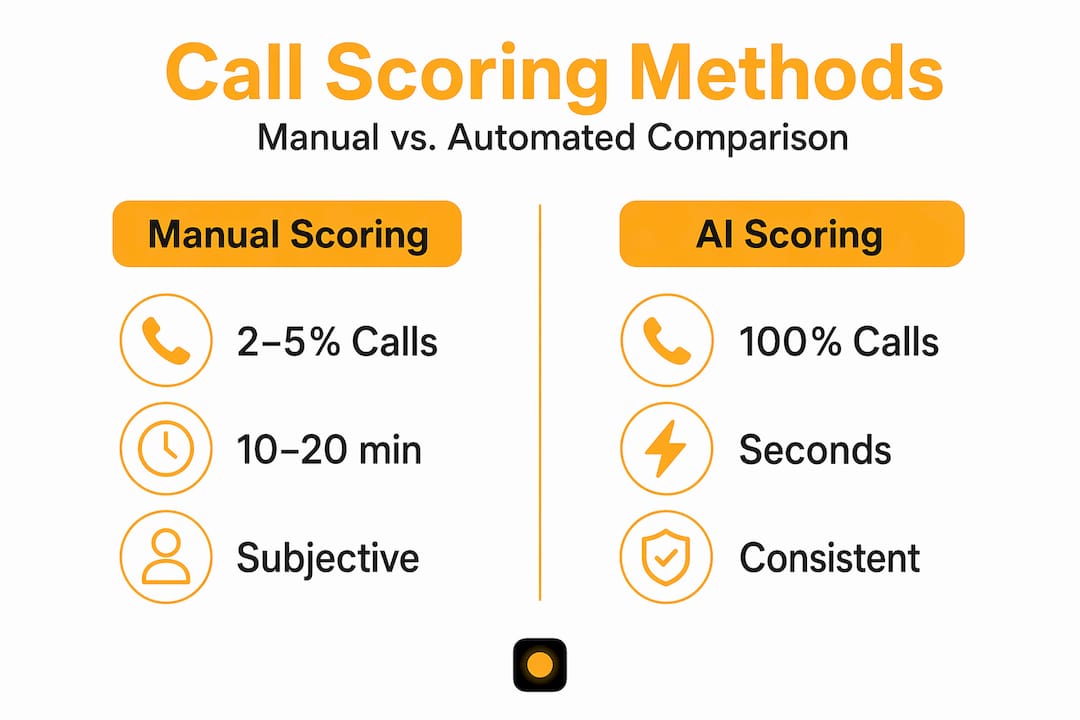
The problem is capacity. Manual review covers only 2–5% of calls, which means the vast majority of your team’s conversations go unexamined. If a rep develops a bad habit on Tuesday, you might not catch it until the following month, after it has already cost you three deals.
Setting up automated AI scoring
AI-enabled scoring changes the math entirely. Here is how a typical implementation works:
-
Build your rubric in the platform. Each criterion becomes a discrete question with defined evidence standards, so the AI scores against facts rather than impressions. Deterministic rubrics define observable facts for each criterion to produce consistent scoring at scale.
-
Integrate your phone or video call system. Most vendors handle this setup within one to two weeks, covering scorecard configuration and system connection.
-
Run calibration against real calls. Before going live, score a sample of real calls manually and compare results to the AI output. Most teams reach 85–95% agreement with senior QA leads within two weeks of calibration.
-
Set score thresholds and alerts. Define what score triggers a coaching conversation versus what score is acceptable, and configure your dashboard accordingly.
-
Review edge cases manually. Automated systems handle volume. Human reviewers handle nuance, regulatory complexity, and calls where context matters most.
Pro Tip: When selecting an AI scoring platform, check whether it uses a separate model family to evaluate calls rather than the same model that processes them. Using a different model family for judging reduces score inflation and removes bias from the evaluation.
Here is a quick comparison of the two approaches:
| Factor | Manual scoring | AI-enabled scoring |
|---|---|---|
| Call coverage | 2–5% of calls | 100% of calls |
| Time per call | 10–20 minutes | Seconds |
| Consistency | Varies by reviewer | Consistent against rubric |
| Setup time | Immediate | 1–2 weeks |
| Best for | Edge cases, coaching | Volume, trend analysis |
Companies deploying automated scoring typically go live within one to two weeks, with vendors handling the technical integration work.
Verifying and Maintaining Scoring Accuracy
A scoring system that nobody trusts is worse than no system at all. Reps will dismiss the data, managers will ignore the dashboards, and the whole program collapses. Calibration is what keeps the system credible.
Running calibration sessions
A calibration session is simple in concept. A group of reviewers, including both human QA leads and whoever manages the AI system, independently scores the same set of calls, then compares results and discusses disagreements. The goal is not perfect agreement. The goal is understanding why disagreements happen and tightening the rubric accordingly.
Use Cohen’s kappa as your measurement standard. A kappa score below 0.6 signals that your rubric is broken and reviewers are essentially guessing. A score between 0.7 and 0.8 is solid. Monthly calibration sessions should reset if disagreement on key areas exceeds 5%.
Watching for model drift
AI models do not stay static. Silent updates from vendors and gradual shifts in how reps speak on calls can cause an AI scoring model to drift from its original calibration without any obvious warning signs. Human calibration reviews must be continuous to catch this drift before it corrupts your data.
Practically, this means running a fresh batch of human-scored calls against your AI output every month, not just at launch. If agreement rates drop, investigate before assuming the reps have gotten worse.
Connecting scores to coaching
Score data becomes useful when it triggers action. Set clear thresholds:
-
Scores above your target benchmark: acknowledge and document what the rep did well.
-
Scores in the middle range: schedule a brief coaching conversation focused on one or two specific criteria.
-
Scores below a defined floor: trigger a structured coaching session with call examples, not a performance warning.
Call scoring data links rep behavior with business outcomes, which means you can eventually show a direct line between improved scores and improved conversion rates. That is the ROI case for the entire program.
Common Pitfalls and How to Avoid Them
Even well-designed scoring programs run into predictable problems. Here are the ones worth watching for before they cost you time and credibility.
Overcomplicated scorecards. More criteria feel more thorough, but they produce noise, not signal. If your reviewers are spending more than eight minutes per call, your scorecard is too long. Cut it down and revisit what you removed after 90 days of data.
One scorecard for every call type. A discovery call and a closing call are completely different conversations. Scoring them against the same criteria produces misleading results. Build separate scorecard versions for your major call types and make sure reps know which applies to each stage.
Evaluator fatigue. Even with AI handling volume, human reviewers still handle edge cases and calibration. Rotating reviewers and capping manual review sessions at 90 minutes prevents the kind of fatigue that quietly degrades scoring quality.
Ignoring emotional and compliance signals. Tone, pacing, and whether a rep disclosed required information are all scoreable. AI tools can flag these patterns at scale, but someone needs to define what “appropriate urgency” or “compliant disclosure” actually looks like in your specific context.
Pro Tip: Start your scoring program with just three criteria for the first 30 days. Score every call against those three, build the habit, and add criteria only after your team trusts the baseline data. A simple system used consistently beats a perfect system ignored.
My Take on What Sales Teams Get Wrong Here
I’ve watched a lot of sales teams build scoring programs with the best intentions and then quietly abandon them six months later. The pattern is almost always the same. They build a 20-point scorecard because it feels comprehensive, skip calibration because it feels bureaucratic, and then wonder why their managers don’t trust the numbers.
What I’ve learned is that the value of a scoring system is not in its sophistication. It’s in its consistency. A five-criterion scorecard that every manager uses the same way, every week, for a full year will generate more useful coaching insights than any elaborate system that gets gamed or ignored.
The shift to automation is real, and it matters. Automation transforms QA teams from people who spend their days listening to calls into people who spend their days improving the rubric and coaching from the data. That is a better use of human judgment, not a replacement for it.
The teams I’ve seen get the most out of scoring are the ones who treat calibration as a standing meeting, not a launch task. They sit down monthly, score the same five calls together, and have honest conversations about where the rubric is unclear. That practice alone builds more trust in the data than any technology decision.
If you are starting from scratch, resist the urge to make it perfect before you make it real. Score calls this week, even imperfectly. The iteration will teach you more than any planning session.
— Neil
How Offbook Fits Into Your Scoring Program
Offbook approaches call quality from a different angle than post-call scoring tools, and that distinction matters for B2B sales teams trying to improve in real time.
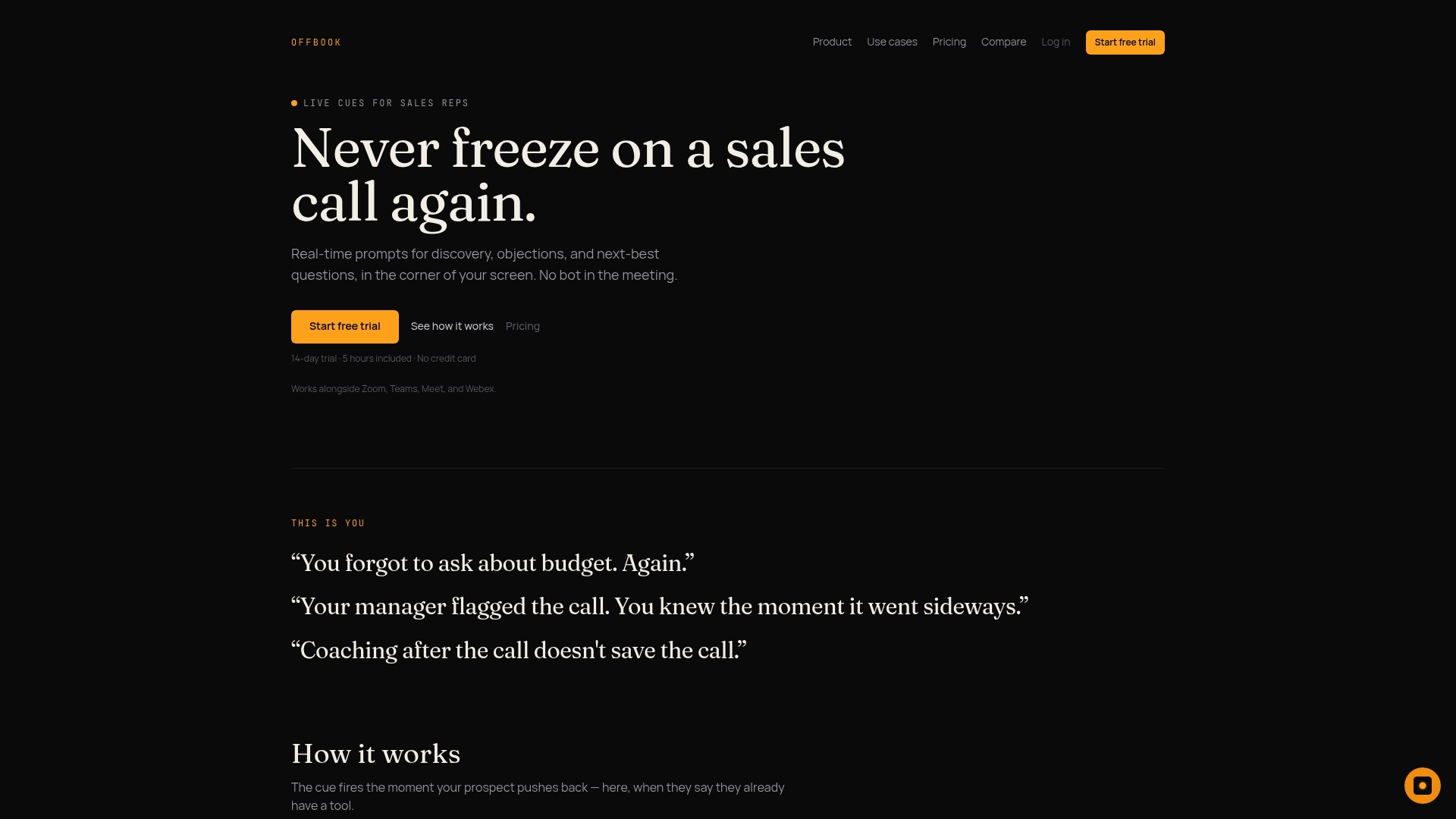
While a scoring system tells you what went wrong after the call ends, Offbook surfaces live AI cues during the conversation, prompting reps on-screen with the right questions to ask, qualification gaps to close, and objections to handle. It structures those cues around proven frameworks like MEDDIC and MEDDPICC, so your reps are not just scored against a rubric after the fact. They are coached against it in the moment.
For B2B sales teams running on tight pipelines and limited coaching bandwidth, that combination of pre-call preparation, live coaching, and post-call data creates a feedback loop that scoring alone cannot replicate. Offbook also generates pre-call briefs on the companies and people your reps are about to meet, so they walk into every conversation already prepared. Explore the full product capabilities to see how it fits your current sales motion.
FAQ
What is a sales call quality scoring system?
A sales call quality scoring system is a structured framework that evaluates rep performance on calls using defined criteria, weighted scores, and a repeatable review process. It replaces subjective impressions with consistent, measurable data.
How many criteria should a sales call scorecard include?
Limit your scorecard to 5–8 criteria. Scorecards with more than that tend to be abandoned because they take too long to complete and produce more noise than useful signal.
What is the difference between manual and automated call scoring?
Manual scoring covers 2–5% of calls and takes 10–20 minutes per call. Automated AI scoring covers 100% of calls in seconds, though it requires an initial calibration period of one to two weeks to reach reliable accuracy.
How often should you calibrate a call scoring system?
Run calibration sessions monthly. Have reviewers independently score the same set of calls, compare results, and update the rubric when disagreement on key criteria exceeds 5%.
How do you use call scores to improve rep performance?
Set score thresholds that trigger specific actions. High scores get documented as best practices, mid-range scores prompt a focused coaching conversation, and low scores trigger a structured session with call examples tied to the specific criteria where the rep struggled.