7 Common Sales Coaching Program Mistakes to Fix Now
Uncover and fix the 7 common sales coaching program mistakes. Transform your approach with effective strategies for better results!
Published: July 28, 2026
Author: OffBook Editorial Team

The six most common sales coaching program mistakes are: telling instead of asking, confusing pipeline inspection with coaching, coaching only when something breaks, tracking outcome metrics instead of leading behaviors, applying one-size-fits-all coaching, and coaching without data. Fix them by shifting to behavior-first, question-led, weekly inspection. Here is the short version:
- Telling instead of asking: Ask one open-ended question before offering any advice.
- Pipeline inspection mistaken for coaching: Separate deal reviews from skill development sessions.
- Reactive-only coaching: Schedule proactive weekly coaching conversations, not just crisis calls.
- Outcome metrics over leading behaviors: Track discovery quality and question ratio alongside close rate.
- One-size-fits-all coaching: Assess each rep’s experience level and adapt your approach.
- Coaching without data: Pull call recordings and CRM signals before every one-on-one.
Offbook’s real-time cues and pre-call briefs address all six by surfacing behavioral signals during live calls, structured around MEDDIC and MEDDPICC. Without that kind of in-the-moment reinforcement, reps often revert to old habits within 30 to 90 days of any training event.
Table of Contents
- The six biggest sales coaching mistakes, and how to fix each one
- How to audit your sales coaching program in two days
- A 30/60/90 remediation playbook for sales managers
- How real-time coaching tools prevent these mistakes
- Key Takeaways
- What actually moves outcomes in sales coaching
- Offbook closes the gap between coaching and the call
- Sources and further reading
The six biggest sales coaching mistakes, and how to fix each one
1. Telling instead of asking
The most pervasive coaching mistake is the instinct to tell. A manager sees a stalled deal and immediately prescribes the fix. The rep gets the answer, closes the deal, and learns nothing. Next quarter, the same problem reappears.

How it shows up: Reps who constantly escalate to their manager before attempting their own diagnosis. Call recordings where the coach talks more than the rep.
Diagnostic questions to ask yourself:
- In my last five coaching sessions, did I offer advice before asking a question?
- Can my reps articulate why a deal stalled, or do they just describe what happened?
- Do reps bring me problems or bring me their thinking?
Coaching prompt to use: “Before I share what I’m seeing, what do you think is driving the buyer’s hesitation?”
Pro Tip: Wait at least 5 seconds after a rep finishes speaking before responding. Deliberate silence forces the rep to process and surface better reasoning, rather than waiting for you to rescue them.
2. Confusing pipeline inspection with coaching
Pipeline reviews answer “what is the deal status?” Coaching answers “what behavior needs to change?” Conflating the two means reps get interrogated about forecast accuracy but never develop the skills to improve it.
How it shows up: One-on-ones that run entirely through the CRM. No time spent on call behavior, discovery quality, or objection handling.
Diagnostic questions:
- Does my pipeline review include any question about how the rep is selling, not just what they are selling?
- When did I last listen to a rep’s call and give specific behavioral feedback?
Coaching prompt: “Walk me through what you learned about the buyer’s current state on that last call. What did you ask to get there?”
3. Reactive-only coaching
Coaching that only happens when a deal is at risk or a rep misses quota is damage control, not development. Managers who reserve coaching for formal reviews create a punitive association with the conversation, and reps stop bringing real problems forward.
Diagnostic questions:
- How many of my coaching conversations this month were triggered by a problem versus scheduled proactively?
- Do my reps see coaching as support or as a performance warning?
Coaching prompt: “I want to spend 20 minutes this week on your discovery approach, not because anything is wrong, but because it’s the highest-leverage skill we can sharpen right now.”
4. Tracking outcome metrics instead of leading behaviors
Close rate tells you what happened. Discovery completeness, question-to-statement ratio, and talk-listen balance tell you why it happened and what to change. Coaching to close rate alone is like coaching a basketball player by watching the scoreboard and ignoring their shooting form.
Diagnostic questions:
- Can I name three behavioral metrics I track per rep, separate from quota attainment?
- Do my reps know which behaviors I’m watching, not just which numbers I’m measuring?
Coaching prompt: “On your last three discovery calls, what percentage of the time were you asking versus explaining? What would you want that ratio to be?”
5. One-size-fits-all coaching
A new rep needs structure and explicit guidance. A senior rep needs space to think and a thought partner, not a playbook recitation. Applying the same coaching approach to both wastes time and frustrates your best performers.
Diagnostic questions:
- Do I coach my top performers differently from my developing reps?
- Am I spending the most coaching time where it will produce the most growth, not just where the problems are loudest?
Coaching prompt for a senior rep: “You’ve run this play before. What would you do differently this time, and what would you want me to challenge you on?”
6. Coaching without data-driven insights
Coaching from memory or gut feel introduces bias and inconsistency. Without call recordings, CRM hygiene data, and behavioral signals, managers coach the rep they think they know, not the rep who actually showed up on the last call.
Diagnostic questions:
- Do I review at least one call recording before each coaching session?
- Am I coaching based on what I observed, or what I remember from a month ago?
Coaching prompt: “I listened to your call with [Company X] on Tuesday. At the 12-minute mark, the buyer mentioned budget constraints and you moved on. What were you thinking at that moment?”
How to audit your sales coaching program in two days
Run this checklist before changing anything. Diagnosis first.
What to review:
- 10 call recordings (sample across experience levels and deal stages)
- Last 30 days of one-on-one notes (are they coaching notes or pipeline updates?)
- Pipeline review scripts or agendas (do they include behavioral questions?)
- Manager training records (when were managers last trained to coach, not just manage?)
Metrics that matter:
| Metric type | Indicator | What to measure |
|---|---|---|
| Leading (behavioral) | Discovery completeness | Did the rep diagnose the buyer’s current state? |
| Leading (behavioral) | Question-to-statement ratio | How often does the rep ask vs. tell on calls? |
| Leading (behavioral) | Talk-listen balance | Is the rep talking more than 60% of the time? |
| Leading (behavioral) | CRM hygiene | Are next steps, contacts, and deal stage current? |
| Lagging (outcome) | Close rate | Win rate by rep, stage, and deal size |
| Lagging (outcome) | Pipeline velocity | Average days from first call to close |
Timeline: Expect behavioral metrics to shift within 30–60 days of consistent manager inspection. Lagging outcomes like close rate typically move in the 60–90 day window, after sustained reinforcement takes hold.
A 30/60/90 remediation playbook for sales managers
Days 0–30: Diagnose and reset
- Run the two-day audit above and identify the top two behavioral gaps per rep.
- Restructure one-on-ones: 10 minutes on a specific call moment, 10 minutes on the rep’s diagnosis of a live deal, 5 minutes on one skill to practice this week.
- Train managers to ask one open-ended question before offering any advice, every session.
- Add one behavioral question to every pipeline review: “What did you learn about the buyer’s current state?”
Days 30–60: Reinforce with micro-practice
- Run a 20-minute role-play each week. Format: manager plays the buyer, rep runs discovery, debrief focuses on question quality not outcome.
- Track question-to-statement ratio and talk-listen balance from call recordings weekly.
- Consistent inspection at this cadence, not monthly reviews, is what turns new behaviors into habits.
Days 60–90+: Scale and measure
- Compare close rates and pipeline velocity against the pre-audit baseline.
- Identify which reps improved fastest and document what coaching inputs drove it.
- Adjust coaching frequency: high performers may need less frequent sessions; developing reps may need more focused skill work.
Pro Tip: Training that treats coaching as a one-off event produces short-term lifts and long-term reversion. The cadence above works because it embeds inspection into the weekly rhythm, not the quarterly calendar.
Sample rescue-avoidance script (when you feel the urge to jump in with the answer):
How real-time coaching tools prevent these mistakes
Three tool categories address the six mistakes differently:
| Tool type | Mistakes addressed | Key limitation |
|---|---|---|
| Manual program management | None systematically | Relies entirely on manager memory and discipline |
| Call recording + post-call review | Data gap, one-size-fits-all (partially) | Feedback arrives too late to change the call outcome |
| Real-time coaching (e.g., Offbook) | All six, in the moment | Requires rep adoption and call setup |
Post-call review is better than nothing, but it coaches the last call, not the current one. Real-time cues surface the right question at the moment a rep needs it, not 48 hours later in a debrief.
Offbook addresses the six mistakes directly: live AI cues prompt reps on discovery gaps, objection handling, and MEDDIC/MEDDPICC qualification during the call itself. Pre-call briefs eliminate the “coaching without data” problem before the conversation starts. Behavioral signals from live calls give managers objective data for one-on-ones, replacing gut feel with evidence. Learn more about AI cues in practice and how they fit into a B2B coaching program.
Pro Tip: Use real-time cues for in-call behavior change and post-call recordings for manager coaching sessions. They serve different purposes. One prevents the mistake; the other diagnoses it after the fact.
Key Takeaways
The single highest-leverage fix in any coaching program is replacing advice-giving with question-asking, then measuring the behavioral shift before expecting outcome metrics to move.
| Point | Details |
|---|---|
| Ask before advising | Ask one open-ended question before offering advice to build rep autonomy and critical thinking. |
| Separate inspection from coaching | Pipeline reviews and skill development sessions serve different purposes; never conflate them. |
| Track leading indicators | Measure discovery quality, question ratio, and talk-listen balance before looking at close rate. |
| Expect 60–90 days for outcomes | Behavioral metrics shift within 30–60 days; lagging outcomes like close rate follow after sustained inspection. |
| Offbook for in-call reinforcement | Offbook surfaces live MEDDIC/MEDDPICC cues during calls, preventing mistakes before they become habits. |
What actually moves outcomes in sales coaching
Most sales leaders invest in frameworks. MEDDIC, MEDDPICC, SPIN, Challenger. The frameworks are not the problem. The problem is treating a framework as the finish line rather than the starting point.
A framework structures the conversation. It does not tell you why a rep skips economic buyer qualification on every third call, or why discovery consistently stalls at the surface level. That diagnosis requires observing specific, observable behaviors: what the rep actually said, when they said it, and what they did not ask. Frameworks give you the map; behavioral diagnosis tells you where the rep is actually standing on it.
The other blind spot most leaders miss: they coach the reps who are loudest about needing help and assume the quiet performers are fine. Some of the highest-leverage coaching conversations happen with mid-tier reps who are one or two behavioral adjustments away from top-quartile performance. The audit checklist and remediation playbook above are built to surface those reps, not just the ones already on a performance plan.
Offbook closes the gap between coaching and the call
Knowing the six mistakes is one thing. Catching them in real time, on a live deal, is another. Offbook puts the coaching inside the call itself: live AI cues prompt reps on the right discovery questions, qualification gaps, and objection responses, all mapped to MEDDIC and MEDDPICC, without a bot joining the meeting or the rep breaking flow to check notes.
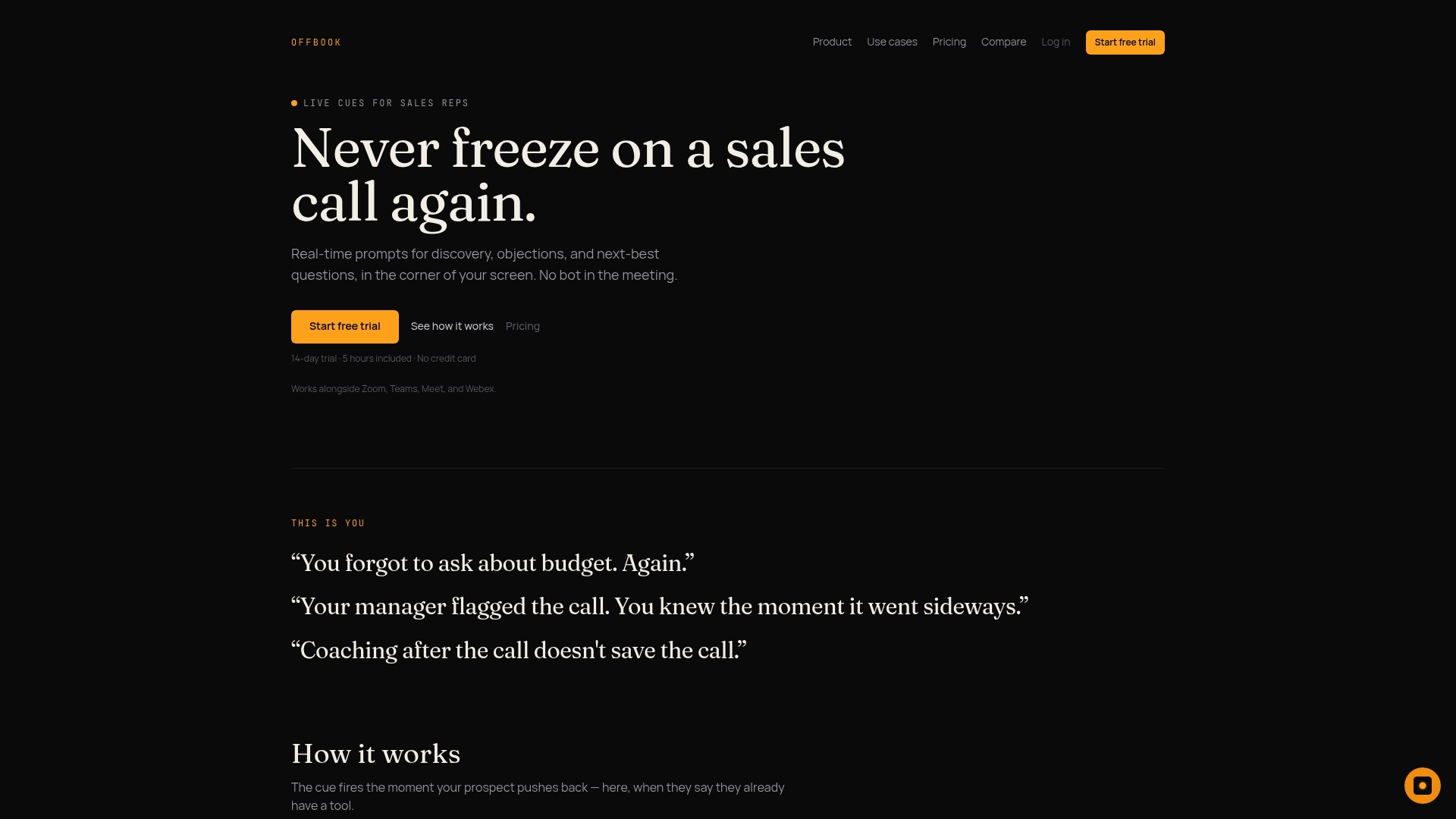
Pre-call briefs mean reps walk in prepared. Behavioral signals from every call give managers the objective data they need to coach on evidence, not memory. The result is a coaching program that does not depend on a manager being in the room or a rep remembering last week’s training.
If you are running the audit this week and want to see how real-time coaching fits your program, see Offbook for sales teams and book a demo.
Sources and further reading
- The 6 Most Common Sales Coaching Mistakes And How to Fix Them — MySalesCoach
- Why Sales Training Fails — Sales Growth Company (30–90 day reversion finding)
- Leadership Development: 4 Common Coaching Pitfalls — RBL Group
- Coaching Mistakes Managers Make — Target Training (deliberate silence / 5-second pause)
- Common Sales Training Mistakes to Avoid — FLSC (reinforcement cadence)
- Offbook: AI call coaching for sales — product page and demo
- How AI Cues Improve Sales Performance — Offbook blog
- Sales Coaching Programs: A Startup Team Leader’s Guide — Offbook blog (program design and implementation)