Just-in-Time Sales Coaching: A B2B Team Guide
Discover what is just-in-time sales coaching and how it boosts win rates by 28%. Improve your B2B team's performance with real-time support.
Published: June 27, 2026
Author: OffBook Editorial Team

Just-in-time sales coaching is defined as the real-time delivery of specific, situational guidance to sales reps during or immediately before a live call, designed to correct behavior and advance deals in the moment. The industry term for this practice is “coaching in the flow of work,” and it produces measurably better outcomes than periodic review sessions. Research shows effective coaching drives a 28% higher win rate and an 88% productivity increase compared to traditional approaches. Those numbers reflect a simple truth: feedback lands hardest when it arrives at the exact moment a rep needs it, not three days later in a one-on-one meeting.
What is just-in-time sales coaching?
Just-in-time sales coaching delivers targeted guidance at the precise moment a rep faces a real selling situation. The term borrows from lean manufacturing, where JIT systems supply materials exactly when needed, eliminating waste. Applied to sales, the same logic holds: coaching supplied after the fact is coaching that arrives too late to change the outcome.
Traditional coaching runs on a weekly or monthly cadence. A manager reviews call recordings, identifies patterns, and schedules a session to discuss them. By then, the deal has moved on, the objection has been mishandled, and the rep has already formed a habit around the wrong behavior. JIT coaching flips that sequence entirely. Guidance arrives during the call or in the 30 seconds before it, when the rep can still act on it.
This approach sits inside a broader category called what is sales coaching, which covers everything from onboarding to long-term skill development. JIT coaching is the tactical, real-time layer of that broader system. It does not replace strategic development. It handles the moment-by-moment decisions that determine whether a specific deal progresses.
How does just-in-time coaching differ from traditional sales coaching?
The most important difference is timing. Traditional coaching is retrospective. JIT coaching is concurrent. That distinction changes everything about how reps learn and how managers spend their time.

A traditional coaching session might run 45 minutes and cover five calls from the past two weeks. The rep hears what they did wrong, nods, and returns to their desk. Without immediate application, retention drops sharply. JIT interventions typically require only 30 seconds to 2 minutes per touchpoint. That brevity is a feature, not a limitation. Short, specific prompts tied to live situations produce faster behavior change than long retrospective discussions.
Scale is the other major difference. A manager running weekly one-on-ones can realistically coach six to eight reps before the calendar collapses. Micro-coaching messages allow a manager to support up to eight direct reports without disrupting anyone’s schedule. The coaching happens in the workflow, not around it.
Key structural differences between the two approaches:
- Timing: Traditional coaching is scheduled and retrospective. JIT coaching is immediate and situational.
- Format: Traditional sessions run 30–60 minutes. JIT interventions last 30 seconds to 2 minutes.
- Retention: Retrospective feedback fades quickly. Contextual feedback applied in the moment sticks.
- Manager capacity: Traditional coaching bottlenecks at six to eight reps. JIT micro-coaching scales across larger teams without calendar strain.
- Outcome focus: Traditional coaching improves future calls. JIT coaching improves the call that is happening right now.
Pro Tip: Set a rule that every JIT coaching message contains exactly one action. “Ask about their current vendor contract” beats “work on discovery and qualification and make sure you’re building rapport.” One prompt, one behavior, one moment.
What are the core benefits of just-in-time sales coaching?
The productivity gains from JIT coaching are well documented. Effective coaching drives an 88% increase in productivity, a figure that reflects how much output changes when reps receive guidance they can immediately apply. That is not a marginal improvement. It represents a fundamental shift in how quickly reps develop competence.
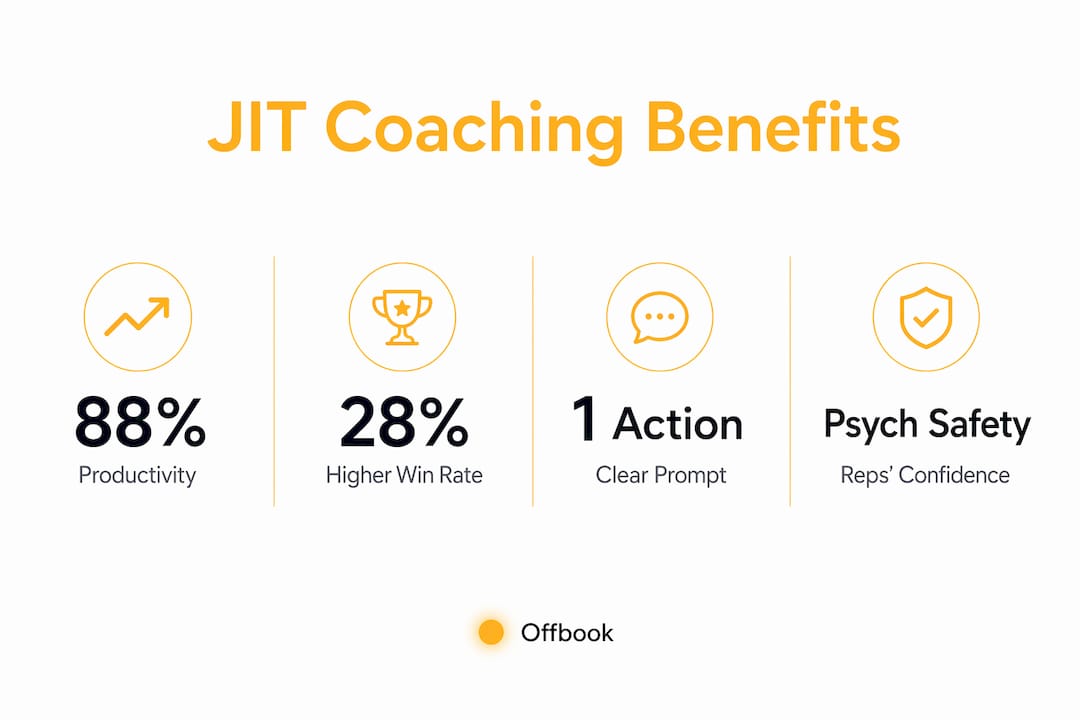
Learning retention improves because context does the heavy lifting. JIT training delivers targeted content at the moment of need, which increases retention and reduces workflow disruption. A rep who hears “ask about budget authority before you present pricing” during a live call will remember that lesson far longer than one who reads it in a training deck.
The benefits extend beyond individual performance:
- Faster skill development: Reps apply new behaviors immediately, compressing the time between learning and mastery.
- Higher engagement: Coaching embedded in work feels relevant, not theoretical, which keeps reps more engaged with the process.
- Psychological safety: Frequent, curiosity-based feedback delivered in the moment builds a culture where reps feel supported rather than evaluated.
- Deal progression: Guidance tied to a specific live deal improves that deal’s outcome directly, not just the rep’s abstract skill level.
- Coaching culture: High-performing organizations that embed JIT coaching shift the perception of coaching from punitive review to growth support.
The psychological safety point deserves emphasis. When coaching arrives as a live prompt rather than a post-call critique, reps experience it as support. That shift in perception changes how openly reps engage with feedback over time.
How does AI deliver just-in-time coaching during live calls?
AI makes JIT coaching possible at scale. A human manager cannot monitor every call in real time. AI can listen to every conversation simultaneously and surface the right prompt at the right moment without joining the meeting or disrupting the flow.
AI-driven coaching automates baseline tactical feedback, freeing human managers to focus on strategic development and emotional intelligence work. That division of labor is the key insight. AI handles the tactical layer: “You haven’t asked about the decision process yet.” Managers handle the strategic layer: “Here’s how to think about multi-threaded deals in this vertical.”
Two delivery models define how AI coaching reaches reps:
Push coaching surfaces insights automatically, without the rep requesting them. The system detects a trigger, such as a competitor mention or a pricing objection, and displays a prompt on screen. Push models lower adoption barriers because reps do not need to pause the conversation to ask for help.
Pull coaching requires the rep to request guidance. The rep notices a gap, taps a prompt, and receives a suggestion. Pull models give reps more control but depend on reps recognizing when they need help, which is often the hardest part of selling.
Push coaching wins for live call support. Pull coaching works better for pre-call preparation, where reps have time to review materials and choose what to focus on.
Offbook operates on a push model. It listens to the conversation and displays live cues on screen, covering questions to ask, objections to handle, and qualification gaps to close, all structured around MEDDIC and MEDDPICC. No bot joins the meeting. The rep sees the prompt. The buyer never knows it exists. For teams exploring AI-assisted sales conversations, this architecture solves the adoption problem that kills most real-time coaching tools.
Pro Tip: Evaluate any AI coaching tool by asking one question: does it surface one prompt or five? Systems that display multiple simultaneous suggestions create cognitive overload. The best tools show one high-impact action and disappear when it is no longer needed.
Best practices for implementing JIT coaching in B2B teams
Effective implementation requires more than turning on a tool. The coaching system needs to speak the same language as the sales team, surface the right information at the right moment, and fit into a culture that treats feedback as growth.
Anchor coaching to a shared sales framework
Standardized frameworks like MEDDPICC or MEDDIC are critical for JIT coaching effectiveness. When every prompt references the same qualification criteria, reps and managers share a common vocabulary. “You’re missing Economic Buyer clarity” means the same thing to everyone on the team. Without that shared language, coaching prompts create confusion rather than clarity.
Manage cognitive load ruthlessly
Overloading reps with multiple coaching prompts during calls leads to distraction and reduced effectiveness. The best systems surface one actionable prompt at a time and disappear when not needed. Build your coaching system around the “one prompt, one moment” principle. If a rep is handling a pricing objection, they need one response framework, not a list of six options.
Balance real-time coaching with post-call development
JIT coaching handles the tactical layer. Post-call sessions handle the strategic layer. Both are necessary. Use real-time prompts to correct in-the-moment behavior. Use post-call reviews to identify patterns, build skills, and discuss deal strategy. Teams that replace all coaching with JIT prompts lose the depth that comes from longer developmental conversations.
Set clear availability windows for async coaching
Not every coaching moment requires a live call. Managers can deliver micro-coaching through short voice messages, annotated call clips, or brief written notes tied to specific moments in a recording. Micro-coaching at scale works best when managers set defined windows for async feedback, so reps know when to expect it and managers can batch their review time.
Build a coaching culture before deploying the tools
The gap between current rep behavior and the ideal defined by your sales framework is what JIT coaching targets. Reps need to understand that gap exists and that coaching exists to close it, not to expose failure. Frame every coaching interaction as a question: “What would the ideal version of this call look like?” That framing shifts coaching from evaluation to collaboration.
Key takeaways
Just-in-time sales coaching is the most direct path from training to behavior change because it delivers guidance at the exact moment a rep can act on it.
| Point | Details |
|---|---|
| Timing drives impact | Coaching delivered during a live call changes that call’s outcome; retrospective feedback changes future calls at best. |
| AI handles the tactical layer | Push-model AI coaching surfaces one prompt at a time, freeing managers for strategic and developmental work. |
| Shared frameworks are non-negotiable | MEDDIC or MEDDPICC gives every coaching prompt a common language, reducing confusion and improving consistency. |
| Cognitive load determines adoption | Systems that surface one high-impact action outperform those that display multiple simultaneous suggestions. |
| Culture precedes tools | Reps adopt JIT coaching faster when they experience it as growth support rather than performance surveillance. |
The shift I keep watching happen in real time
The managers who get the most out of JIT coaching are the ones who stop thinking of themselves as performance reviewers and start thinking of themselves as deal collaborators. That is a real identity shift, and it does not happen automatically.
I have watched teams deploy real-time coaching tools and see almost no behavior change, not because the tool failed, but because the manager kept using it as evidence in post-call critiques. “See, the system flagged that you missed the Economic Buyer question.” That framing turns a coaching tool into a surveillance tool, and reps respond accordingly. They stop trusting the prompts.
The teams that see the coaching shift from retrospective review to live intervention are the ones where managers model curiosity. They ask “what were you thinking when you skipped the budget question?” instead of “why didn’t you follow the prompt?” That one change in framing produces a completely different conversation.
AI augments that dynamic rather than replacing it. The system catches the tactical gaps. The manager explores the reasoning behind them. Together, they cover ground that neither could cover alone. The future of sales coaching is not AI versus human. It is AI handling the moment-by-moment tactical layer so humans can go deeper on the strategic and emotional dimensions that actually build great salespeople.
The teams I see winning with JIT coaching are not the ones with the most sophisticated tools. They are the ones where coaching is genuinely seen as the fastest path to a bigger number, not a check-the-box activity.
— Neil
How Offbook delivers real-time coaching on live calls
Sales teams that want JIT coaching without a bot joining their meetings have a specific problem to solve. The coaching needs to be invisible to the buyer and immediate for the rep.
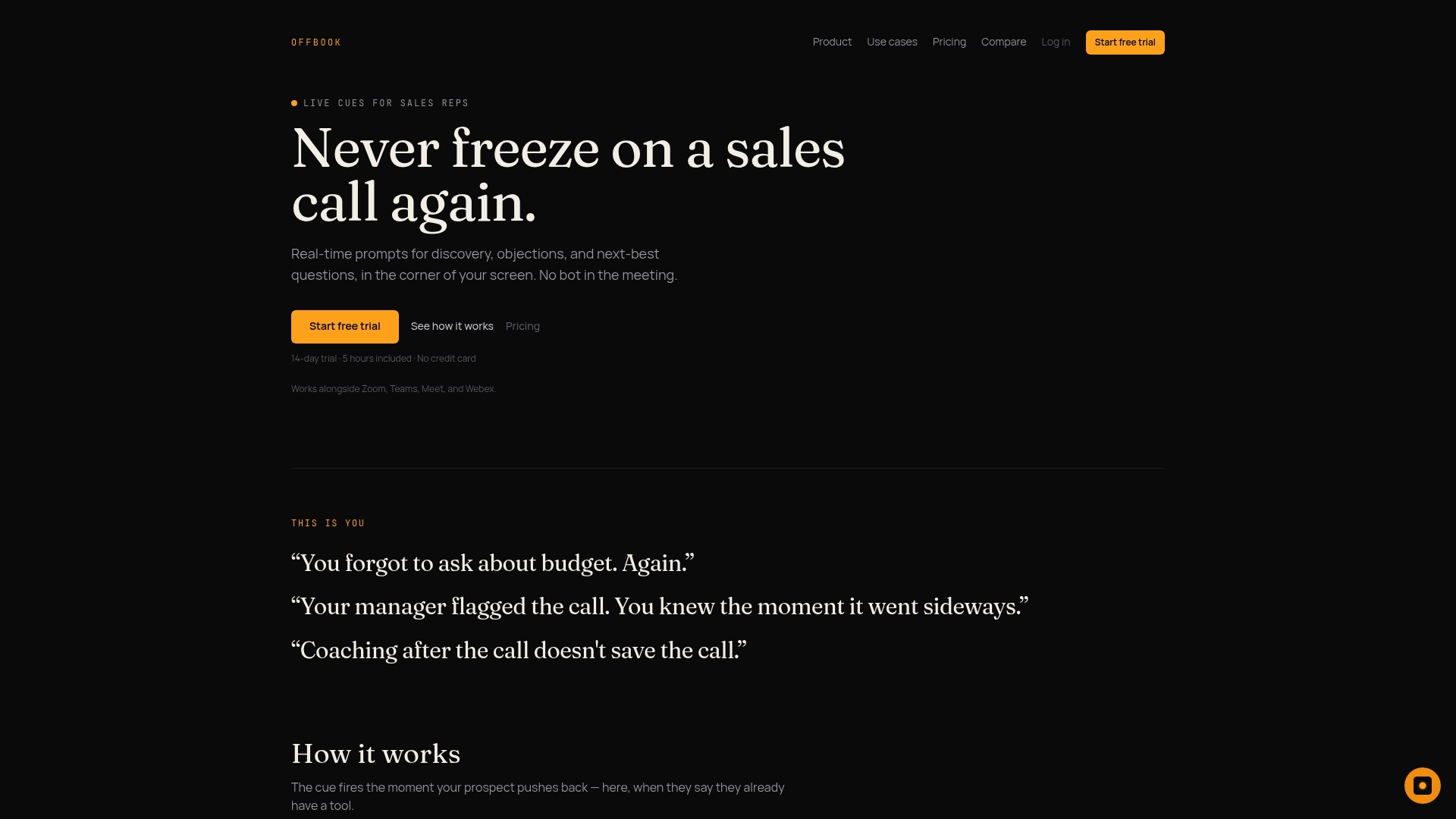
Offbook listens to your video calls and surfaces live AI cues on screen, covering the right questions to ask, objections to handle, and MEDDIC or MEDDPICC qualification gaps to close. No recording bot. No meeting disruption. Just the prompt a rep needs, at the moment they need it. Offbook also generates pre-call briefs so reps walk into every conversation prepared. For B2B SaaS teams at the seed and Series A stage, AI call coaching built around your sales framework is the fastest way to run more disciplined calls and close more deals.
FAQ
What is just-in-time sales coaching?
Just-in-time sales coaching is the delivery of specific, situational guidance to a sales rep during or immediately before a live call. It is designed to correct behavior and improve deal outcomes in real time, not after the fact.
How does JIT coaching improve win rates?
Effective coaching drives a 28% higher win rate by ensuring reps receive the right guidance at the moment they can act on it, rather than in a retrospective session where the deal has already moved on.
What is the difference between push and pull coaching?
Push coaching automatically surfaces prompts to reps based on conversation triggers, requiring no action from the rep. Pull coaching requires the rep to request guidance. Push models improve adoption during live calls because reps do not need to pause the conversation.
How does AI support in-call sales coaching?
AI-driven coaching automates tactical feedback during live calls, detecting triggers like objections or qualification gaps and displaying a prompt on screen. This frees human managers to focus on strategic development and deeper skill-building conversations.
What sales frameworks work best with JIT coaching?
Frameworks like MEDDIC and MEDDPICC work best because they give every coaching prompt a shared language. When the entire team uses the same qualification criteria, real-time prompts are clear, consistent, and immediately actionable.