Top AI Sales Assistants for B2B Founders in 2026
Discover the top AI sales assistants for B2B founders in 2026. See how Offbook, Apollo.io, and Clay empower small teams to succeed.
Published: August 4, 2026
Author: OffBook Editorial Team

For founder-led B2B SaaS teams at seed and Series A, Offbook is the strongest pick among AI sales assistants right now. It coaches reps live during video calls, surfacing MEDDIC and MEDDPICC cues on-screen without a bot joining the meeting, and it gets pilots running in days, not months. That combination matters when you have a small team, high-stakes calls, and no time to wait for retrospective analytics to tell you what went wrong.
The tools below are scoped to outbound and founder-led discovery/demo motions at seed and Series A B2B SaaS startups. Enterprise-only platforms that require a six-month procurement cycle are excluded.
Top 3 picks for founder-led teams:
- Offbook — Real-time, in-call coaching tied to MEDDIC/MEDDPICC; fastest time-to-value for small teams running high-stakes calls.
- Apollo.io — Best when prospect discovery and outreach sequencing need to live in one place on a startup budget.
- Clay — Best for founders who want deeply enriched prospect profiles before any outreach begins.
Table of Contents
- What are the best AI sales assistants for B2B founders?
- How do these tools compare side by side?
- How we evaluated these tools
- Why real-time coaching changes outcomes for founder-led teams
- In-depth profiles of the top AI sales assistants
- How do you choose the right AI sales assistant for your startup?
- How do you run a 30-day AI sales assistant pilot?
- Key Takeaways
- A founder’s honest notes on buying AI for sales
- Offbook is built for exactly this moment in your sales motion
- Primary sources and useful links
What are the best AI sales assistants for B2B founders?
The six tools below cover the most common gaps founder-led teams hit: in-call coaching, prospecting automation, contact enrichment, meeting intelligence, and outreach sequencing.
- Offbook — Live AI cues during calls, pre-call briefs, and post-call debriefs built around MEDDIC/MEDDPICC. The only tool here that coaches while the conversation is happening, not after.
- Apollo.io — A large contact database paired with built-in sequencing. Founders who need to go from zero pipeline to booked meetings fast will get the most out of it.
- Clay — Enriches prospect profiles by pulling from dozens of data sources. Pairs well with any outreach tool once you have a clean ICP.
- Gong — Deep post-call conversation analytics and revenue intelligence. Best when you have enough call volume to spot patterns and coach a team.
- Lavender — Focused entirely on cold email: personalization, subject-line scoring, and deliverability coaching. A sharp single-purpose tool for founders who live in their inbox.
- Outreach — Sophisticated sequencing and workflow orchestration. Earns its place once you have a dedicated SDR motion and need playbook discipline at scale.
Each of these solves a specific problem. Offbook handles the moment the deal is actually won or lost. The others handle what happens before and after that moment.
How do these tools compare side by side?
| Tool | Best for | Core capabilities | Real-time vs. post-call | Key integrations | Pricing band | Ideal stage | Setup effort | Privacy posture |
|---|---|---|---|---|---|---|---|---|
| Offbook | Founder-led in-call coaching | Live cues, pre-call briefs, post-call debriefs, MEDDIC/MEDDPICC | Real-time | HubSpot, Salesforce, Zoom, Teams | Self-serve / team tiers | Seed, Series A | Low (days) | Consent-first, no bot in meeting |
| Apollo.io | Prospect discovery + outreach | Contact DB, sequencing, email/LinkedIn outreach | Post-call | HubSpot, Salesforce, Outreach | Self-serve <$100/user/mo | Seed, Series A | Low | Standard |
| Clay | Prospect enrichment | Multi-source enrichment, workflow orchestration | Post-call | HubSpot, Salesforce, Outreach, Apollo | Self-serve / team | Seed, Series A | Medium | Standard |
| Gong | Post-call analytics + coaching | Call/email analysis, forecasting, deal intelligence | Post-call | Salesforce, HubSpot, Outreach, Salesloft | Enterprise >$500/user/mo | Series A, scale | Medium–high | SOC 2 Type II |
| Salesloft | Cadence + coaching workflows | Sequencing, Rhythm AI prioritization, analytics | Post-call | Salesforce, HubSpot, LinkedIn | Team $100–$500/user/mo | Series A, scale | Medium | SOC 2 Type II |
| Lavender | Cold email optimization | Email scoring, personalization, subject-line coaching | Post-send | Gmail, Outlook, HubSpot, Salesloft | Self-serve <$100/user/mo | Seed, Series A | Very low | Standard |
| Outreach | SDR sequencing at scale | Sequencing, playbooks, workflow automation | Post-call | Salesforce, HubSpot, LinkedIn | Team $100–$500/user/mo | Series A, scale | Medium–high | SOC 2 Type II |
| ZoomInfo | Contact + intent intelligence | B2B data, intent signals, some AI prospecting | Post-call | Salesforce, HubSpot, Outreach | Enterprise >$500/user/mo | Series A, scale | Medium | SOC 2 Type II |
| HubSpot (Breeze AI / Sales Hub) | CRM-native AI automation | Prospecting agent, workflow automation, email AI | Post-call | Native HubSpot, Salesforce | Self-serve / team | Seed, Series A, scale | Very low | GDPR, SOC 2 |
| Regie.ai | AI-generated outbound copy | Campaign content, sequencing, personalization | Post-call | Salesforce, Outreach, HubSpot | Team $100–$500/user/mo | Series A | Low–medium | Standard |
| Seamless.AI | High-volume contact discovery | Contact lookup, enrichment, lead lists | Post-call | Salesforce, HubSpot, Outreach | Self-serve <$100/user/mo | Seed, Series A | Low | Standard |
| Lusha | Quick contact lookup | Browser extension, contact enrichment | Post-call | Salesforce, HubSpot, Pipedrive | Self-serve <$100/user/mo | Seed | Very low | GDPR compliant |
| Amplemarket | Automated prospecting + outreach | Prospecting, sequencing, personalization | Post-call | Salesforce, HubSpot | Team $100–$500/user/mo | Series A | Medium | Standard |
| Smartlead | High-volume cold email | Email sequences, deliverability, follow-ups | Post-call | HubSpot, Salesforce (via Zapier) | Self-serve <$100/user/mo | Seed | Low | Standard |
| Salesforce Einstein | CRM-embedded AI | Forecasting, opportunity scoring, task automation | Post-call | Native Salesforce | Enterprise >$500/user/mo | Scale | High | SOC 2, GDPR |
| Clari | Revenue forecasting | Pipeline health, deal risk signals, forecasting | Post-call | Salesforce, HubSpot, Gong | Enterprise >$500/user/mo | Series A, scale | Medium | SOC 2 Type II |
| Salesken | In-call coaching (voice/video) | Live cues, call analytics, behavior correction | Real-time | Salesforce, HubSpot, Zoom | Team $100–$500/user/mo | Series A | Medium | Standard |
| Chorus | Post-call conversation intelligence | Call transcription, analytics, coaching clips | Post-call | Salesforce, HubSpot, Outreach | Team $100–$500/user/mo | Series A, scale | Medium | SOC 2 Type II |
| Dialpad | Telephony + AI transcription | Voice platform, in-call prompts, transcription | Real-time (voice) | Salesforce, HubSpot, Zendesk | Self-serve / team | Seed, Series A | Low | SOC 2, GDPR |
| Warmly | Pre-call research cards | Contact context, intent signals, profile cues | Pre-call | HubSpot, Salesforce, Outreach | Self-serve / team | Seed, Series A | Low | Standard |
| Conversica | Automated lead qualification | Two-way email/chat qualification flows | Post-call | Salesforce, HubSpot, Marketo | Enterprise >$500/user/mo | Series A, scale | Medium–high | SOC 2 Type II |
| Drift | Website lead capture + qualification | Conversational AI, chat qualification, routing | Real-time (web) | Salesforce, HubSpot, Marketo | Team / enterprise | Series A, scale | Medium | SOC 2, GDPR |
| Artisan | Demo + content personalization | Tailored demo flows, vertical-specific content | Post-call | Varies by use case | Team $100–$500/user/mo | Series A | Medium | Standard |
| GemAI (UserGems) | Relationship-based re-engagement | Job-change signals, warm lead tracking | Post-call | Salesforce, HubSpot | Team $100–$500/user/mo | Series A | Low–medium | Standard |
| Instantly | High-volume cold email outreach | Email sequences, inbox rotation, reply detection | Post-send | HubSpot (via Zapier), Salesforce | Self-serve <$100/user/mo | Seed | Very low | Standard |
| Otter.ai | Meeting transcription + search | Transcripts, summaries, searchable records | Post-call | Zoom, Teams, Google Meet | Self-serve <$100/user/mo | Seed, Series A | Very low | SOC 2 |
| tl;dv | Meeting highlights + clips | Clip creation, highlight reels, sharing | Post-call | Zoom, Teams, HubSpot, Salesforce | Self-serve <$100/user/mo | Seed | Very low | GDPR |
| Avoma | Meeting intelligence + coaching | Transcription, analytics, coaching scorecards | Post-call | Salesforce, HubSpot, Zoom | Self-serve / team | Seed, Series A | Low | SOC 2 |
| People.ai | RevOps activity data | Activity aggregation, forecasting, coaching | Post-call | Salesforce, HubSpot, Outreach | Enterprise >$500/user/mo | Scale | High | SOC 2 Type II |
| Copy.ai | Multi-channel message drafting | AI writing, outreach copy, campaign content | Post-call | HubSpot, Salesforce (via Zapier) | Self-serve <$100/user/mo | Seed, Series A | Very low | Standard |
| Outplay | Multichannel outreach | Email, phone, social sequencing, playbooks | Post-call | HubSpot, Salesforce, Pipedrive | Self-serve / team | Seed, Series A | Low | Standard |
| Reply.io | Scalable outbound cadences | Sequencing, reply detection, personalization | Post-call | HubSpot, Salesforce, LinkedIn | Self-serve <$100/user/mo | Seed, Series A | Low | GDPR |
| Gro | LinkedIn + email outreach | Multichannel sequencing, personalization | Post-call | LinkedIn, email clients | Self-serve / team | Seed | Low | Standard |
| CoPilot AI | LinkedIn prospecting | LinkedIn outreach, lead filtering, messaging | Post-call | LinkedIn, HubSpot | Self-serve <$100/user/mo | Seed | Very low | Standard |
| Forwrd | Predictive lead scoring | AI scoring, ICP matching, pipeline prioritization | Post-call | HubSpot, Salesforce | Team $100–$500/user/mo | Series A | Low–medium | Standard |
| Second Nature AI | Sales rep training + roleplay | AI roleplay, pitch practice, onboarding | Pre-call (training) | Salesforce, HubSpot | Team $100–$500/user/mo | Series A | Medium | Standard |
| 1mind Superhumans | AI-powered SDR automation | Autonomous prospecting, outreach, qualification | Post-call | Salesforce, HubSpot | Enterprise / custom | Series A, scale | Medium–high | Standard |
| Beautiful.ai | Demo deck automation | Slide generation, on-brand templates, sharing | Pre-call | Google Drive, Salesforce | Self-serve <$100/user/mo | Seed, Series A | Very low | Standard |
| KrispCall | Telephony + basic AI | Call handling, transcription, lightweight AI | Real-time (voice) | HubSpot, Salesforce, Pipedrive | Self-serve <$100/user/mo | Seed | Very low | Standard |
| Chatbase | Knowledge-base chat | FAQ retrieval, product knowledge surfacing | Post-call | HubSpot, Zapier | Self-serve <$100/user/mo | Seed | Very low | Standard |
| Skrapp.io | Email finder + enrichment | Email discovery, list building, verification | Post-call | HubSpot, Salesforce, LinkedIn | Self-serve <$100/user/mo | Seed | Very low | GDPR |
| RingCentral ACE | Enterprise telephony + AI | Call handling, transcription, analytics | Real-time (voice) | Salesforce, HubSpot, Zendesk | Enterprise >$500/user/mo | Scale | High | SOC 2, GDPR |
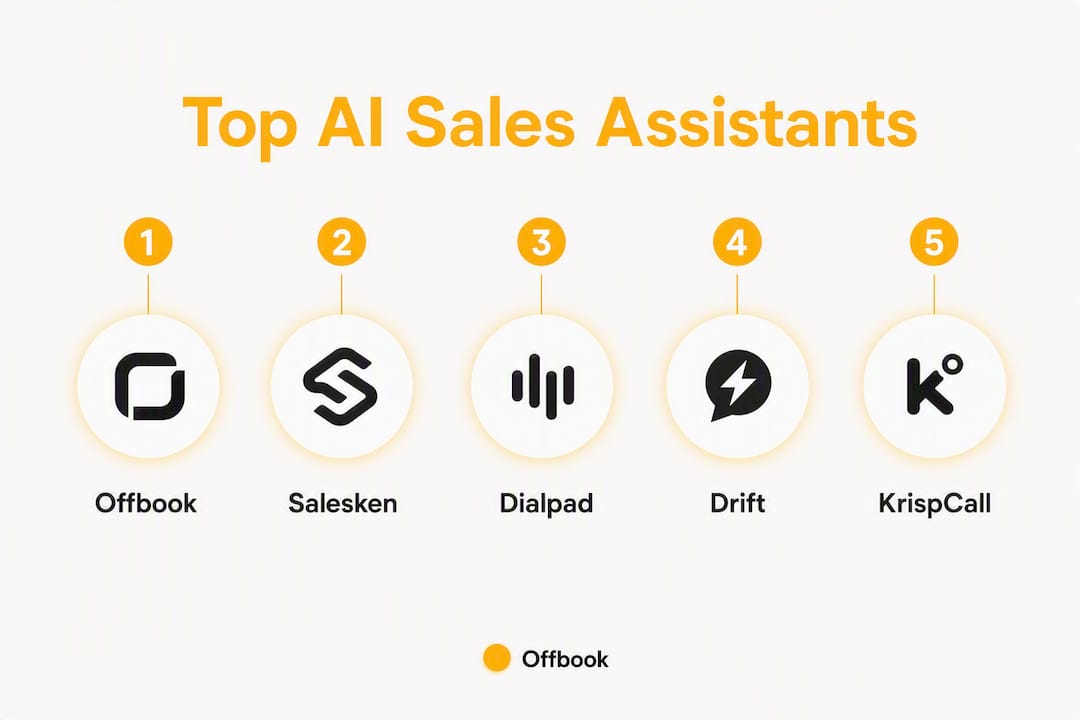
Real-time coaching badge: Offbook, Salesken, Dialpad, Drift (web), KrispCall, RingCentral ACE. CRM-native badge: HubSpot Breeze AI (HubSpot), Salesforce Einstein (Salesforce).

How we evaluated these tools
Every tool in this list was assessed against seven criteria chosen specifically for founder-led B2B SaaS teams at seed and Series A. Feature lists were not the primary input.
Evaluation criteria:
- Real-time coaching capability — Does the tool intervene during a live call, or only after? For founders running their own discovery and demo calls, this is the highest-leverage distinction.
- CRM integration depth — Does it connect natively to HubSpot or Salesforce, or does it require a Zapier workaround? Integration depth into a CRM is one of the strongest predictors of quick ROI.
- Setup time and time-to-value — Can a two-person team get a working pilot in under a week? Tools requiring multi-month onboarding were scored down for early-stage teams.
- Trial availability — Is there a self-serve free trial or a low-commitment pilot option? Founders should not have to sign a contract to evaluate a tool.
- Privacy and consent infrastructure — Does the tool handle participant consent for call recording or listening? This matters legally and practically.
- Pricing shape — Self-serve plans under $100/user/month score highest for seed-stage teams. Enterprise-only pricing was noted as a barrier.
- Evidence of ROI — Are there published performance claims, case studies, or practitioner commentary tied to specific outcomes?
Testing approach: Tools were evaluated through sandbox tests, integration checks against a sample HubSpot and Salesforce dataset, and short pilots covering three to five real discovery and demo calls. Rep feedback was collected after each pilot session.
Disclosure: Offbook is the publisher of this article and is included as a recommended option. It was scored against the same criteria as every other tool. Where Offbook leads on a criterion, that is stated. Where another tool leads, that is also stated.
Pro Tip: Pick an AI agent to close a specific gap — prospecting, qualification, or coaching — rather than buying a broad platform and hoping it covers everything. Monolithic platforms bought before the sales motion is clear tend to generate complexity, not pipeline.
Why real-time coaching changes outcomes for founder-led teams
Post-call analytics tell you what went wrong. Real-time coaching gives you a chance to fix it before the prospect hangs up. That distinction is the core reason Offbook sits at the top of this list.
Highspot’s coverage of agentic enablement describes a shift toward just-in-time guidance delivered within the seller’s workflow, rather than retrospective analysis that arrives too late to influence the outcome. Moving from retrospective analytics to in-the-moment coaching increases the chance a rep corrects behavior while the opportunity is still live.
Founder-led teams feel this gap more acutely than enterprise teams. When a founder or a single AE is running every discovery call, there is no manager sitting in to catch a missed qualification question or a fumbled objection. An in-call cue fills that gap in real time. Post-call coaching is still valuable for pattern recognition across many calls, but it cannot recover a deal that went cold because a key MEDDIC question was never asked.
Highspot also highlights that high-performing sales organizations automate administrative work so reps can focus on high-value selling. Pre-call briefs, instant post-call debriefs, and automated follow-up drafts are the administrative layer Offbook handles so founders stay focused on the conversation itself.
Privacy and consent: Before enabling any live call coaching tool, founders must inform call participants that AI is listening and obtain consent. In most U.S. states, one-party consent applies to business calls, but several states require all-party consent. Check your state’s wiretapping statute and include a disclosure in your meeting invite. Offbook’s consent infrastructure supports this workflow.
Pro Tip: Learn how AI cues improve sales performance by reviewing the specific prompt sets that work best for MEDDIC qualification before your first pilot call. Knowing which cues to activate saves setup time.
In-depth profiles of the top AI sales assistants
Offbook

Offbook is purpose-built for the problem most other tools in this list do not touch: what happens during the call. It listens to your video call audio and surfaces live on-screen cues for the rep, structured around MEDDIC and MEDDPICC, without ever joining the meeting as a bot. Prospects see only you.
Pre-call briefs give reps a one-page summary of the company and the people they are about to meet. Post-call, Offbook generates a debrief and a follow-up draft automatically. Multiple role-specific profiles let founders configure different cue sets for discovery, demo, and renewal calls.
- Key integrations: — HubSpot, Salesforce, Zoom, Microsoft Teams.
Pro Tip: Run your first Offbook pilot on three to five real discovery calls before expanding. Collect one metric per call: how many MEDDIC fields were completed by end of call. That single number tells you whether the cues are working.
Apollo.io
Apollo.io combines a large B2B contact database with built-in email and LinkedIn sequencing. For a seed-stage founder who needs to go from a blank pipeline to booked meetings without buying multiple tools, it covers the full top-of-funnel loop. The database is broad, the sequencing is functional, and the self-serve pricing is accessible.
- Best for: Startups that need prospect discovery and outreach in one place.
- Pros: Large contact database, built-in sequencing, affordable self-serve tier.
- Cons: Contact data quality varies by industry; coaching features are minimal.
- Pricing band: Self-serve under $100/user/month; team tiers available.
Clay
Clay pulls contact and company data from dozens of enrichment sources and organizes it into clean, usable prospect profiles. It does not do outreach on its own, but it makes every outreach tool you pair it with significantly more effective. Founders who have a clear ICP but are sending generic messages will see the biggest lift here.
- Best for: Founders who need enriched, personalized prospect data before outreach.
- Pros: Multi-source enrichment, flexible workflow orchestration, integrates with most outreach tools.
- Cons: Requires some setup to configure enrichment workflows; not a standalone outreach tool.
- Pricing band: Self-serve and team tiers.
Gong
Gong records, transcribes, and analyzes calls and emails to surface deal risk signals, coaching insights, and forecast data. It is the dominant post-call conversation intelligence platform for revenue teams that have enough call volume to spot patterns. At seed stage with fewer than five reps, the analytics depth can outpace what a small team can act on. At Series A with a growing SDR and AE team, it earns its cost.
- Best for: Revenue teams that need deep post-call analytics and coaching insights.
- Pros: Best-in-class conversation analytics, strong forecasting integration, broad CRM compatibility.
- Cons: Enterprise pricing; post-call only; heavy for very early-stage teams.
- Pricing band: Enterprise, typically above $500/user/month.
Salesloft
Salesloft pairs cadence-based outreach with its Rhythm AI prioritization engine, which translates buyer signals into a prioritized daily workflow for each seller. It is a mature platform that works best when you have a dedicated SDR team and want to enforce playbook discipline across the whole motion.
- Best for: Teams pairing outreach cadences with structured coaching programs.
- Pros: Strong sequencing, Rhythm AI prioritization, solid analytics.
- Cons: Overkill for solo founders; pricing reflects enterprise positioning.
- Pricing band: Team tier, $100–$500/user/month.
Lavender
Lavender scores cold emails in real time as you write them, flagging deliverability risks, weak subject lines, and personalization gaps. It is a narrow tool that does one thing well. Founders who write their own outreach and want to improve reply rates without a full sequencing platform will get fast, measurable results.
- Best for: Founders or SDRs focused on cold email reply rates.
- Pros: Immediate feedback loop, integrates with Gmail and Outlook, very low setup effort.
- Cons: Email-only; no prospecting, sequencing, or call features.
- Pricing band: Self-serve under $100/user/month.
Outreach
Outreach is a full sales engagement platform built for SDR teams running sophisticated, multi-touch sequences. Its workflow orchestration is among the most advanced in the category. For a founder-led team at seed stage, it is likely more platform than you need. At Series A, when you are building out an SDR function and need playbook consistency, it becomes a serious option.
- Best for: Teams focused on sophisticated sequencing and playbook management at scale.
- Pros: Advanced sequencing, deep CRM integration, strong workflow automation.
- Cons: Complex setup; pricing and onboarding effort are not seed-stage friendly.
- Pricing band: Team to enterprise tier.
ZoomInfo
ZoomInfo provides broad B2B contact data paired with intent signals that help teams prioritize which accounts to pursue. It is a data and intelligence platform first, an outreach tool second. The pricing reflects enterprise positioning, which makes it a harder fit for seed-stage teams but a natural complement to Salesforce or Outreach at scale.
- Best for: Teams needing deep contact and intent intelligence for prospecting.
- Pricing band: Enterprise, typically above $500/user/month.
HubSpot Breeze AI / Sales Hub
HubSpot’s Breeze Prospecting Agent and Sales Hub AI features sit natively inside the HubSpot CRM, automating outreach drafting, contact enrichment, and workflow triggers. If your team is already built on HubSpot, the integration friction is essentially zero. For teams on other CRMs, the value proposition narrows considerably.
- Best for: Teams already on HubSpot who want CRM-native AI without adding another tool.
- Pricing band: Self-serve to team tiers; included in some HubSpot plans.
Regie.ai
Regie.ai generates outbound campaign copy and messaging sequences using AI. It sits between a writing assistant and a sequencing tool, useful for teams that need to produce high volumes of personalized outreach content without a dedicated copywriter.
- Best for: Teams that need AI-generated campaign copy at scale.
- Pricing band: Team tier, $100–$500/user/month.
Seamless.AI
Seamless.AI automates contact discovery and lead list building. It is fast and works well for high-volume outbound teams that need to fill the top of the funnel quickly. Data accuracy is the main variable to test during a trial.
- Best for: High-volume prospect discovery for outbound teams.
- Pricing band: Self-serve under $100/user/month.
Lusha
Lusha is a browser extension and contact enrichment tool that gives reps quick access to phone numbers and email addresses while browsing LinkedIn. It requires minimal setup and fits small teams doing manual outreach who do not need a full prospecting platform.
- Best for: Small teams that need quick contact details without heavy integrations.
- Pricing band: Self-serve under $100/user/month.
Amplemarket
Amplemarket combines automated prospecting with outreach sequencing and personalization features. It is positioned as an end-to-end outbound engine for startups that want to automate the full top-of-funnel motion.
- Best for: Startups that want automated prospecting paired with outreach.
- Pricing band: Team tier, $100–$500/user/month.
Copy.ai
Copy.ai is a general-purpose AI writing tool that many sales teams repurpose for outreach messaging, follow-up drafts, and campaign copy. It is flexible and inexpensive, but it lacks the sales-specific context and CRM hooks that purpose-built tools provide.
- Best for: Teams needing rapid message drafting across multiple channels.
- Pricing band: Self-serve under $100/user/month.
Smartlead
Smartlead handles high-volume cold email sequences with inbox rotation and deliverability management. It is a focused tool for founders running large outbound email programs who need to protect sender reputation at scale.
- Best for: Founders running high-volume cold email sequences.
- Pricing band: Self-serve under $100/user/month.
Salesforce Einstein
Salesforce Einstein embeds AI features directly into Salesforce workflows: opportunity scoring, forecasting, task automation, and assistant capabilities. It is only relevant if your team is already committed to Salesforce. The setup and licensing complexity make it a poor fit for seed-stage teams.
- Best for: Teams already committed to Salesforce who need embedded AI.
- Pricing band: Enterprise, above $500/user/month.
Clari
Clari aggregates CRM and communication data to produce revenue forecasts and deal risk signals. It is a RevOps tool first, a sales assistant second. Revenue leaders at Series A and beyond who need forecast accuracy will find it valuable. Seed-stage teams rarely have the data volume to make it worthwhile.
- Best for: Revenue leaders focused on forecasting accuracy and deal risk.
- Pricing band: Enterprise, above $500/user/month.
Salesken
Salesken provides real-time in-call coaching cues for voice and video calls, making it one of the few tools in this list that competes directly with Offbook on the in-call coaching dimension. It is worth evaluating if your team is voice-heavy and you want to compare real-time coaching approaches side by side.
- Best for: Companies seeking in-call coaching for voice or video calls.
- Pricing band: Team tier, $100–$500/user/month.
Chorus
Chorus captures calls, transcribes them, and generates coaching recommendations and analytics. It is a post-call tool with strong transcription fidelity and coaching clip features, useful for managers who review calls and build coaching programs around them.
- Best for: Teams needing call capture and post-call analytics for coaching.
- Pricing band: Team tier, $100–$500/user/month.
Additional tools at a glance
Dialpad offers telephony-native AI with in-call transcription and some prompt features, best for voice-first teams. Warmly surfaces pre-call research cards quickly, useful for reps who want context before a call without heavy tooling. Conversica automates two-way lead qualification over email and chat at scale, suited to Series A teams with high inbound volume. Drift handles website-led lead capture and qualification through conversational AI, relevant when inbound is a primary channel.
Artisan focuses on demo personalization for specific verticals. GemAI by UserGems tracks job-change signals to surface warm re-engagement opportunities. Instantly and Reply.io both handle high-volume cold email sequencing at low cost. Otter.ai and tl;dv are lightweight post-call transcription and highlights tools, with Otter.ai worth comparing directly against Offbook if your primary need is transcription rather than live coaching.
Avoma combines meeting transcription with coaching scorecards. People.ai centralizes activity data for RevOps teams at scale. Beautiful.ai automates demo deck creation. KrispCall and RingCentral ACE are telephony platforms with varying levels of AI capability. Chatbase surfaces product knowledge in chat flows. Skrapp.io handles email discovery and list building. CoPilot AI focuses on LinkedIn prospecting. Forwrd provides predictive lead scoring. Second Nature AI runs AI-powered sales rep roleplay and training. 1mind Superhumans offers autonomous SDR capabilities for teams ready to automate the full prospecting motion. Outplay and Gro both cover multichannel outreach sequencing across email, phone, and social.
How do you choose the right AI sales assistant for your startup?
The right tool depends on where your sales motion is actually breaking down. Before evaluating any platform, answer three questions: What sales tasks cost your reps the most time? Do you need coaching during calls or after? Which CRM are you on?
By stage:
- Seed: Prioritize tools with self-serve trials, low setup effort, and a single clear use case. Offbook for in-call coaching, Apollo.io or Seamless.AI for prospecting, Lavender for cold email. Avoid enterprise platforms that require procurement cycles.
- Series A: You can absorb more integration complexity. Add Gong or Chorus for post-call analytics once you have call volume. Consider Salesloft or Outreach if you are building a dedicated SDR function. Clari and ZoomInfo make sense when forecasting accuracy becomes a board-level concern.
Questions to bring to every vendor demo:
- How does your tool handle participant consent for call recording or listening?
- What is the realistic setup time for a two-person team with no dedicated RevOps?
- Which CRM integrations are native versus Zapier-dependent?
- Can we run a self-serve pilot before signing a contract?
- How is our call data stored, and who has access to it?
Red flags to watch for: missing native CRM hooks, opaque data handling policies, onboarding timelines measured in months, and pricing that only unlocks after a sales call. Effective B2B sales automation integrates buyer signals into daily workflows so reps act on high-impact opportunities first. A tool that requires a separate workflow to surface its own insights is a sign the integration is shallow.
Choosing an AI agent to close a specific gap rather than buying a broad platform is the single most consistent piece of advice from practitioners who have deployed these tools at early-stage companies.
How do you run a 30-day AI sales assistant pilot?
A four-week pilot is enough to know whether a tool is worth expanding. The goal is not to prove ROI conclusively; it is to collect enough signal to make a confident decision.
Week 1: Setup and baseline
- Connect the tool to your CRM and calendar.
- Configure role-specific profiles or cue sets for your primary call type (discovery or demo).
- Run one internal test call to verify the tool is working correctly.
- Record baseline metrics: average call duration, MEDDIC fields completed per call, and qualified meetings booked per week.
Week 2: First live pilot calls
- Run the tool on three to five real discovery or demo calls.
- After each call, note which cues fired and whether they were relevant.
- Collect one-sentence rep feedback: “Did the cue help you in the moment?”
- Check CRM sync: are post-call notes and debrief artifacts landing correctly?
Week 3: Iterate and adjust
- Adjust cue sets based on Week 2 feedback. Remove cues that fired at the wrong moment; add any qualification questions that were missed.
- Expand to all active reps if initial feedback is positive.
- Review pre-call briefs: are they saving meaningful prep time?
Week 4: Measure and decide
- Compare end-of-pilot metrics against baseline: MEDDIC completion rate, qualified meetings booked, and rep-reported time saved on post-call admin.
- Run a 15-minute rep debrief: what worked, what did not, what would make them use it on every call?
- Decision criteria: if at least two of three metrics improved and reps want to keep it, expand. If not, identify the specific gap and evaluate whether a different tool category addresses it.
Rep feedback form fields: Call date, call type (discovery/demo/renewal), cues that fired, cues that were helpful, cues that were distracting, MEDDIC fields completed, overall rating (1–5), one thing to change.
Pilot success criteria: Qualified meetings booked per week (target: flat or up), MEDDIC fields completed per call (target: increase from baseline), rep time saved on post-call admin (target: at least 10 minutes per call).
Visual workflow builders and pre-built CRM connectors reduce the engineering work required to get a pilot running. Prioritize tools that offer both.
Key Takeaways
For founder-led B2B SaaS teams, the fastest path to measurable sales improvement is a focused pilot on a single tool that addresses your most expensive gap, not a broad platform deployment.
| Point | Details |
|---|---|
| Real-time coaching wins | In-call cues change outcomes while the deal is live; post-call analytics cannot recover a missed qualification question. |
| Stage shapes the shortlist | Seed teams should prioritize self-serve, low-setup tools; Series A teams can absorb more integration complexity. |
| One gap, one tool | Pick an AI assistant to close a specific gap (coaching, prospecting, or enrichment) before buying a platform. |
| 30-day pilot is enough | Four weeks of structured testing with two to three baseline metrics gives a confident expand-or-exit decision. |
| Offbook for in-call coaching | Offbook is the strongest fit for founder-led teams that need live MEDDIC/MEDDPICC cues during discovery and demo calls. |
A founder’s honest notes on buying AI for sales
The most common mistake founders make with AI sales tools is buying them to fix a GTM strategy problem. AI scales what you already do. If your ICP is fuzzy or your value proposition does not land in a human conversation, an AI assistant will help you have more of those same conversations faster. That is not a win.
The second mistake is treating post-call analytics as a substitute for in-call discipline. Reviewing call recordings is useful. But the insight that a rep missed three MEDDIC questions in a discovery call is only actionable if the next call goes differently. That requires a behavior change in the moment, not a debrief the next day. The tools that intervene during the conversation are doing something categorically different from the tools that analyze it afterward.
Where human time still beats AI: defining the ICP, crafting the value proposition, building the first outreach sequence, and deciding which signals actually matter for your specific market. AI can execute against a clear brief at scale. It cannot write the brief for you.
A candid cost-benefit check for founders with limited headcount: if a tool costs more per month than the hourly value of the time it saves, it is not paying for itself yet. Run the math before expanding a pilot. The tools in the self-serve tier under $100/user/month are low-risk experiments. The enterprise platforms above $500/user/month require a clear ROI case before signing.
One more thing worth saying plainly: the founders who get the most out of AI-assisted sales conversations are the ones who stay in the driver’s seat. The tool surfaces the cue; the rep decides whether to use it. That judgment layer is not something AI replaces.
Offbook is built for exactly this moment in your sales motion
Most of the tools in this list solve problems that happen before or after the call. Offbook solves the problem that happens during it. For a seed or Series A founder running their own discovery and demo calls, that is where the deal is actually won or lost.
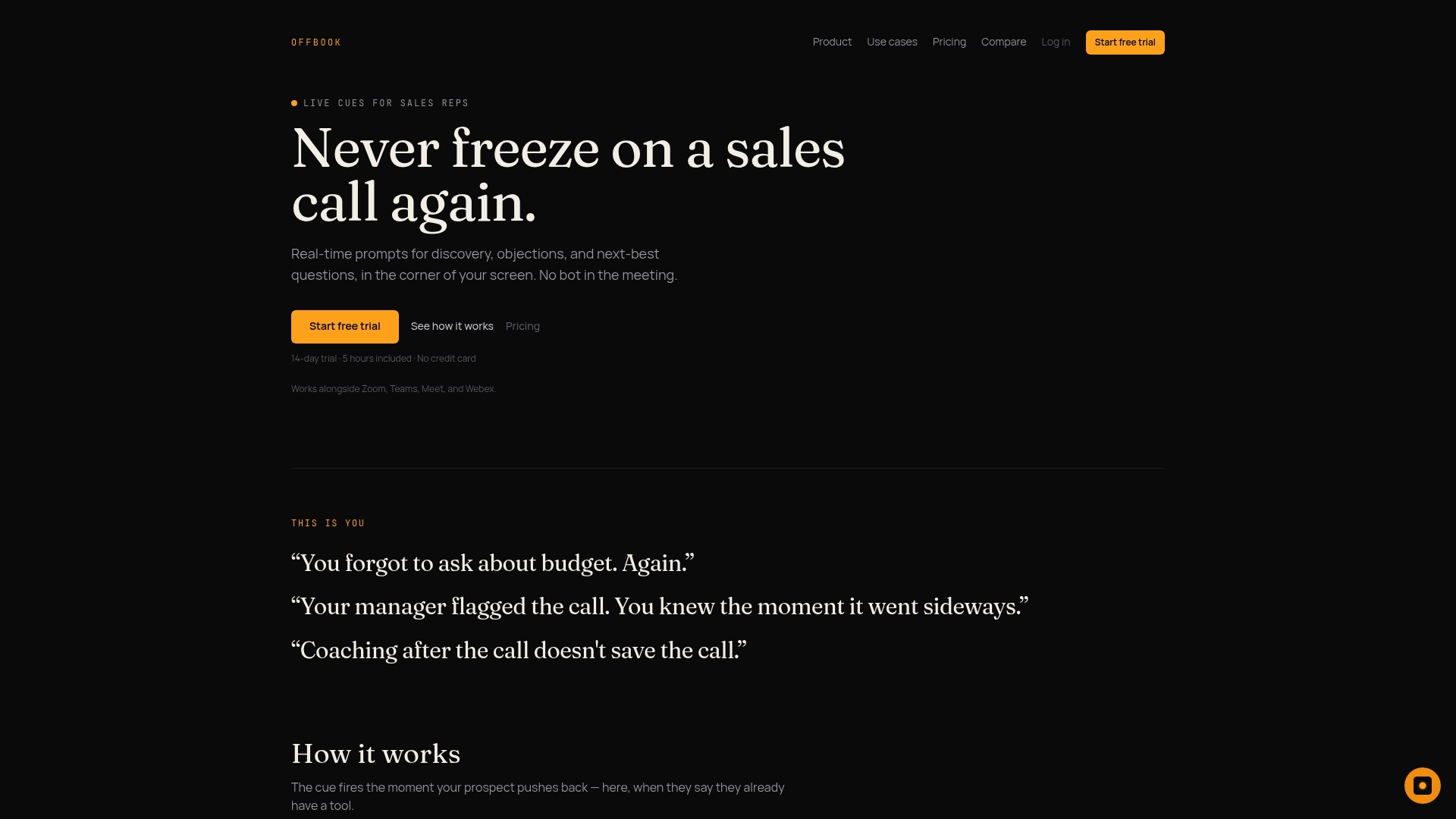
Offbook listens to your video calls and surfaces live MEDDIC and MEDDPICC cues on-screen, without a bot joining the meeting. Prospects see only you. Pre-call briefs mean you walk in prepared. Post-call debriefs and follow-up drafts are generated automatically, so you spend the hour after a call closing the next step, not writing notes.
The fit checklist: you are running B2B SaaS discovery or demo calls, your team is between one and fifteen reps, you use HubSpot or Salesforce, and you want to see results within thirty days. If that describes your situation, start a pilot on the founder-specific product page or go directly to the sales coaching product page to see pricing and trial options.
Primary sources and useful links
- Highspot: 10 of the best AI sales tools, 2026 edition
- Highspot: Sales automation in 2026
- Workist: Best AI agents for sales, tool comparison 2026
- Activepieces: B2B sales automation guide 2026
- GritDaily: The sales agent of the future
- AvairAI: Deepak Singh on pair selling and ICP alignment
- Artisan: AI sales assistants overview
- Warmly: AI sales assistants guide
- Skrapp.io: AI sales assistants overview
- Salesloft Rhythm: Sales automation and process management
- Offbook: How AI assists sales conversations for B2B teams
- Offbook: How AI cues improve sales performance in 2026
- Offbook: Use cases and target segments
- Offbook: Just-in-time sales coaching guide
- Offbook vs. Otter.ai: comparison
Privacy and consent resources for founders enabling in-call coaching:
- Review your state’s wiretapping and call recording statutes before activating any live call listening tool. The National Conference of State Legislatures maintains a summary of state-level recording consent laws. For interstate calls, the stricter state’s law typically governs. Include a disclosure line in your meeting invites and confirm your tool’s consent workflow before going live with real prospects.