B2B Prospect Research Best Practices for Sales Teams
Discover effective B2B prospect research best practices to boost your sales team's outreach success and response rates significantly.
Published: June 24, 2026
Author: OffBook Editorial Team

B2B prospect research best practices are defined as structured, signal-driven processes that identify the right buyers, surface relevant triggers, and build outreach that earns a response. Generic cold email produces reply rates of 1–5%, while personalized outreach tied to specific buying signals pushes that number to 15–25%. The difference is not effort. It is method. Sales teams that build a repeatable research process, anchor it to a clear ideal customer profile, and validate their data before outreach consistently outperform those who wing it. This article breaks down the exact methods that work.
1. What are the top time-efficient B2B prospect research methods?
Pre-call research is a structured, time-boxed activity. A 10-minute checklist covers standard SMB prospects, while mid-market and enterprise accounts warrant 15–20 minutes to expand stakeholder mapping and trigger-event research. Spending more time than that produces diminishing returns. The goal is actionable intelligence, not a biography.

The most repeatable framework for fast research is the 3x3 method. You spend 3 minutes per prospect finding one personal trigger, one company trigger, and one industry trigger. That discipline improves appointment rates and drives response rates 6x higher than generic outreach. It also lets you run 60–100 personalized touches daily without burning your morning on research.
Here is how to structure a 10-minute pre-call scan:
- LinkedIn profile (3 min): Recent posts, job tenure, shared connections, and any public comments on industry topics
- Company page and news (3 min): Funding rounds, product launches, leadership changes, and recent press
- Industry trigger (2 min): A regulatory shift, competitor move, or market trend relevant to their vertical
- CRM history (2 min): Past interactions, open opportunities, and any notes from previous reps
Pro Tip: Set a hard timer. When the clock hits 10 minutes, stop. Anything you have not found in that window is unlikely to change your opening line.
For enterprise accounts, extend the company and stakeholder sections. Use LinkedIn Sales Navigator to map multiple contacts and cross-reference titles against the buying committee structure you expect for that deal size.
2. How does signal-based personalization enhance B2B outreach success?
Signal-based personalization shifts outreach from generic value statements to context-verified messaging. A rep who references a prospect’s recent Series B funding or a new VP of Sales hire is not just being clever. That rep is proving they did the work, and buyers notice.
The concept of signal density matters here. Stacking multiple relevant triggers in a single outreach sequence produces stronger results than any single trigger alone. Effective signals to monitor include:
- Leadership hires or departures
- Funding announcements
- New product launches or pivots
- Active hiring in a specific department
- Competitor news that creates urgency
“Signal-based personalization fundamentally shifts outreach from generic value statements to credible, context-verified messaging, driving higher reply rates and pipeline success.” — B2B Prospecting in 2026
Continuous monitoring is the part most teams skip. A trigger that was relevant three weeks ago is stale today. Set up Google Alerts for target accounts, follow company pages on LinkedIn, and use intent data platforms to catch signals as they happen. When you reference a trigger in your message, name it specifically. “I saw you hired a new Head of Revenue Operations last month” outperforms “I noticed some changes at your company” every time.
3. What are best practices for stakeholder mapping and buying committee research?
Buying committee mapping is not a one-time task. Treating stakeholder maps like static org charts leads to stale data and missed engagement opportunities within weeks. Buyers change roles, procurement gets added late, and compliance reviewers appear out of nowhere. Your map has to keep up.
The most effective approach focuses on depth over breadth. Five well-understood stakeholders produce better outcomes than twenty shallow contacts. For each key stakeholder, you want to know their role in the decision, their primary concern, and who influences them internally.
Follow this sequence to build a living map:
- Start with LinkedIn and CRM data to identify the core economic buyer, champion, and technical evaluator
- Ask your champion directly: “Who else will be involved in evaluating this?”
- Update the map after every meaningful interaction, especially when new names surface
- Re-survey the map at each stage gate, not just at the start of the deal
- Flag any stakeholder you have not spoken to in 30 days as a coverage gap
86% of B2B purchases stall when stakeholder maps are outdated. That number reflects deals where reps assumed the buying committee was stable and stopped checking. Late-stage surprises from procurement or legal are almost always preventable with earlier mapping.
| Stakeholder Type | Primary Focus | Research Source |
|---|---|---|
| Economic buyer | Budget authority and ROI | LinkedIn, CRM, annual reports |
| Champion | Internal advocacy and adoption | Direct conversation, LinkedIn activity |
| Technical evaluator | Integration and security fit | Job postings, tech stack tools |
| Procurement or legal | Contract terms and compliance | Ask champion directly |
Pro Tip: After every discovery call, update your stakeholder map before you close your laptop. Memory fades fast, and a 2-minute update now prevents a 2-week delay later.
4. How to validate and enrich prospect data to improve lead quality
Bad data wastes outreach. A rep who emails a contact who left the company six months ago does not just lose that touch. They damage sender reputation and miss the real decision-maker entirely. Data validation is the step that separates high-quality prospect lists from expensive noise.
Cross-source validation compares prospect data across multiple platforms to reduce errors and improve accuracy. No single data provider is complete. LinkedIn shows current titles but misses direct dials. CRM records are accurate at entry but decay fast. Intent data platforms show interest signals but not always the right contact.
The validation workflow that works:
- Layer at least two sources: Compare LinkedIn with your CRM and a third-party enrichment tool
- Check for recency: A contact record older than six months needs re-verification before outreach
- Confirm company fit: Re-check firmographic data like headcount and revenue range against current sources
- Score by fit and intent: Rank prospects by how closely they match your ICP and whether intent signals are active
The lead research process works best as a repeatable loop: define your ICP, build your target list, find decision-makers, enrich data, score leads, conduct outreach, then measure and refine. Skipping the enrichment and scoring steps is where most teams lose lead quality. Aim to identify 2–3 persona-matching contacts per account before you start outreach.
5. Which prospect research tools support these methods?
The right tools do not replace research judgment. They feed it. A multi-signal data ecosystem built from LinkedIn, Crunchbase, CRM platforms, intent data providers, and conversation intelligence tools gives you the coverage to build accurate, current, and actionable prospect profiles.
Here is how each tool category contributes:
- LinkedIn and LinkedIn Sales Navigator: Real-time job changes, company news, shared connections, and stakeholder identification
- Crunchbase: Funding history, investor relationships, headcount growth, and leadership changes
- CRM platforms (Salesforce, HubSpot): Historical engagement, open opportunities, and account ownership
- Intent data platforms (Bombora, G2): Signals that a company is actively researching a category you compete in
- Conversation intelligence tools (Gong, Chorus): Patterns from past calls that reveal what messaging resonates with similar buyers
The key is integration. Data that lives in five separate tabs does not help a rep who has 8 minutes before a call. Build a workflow where your CRM pulls in enrichment data automatically, and your pre-call preparation surfaces the most relevant signals in one place. AI tools are accelerating this. Platforms like Offbook generate pre-call briefs automatically, so reps walk into every conversation with current context on the company and the people they are about to meet.
Key takeaways
Effective B2B prospect research requires time-boxed methods, signal-based personalization, and living stakeholder maps updated at every stage gate to drive real pipeline results.
| Point | Details |
|---|---|
| Time-box your research | Use 10 minutes for SMB and 15–20 minutes for enterprise to stay efficient without losing depth. |
| Stack buying signals | Layer leadership changes, funding events, and hiring signals to push reply rates from 1–5% to 15–25%. |
| Map stakeholders as a living document | Re-survey your buying committee at every stage gate to prevent stalled deals. |
| Validate data across sources | Cross-check LinkedIn, CRM, and enrichment tools to eliminate stale contacts before outreach. |
| Track outcome metrics | Measure signal-to-meeting conversion and reply rates by outreach type, not just emails sent. |
What I have learned from years of watching prospect research go wrong
The most common mistake I see is treating research as a pre-outreach ritual rather than an ongoing discipline. A rep spends 20 minutes building a solid prospect profile, sends three emails, gets no reply, and moves on. The research dies with the sequence. That is backwards.
The teams that consistently close more deals treat their prospect intelligence as a living asset. They update stakeholder maps after every call. They re-check signals before re-engaging cold accounts. They ask their champions directly who else is involved, rather than assuming the org chart they built in week one is still accurate. That habit alone prevents most late-stage deal surprises.
The other thing I would push back on is the obsession with volume. High-performing B2B sales teams track signal-to-meeting conversion and pipeline generated from researched accounts. Teams tracking 5–7 meaningful KPIs hit 91% quota attainment versus 73% for those focused on activity counts. Sending 200 generic emails is not a research strategy. It is noise generation.
Focus on fewer, better-researched accounts. Run the 3x3 method. Keep your maps current. Measure what converts, not what gets sent. That is the version of prospect research that actually moves pipeline.
— Neil
How Offbook helps you apply research insights on every call
Research only pays off if you can use it in the moment. Most reps walk into a call with a solid brief and then lose the thread when the conversation goes sideways.
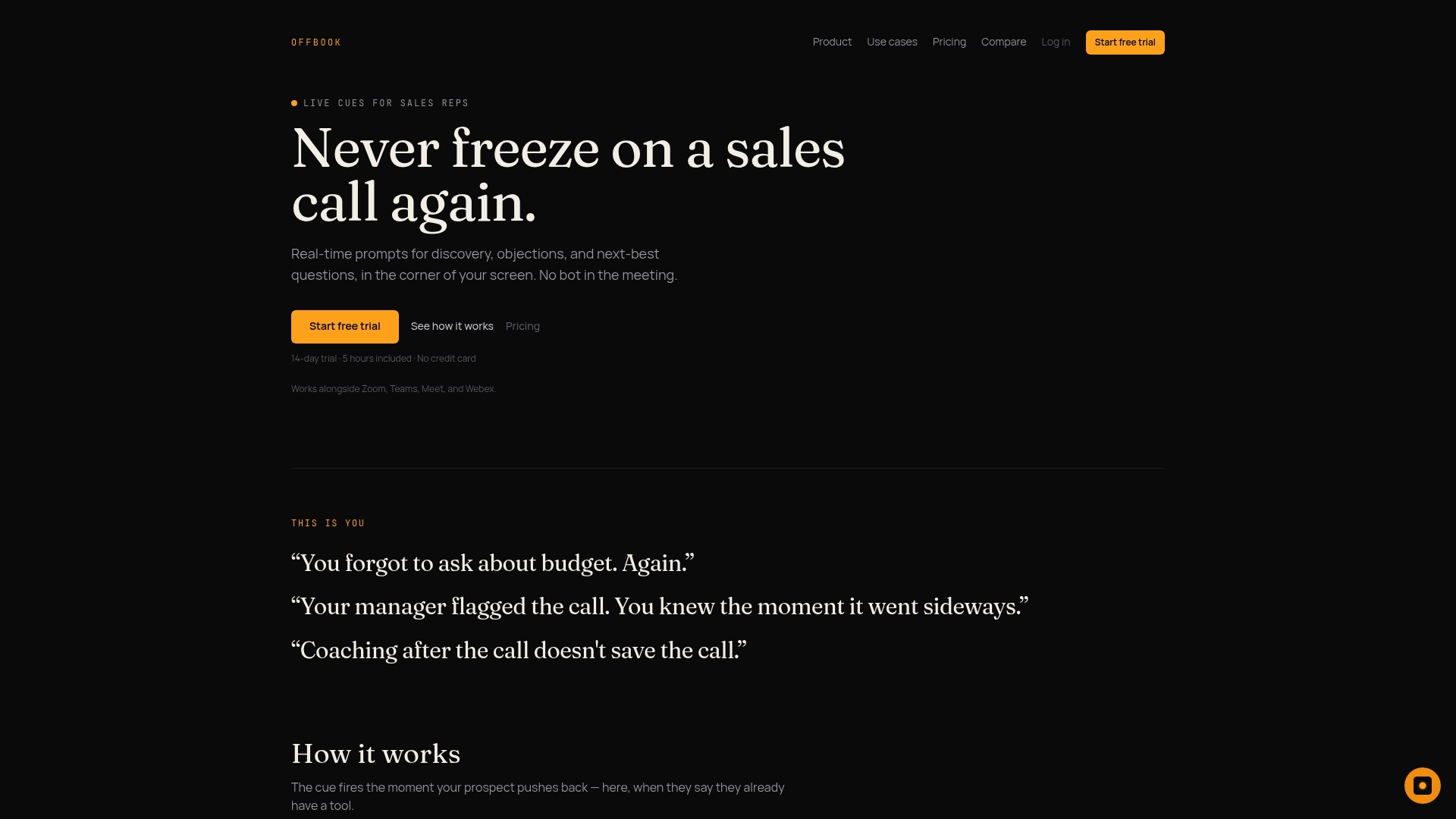
Offbook is built for exactly that gap. It surfaces live AI cues during video calls, prompting reps with the right questions to ask, qualification gaps to close, and objections to handle, all without a bot joining the meeting. It also generates pre-call briefs automatically so your team walks in with current context on every prospect. For B2B SaaS teams at the seed and Series A stage, Offbook’s AI call coaching turns solid research into disciplined, repeatable sales conversations. Your prep does not go to waste when the call gets hard.
FAQ
What is the 3x3 research method in B2B sales?
The 3x3 method means spending 3 minutes per prospect to find one personal trigger, one company trigger, and one industry trigger. It improves response rates 6x compared to generic outreach while keeping total research time under 8 minutes.
How long should pre-call research take for B2B prospects?
A standard SMB prospect requires about 10 minutes of pre-call research. Mid-market and enterprise accounts warrant 15–20 minutes to cover stakeholder mapping and trigger-event research in more depth.
Why do B2B deals stall due to stakeholder mapping errors?
86% of B2B purchases stall when buying committee maps are outdated. Reps miss late-arriving procurement or compliance reviewers because they treat their initial map as final rather than updating it at each stage gate.
What tools are best for B2B prospect research?
LinkedIn Sales Navigator, Crunchbase, Salesforce or HubSpot, intent data platforms like Bombora, and conversation intelligence tools like Gong or Chorus form the core research stack for most B2B sales teams.
How does signal-based personalization improve outreach results?
Referencing specific buying triggers like funding rounds or leadership hires pushes reply rates from the generic 1–5% range up to 15–25%. The key is stacking multiple relevant signals rather than relying on a single data point.