How Enterprise B2B Buying Works: A 2026 Guide
Discover how enterprise B2B buying works in 2026. Learn to navigate complex decisions and understand the influences shaping your sales strategy.
Published: May 31, 2026
Author: OffBook Editorial Team

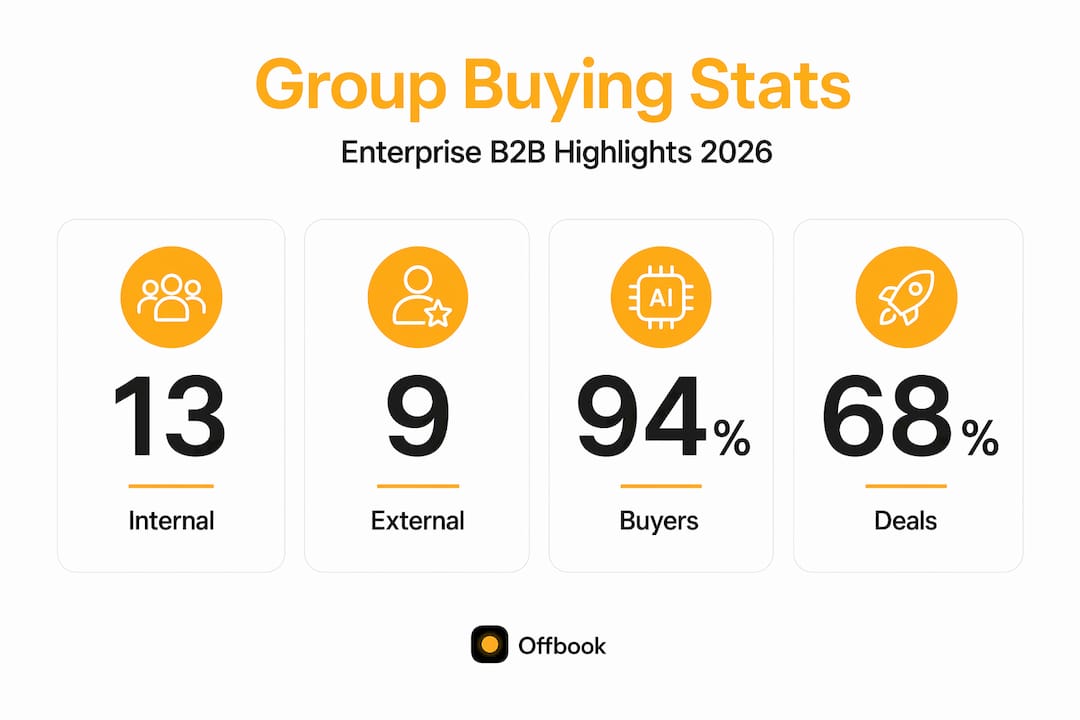
If you think enterprise deals are won by the best pitch, you haven’t seen how enterprise B2B buying works from the inside. The average purchase decision now pulls in 13 internal stakeholders and 9 external influencers, and the vendor who walks away with the contract usually had an advantage long before any formal RFP landed. Add generative AI reshaping how buyers discover and evaluate options, and the B2B purchasing process has become something most sales teams are underprepared for. This guide breaks down every layer of that complexity so you can navigate it with your eyes open.
Table of Contents
- Key takeaways
- How enterprise B2B buying works across a large group
- AI is changing who buyers talk to first
- The role of procurement, pilots, and risk reduction
- The non-linear buying journey and winning early
- My honest take on enterprise buying
- How Offbook helps you win the moments that matter
- FAQ
Key takeaways
| Point | Details |
|---|---|
| Buying groups are large and growing | Enterprise decisions average 13 internal stakeholders, so one champion is never enough to close a deal. |
| Front-runner status is the real prize | 68% of buyers start with a preferred vendor, and that vendor wins 80% of the time. |
| AI is changing discovery, not replacing reps | Buyers use AI to shortlist, but 69% still validate with a human seller before committing. |
| Procurement joins early, not late | In more than half of buying cycles, procurement engages from the start and shapes the deal. |
| Trials are now table stakes for large deals | Over 78% of buyers on $10M+ purchases run a trial before signing. |
How enterprise B2B buying works across a large group
The formal term for this process is organizational buying behavior, and it plays out very differently from the two-person software demos that most SaaS sales teams practice for. When a Fortune 500 company evaluates a new vendor, the decision rarely lives with one person. It distributes across a buying group that includes finance, IT, legal, operations, the end-user team, and often a C-level sponsor who only shows up at the beginning and the end.
Procurement engages from the start in 53% of buying cycles, shaping vendor criteria before the shortlist is even built. That surprises many sales reps who assume procurement only appears at contract time. It doesn’t. It shows up early, sets the rules, and rarely leaves.
Each role in the buying group needs something different from you:
- The economic buyer wants total cost of ownership and a clear return on investment tied to business outcomes.
- The technical evaluator cares about integration complexity, security posture, and whether your architecture fits theirs.
- The end users want to know if they’ll actually use it and whether it solves their daily frustrations.
- Procurement wants a compliant process, competitive pricing, and a vendor who won’t create audit problems.
- Legal arrives late but can kill a deal with a single clause dispute.
Buyers face mounting pressure to justify every dollar spent, which means each stakeholder needs role-specific evidence. A generic deck doesn’t cut it anymore. You need materials that speak directly to each function’s risk assessment criteria.
Pro Tip: Map your deal to a buying group matrix from day one. List every known stakeholder by role, identify who you haven’t spoken to yet, and assign a team member to each relationship. Gaps in coverage are where deals go quiet.
AI is changing who buyers talk to first
94% of business buyers now use AI in their purchasing process, and generative AI has moved ahead of vendor websites and product experts as a meaningful source of early-stage information. That is a structural shift in the B2B buying cycle. Buyers are not waiting to hear from your BDR. They are asking an AI assistant to summarize the vendor landscape, surface pricing signals, and compare capabilities before anyone from your team knows they exist.
This creates a zero-click discovery problem. A buyer might form a strong preference for a competitor based entirely on what an AI surfaces about them. If your pricing is buried in a PDF, your case studies live behind a form gate, and your differentiators are written in corporate language that AI can’t parse, you are invisible in that critical first pass.
Here is what that discovery journey typically looks like in 2026:
- Problem recognition. A business unit leader notices a gap or bottleneck and starts asking questions.
- AI-assisted discovery. They turn to generative AI to get a fast map of solutions, vendors, and categories.
- Peer validation. They check review platforms, LinkedIn threads, and analyst summaries to pressure-test what the AI surfaced.
- Self-service exploration. They visit shortlisted vendor sites, often anonymously, to explore product details and pricing.
- Human engagement. Only after this do they reach out to a seller, and usually with a shortlist already formed.
“Buyers prefer low-friction self-service for early discovery, but they still want human validation at the moments that carry the most risk.”
Gartner data shows that 69% of buyers prefer to validate AI-surfaced insights with a sales rep before committing. The rep’s role has not disappeared. It has concentrated into fewer, higher-stakes conversations where judgment and empathy matter more than information transfer.
Pro Tip: Audit your public-facing content for AI discoverability. Your pricing page, key claims, and trial options should be written in plain, specific language that conversational AI can retrieve and summarize accurately. Vague positioning gets you excluded before the conversation starts.
The role of procurement, pilots, and risk reduction
Understanding enterprise purchasing means understanding why procurement exists in the first place. Large organizations are not optimizing for the fastest possible vendor decision. They are optimizing to avoid catastrophic mistakes, and procurement is the function assigned to that goal.

Waiting to engage procurement after your shortlist is established results in longer negotiation cycles and deal delays that can stretch months. Sellers who treat procurement as a gatekeeper to get past are playing defense. Sellers who treat it as a co-author of the business case move faster.
Trials and sandbox evaluations serve a similar purpose. They reduce the perceived risk of a major commitment and give the buying group a shared reference point.
| Deal size | Buyers using a trial | What it signals |
|---|---|---|
| Under $1M | ~60% | Trial is a standard filter, not a red flag |
| $1M to $10M | ~70% | Expect a formal proof of concept with defined success criteria |
| Over $10M | ~78% | Trial is non-negotiable; structure it or lose control of it |
If you’re selling into enterprise accounts and you don’t have a defined trial experience with clear milestones, success metrics, and a designated buyer contact, you’re leaving the evaluation to chance. The trial is where preference hardens into decision.
For a deeper look at how procurement shapes contracts and pricing, the full breakdown is worth reading before your next enterprise call.
Key principles for working with procurement effectively:
- Bring procurement into the conversation before you’ve presented your full proposal.
- Share a business case framework early so they can begin their internal justification process.
- Anticipate compliance and security questionnaires and have answers staged before they ask.
The non-linear buying journey and winning early
Most sales training treats the B2B buying cycle as a funnel with predictable stages. Awareness, consideration, decision. Neat and sequential. Real enterprise buying repeatedly loops between problem identification, solution assessment, and supplier selection as new stakeholders join, priorities shift, or a competing internal project reshapes the budget conversation.
Here is what a single deal cycle might actually look like:
- Initial problem recognized by operations director.
- IT joins and reframes the problem as an infrastructure issue.
- Vendor shortlist is built, then reopened when a new CTO arrives.
- Finance resets the budget ceiling, forcing a new round of vendor scoring.
- Legal flags a data residency requirement that eliminates two shortlisted vendors.
- A champion leaves the company; the cycle pauses for six weeks.
This kind of disruption is not exceptional. It is the norm for deals above a certain size. Sales and CSM teams need versioned, reusable buyer assets that can respond to committee re-openings without starting from scratch.
| Early preference tactics | Why they work |
|---|---|
| Thought leadership content distributed before buyers are in market | Builds familiarity before comparison shopping begins |
| Direct outreach timed to trigger events (funding, hiring, tool changes) | Reaches buyers when problems are freshly recognized |
| Role-specific case studies published publicly | Enables self-service validation by each stakeholder type |
| Analyst and review platform presence | Confirms credibility during the AI-assisted discovery phase |
The data behind this is hard to argue with. 68% of buyers start with a front-runner vendor already in mind, and that vendor wins 80% of the time. Winning enterprise deals depends on early preference-building across the buying group through integrated brand and demand efforts, not on being the best responder to an RFP that was written with someone else already in mind.
The practical implication is direct. If your marketing and sales teams only engage buyers once they raise a hand, you are almost always too late to be the front-runner.
My honest take on enterprise buying
I’ve watched too many skilled sales reps lose deals they should have won, and the pattern is almost always the same. They did the demo brilliantly, handled the objections well, and then stalled because they had never established why their company was the obvious choice before any of that happened.
The uncomfortable truth about how B2B procurement works is that formal evaluation processes are largely confirmatory. By the time a committee is scoring vendors against a rubric, most of the emotional and strategic preference has already been set. The RFP is not an open competition. It is a justification mechanism for a decision that is already leaning somewhere.
What I’ve learned from observing high-performing enterprise sellers is that they treat every early-stage interaction as preference-building. They show up in the channels buyers trust before those buyers are actively looking. They make sure the right content exists for every stakeholder who might join the deal late. And they treat procurement as a relationship, not a process to survive.
The AI shift makes this even more urgent. Top sales organizations now redesign seller roles around empathy and judgment at key moments, not information delivery. If your reps are still spending most of their call time explaining what your product does, you have a structural problem that no amount of better demos will fix.
My advice: stop competing on the features slide and start competing on confidence. Build it early. Build it for everyone in the room, not just the champion.
— Neil
How Offbook helps you win the moments that matter
Enterprise buying is complex by design. When a rep finally gets time with a buying group, every question counts. Offbook is built for exactly that moment.
Offbook’s AI call coaching for sales gives reps live on-screen prompts during video calls, surfaced without a bot ever joining the meeting. When a new stakeholder joins and the conversation shifts, Offbook cues the rep with the right qualification questions and objection responses, all structured around MEDDIC and MEDDPICC. Pre-call briefs on the company and the people attending mean your rep walks in already knowing the context. For founder-led B2B SaaS teams navigating multi-stakeholder deals, Offbook closes the gap between what a rep knows and what they actually say under pressure. That gap is where enterprise deals are lost. You can also explore how different roles use Offbook to prepare for the conversations that decide deals.
FAQ
How many stakeholders are involved in an enterprise B2B purchase?
Enterprise B2B buying typically involves 13 internal stakeholders and 9 external influencers, according to Forrester’s 2026 research. That number rises further for complex or high-value purchases.
Why do most enterprise deals have a front-runner vendor?
68% of buyers start with a preferred vendor already in mind before formal evaluation begins, and that vendor wins 80% of the time. Preference forms during early-stage digital and AI-assisted research, well before the RFP.
What role does procurement play in the B2B buying cycle?
Procurement engages from the start in more than half of enterprise buying cycles, not just at the contract stage. Early involvement from procurement accelerates deal timelines and reduces the risk of late-stage negotiation delays.
How are buyers using AI in the B2B purchasing process?
94% of business buyers now use AI during the purchasing process, with generative AI ranking as a more meaningful source than vendor websites or product experts. Buyers still validate AI findings with human sellers before making final decisions.
Are trials required for enterprise deals?
More than 60% of business buyers use a trial to reduce risk, and that figure rises to 78% for deals over $10 million. Sellers who design structured trial experiences with defined success metrics maintain more control over the evaluation outcome.