B2B Sales Red Flags Checklist for Reps in 2026
Master the B2B sales red flags checklist. Identify warning signs in deals, improve qualification, and close more sales effectively.
Published: June 21, 2026
Author: OffBook Editorial Team

A B2B sales red flags checklist is a structured qualification tool that helps sales reps identify warning signs in active deals before those deals collapse, stall, or drain pipeline capacity. The industry standard term for this practice is deal qualification scoring, and frameworks like MEDDIC and BANT give it structure. Without a checklist, reps rely on instinct, and instinct loses deals. This guide gives you a practitioner-vetted set of criteria, behavioral signals, and scoring thresholds to run a cleaner pipeline and close more of what you pursue.
What are the key criteria in a B2B sales red flags checklist?
A standard qualification scorecard uses 7 to 12 criteria, balancing thoroughness with daily adoption. Top-tier prospects score 50+ out of 70 or 16+ out of 24 and get prioritized immediately. Every criterion below maps to a real failure mode.
1. Firmographic fit The prospect’s company size, industry, and tech stack must match your ideal customer profile. A mismatch here predicts a painful sales cycle and a churned customer. Check your ICP criteria before the first call, not after the third.

2. Decision-making authority You must know who signs the contract. If your contact cannot name the contract signatory after two calls, that is a red flag, not an open question. Deals without a clear economic buyer stall at legal or procurement every time.
3. Identified pain with quantified cost The buyer must be able to describe the problem and attach a number to it. “We waste time” is not a qualified pain. “We lose roughly $40,000 per quarter in manual reconciliation” is. If they cannot quantify the problem, move the deal to nurture.
4. Budget transparency A prospect who refuses to discuss budget after discovery is protecting information you need to close. Budget conversations do not have to be exact, but the buyer should confirm a range exists and that they have spent on similar tools before.
5. Timeline and compelling event Every real deal has a reason to close by a specific date. A compelling event, like a contract renewal, a board deadline, or a product launch, creates urgency. Without one, “Q3” becomes “Q1 next year” becomes never.
6. Engagement and behavioral signals Buyers who are serious ask questions, share internal documents, and introduce other stakeholders. Buyers who are not serious say yes to everything and go quiet between calls. Track response time, meeting attendance, and whether the buyer initiates any next steps.
7. Internal champion presence A champion is someone inside the buying organization who wants you to win and will advocate for you when you are not in the room. No champion means no internal selling. Deals without a champion fail despite appearances of progress.
8. Competitive situation clarity You need to know who else is in the deal. If the buyer refuses to name competitors or denies evaluating alternatives, they are either not serious or hiding information. Both scenarios require direct qualification.
9. Success criteria definition The buyer must be able to describe what “good” looks like six months after purchase. Vague success criteria predict scope disputes, implementation failure, and churn.
10. Procurement and legal awareness Late-stage surprises from procurement kill deals that looked closed. Ask about the vendor approval process, security reviews, and legal sign-off requirements in discovery, not in month three. Understanding procurement’s role early removes the most common late-stage stalls.
Pro Tip: Score each criterion on a 1 to 3 scale during or immediately after every call. A running total gives you an objective view of deal health that gut feeling cannot.
How to spot behavioral red flags that indicate deals are stalling
Behavioral signals predict deal death before the buyer ever says no. The following warning signs, drawn from deal analysis across B2B sales cycles, indicate a deal is moving toward failure.
-
Declining response velocity. A buyer who replied within hours now takes days. Dropping response velocity is one of the clearest signals that internal priority has shifted. It does not mean the deal is dead, but it means something changed and you need to find out what.
-
Resurfacing of handled objections. When a buyer raises a concern you already addressed two calls ago, they are either not convinced or a new stakeholder has entered the process. Either way, the objection was never truly resolved.
-
Repeated close date changes. One push is normal. Two pushes in the same quarter signals that the deal lacks internal urgency. Three pushes means the compelling event was never real.
-
Drop in meeting attendance. A champion who stops showing up to calls has either lost internal support or been sidelined. Both scenarios require immediate attention.
-
Loss of inbound questions. Engaged buyers ask questions between meetings. They send articles, share internal data, and loop in colleagues. When inbound questions stop, buyer engagement has stalled.
-
“Good news only” feedback. Deals with only positive feedback and no shared risk from buyers often fail despite appearances. If every call ends with enthusiasm but no commitments, the buyer is being polite, not progressing.
-
No stakeholder expansion. Real deals grow in complexity as they advance. If you are still talking to the same one person after four calls, you have not penetrated the organization.
Tracking engagement metrics such as response time, meeting attendance, and champion-initiated next steps on a weekly basis helps you diagnose stalling deals before they fail. Build a simple tracker in your CRM and review it every Friday.
Pro Tip: When you spot two or more behavioral signals in the same week, do not wait for the next scheduled call. Send a direct message asking what changed internally. The answer will tell you everything.
Judgment-based vs. data-driven pipeline prioritization
43% of sellers prioritize their pipeline based on personal judgment, while only 32% use structured frameworks like MEDDIC or BANT. That gap explains most forecast misses.
“Heavy explanation needed early in a deal correlates with heavy defense later.” — Early pipeline warning signs
| Approach | Method | Outcome |
|---|---|---|
| Judgment-based | Rep intuition, relationship feel | Inconsistent forecasts, late-stage surprises |
| Structured scoring | MEDDIC, BANT, custom scorecard | Predictable pipeline, earlier disqualification |
| AI-assisted coaching | Real-time call prompts, gap detection | Qualification gaps caught during the call |
Judgment-based prioritization feels faster but costs more. Reps who rely on gut feeling tend to hold losing deals too long and drop winning deals too early. Structured frameworks like MEDDIC force reps to surface qualification gaps explicitly, which means those gaps get addressed on the call rather than discovered at contract review.
AI call coaching tools take this further. Platforms like Offbook surface live qualification prompts during video calls, flagging gaps in MEDDIC or MEDDPICC coverage as the conversation happens. That is a fundamentally different intervention than reviewing a call recording the next day. A call quality scoring system built on these frameworks gives sales managers objective data to coach from, not just impressions.
The data-driven approach also improves pipeline audits. When every deal has a score, managers can sort by risk in seconds. When deals are scored by feel, audits become debates.
When to disqualify or nurture deals based on red flag scores
Scoring without thresholds is just data collection. You need clear rules for what to do when a deal hits a certain score.
- 0 to 1 red flags: Advance the deal. Maintain normal cadence and focus on deepening champion relationships and confirming the compelling event.
- 2 red flags: Pause and investigate. Schedule a direct conversation to address the gaps before investing more time. Do not add this deal to your forecast.
- 3 or more red flags: Move to nurture. Two or more scoring failures after calls, such as inability to quantify problem cost or an unknown contract signatory, indicate the deal is not real right now.
The most common disqualification triggers are an unknown contract signatory, no confirmed budget, and a missing compelling event. Any one of these alone warrants a direct qualification conversation. All three together means the deal should exit active pipeline immediately.
Nurture is not failure. A deal that is not ready today may be ready in two quarters. A short nurture sequence, three to four touches over 60 days, keeps you present without burning selling time. Early pipeline signals indicate whether demand is real or just polite. Acting on those signals early preserves your leverage.
Audit your full pipeline against your red flags checklist once per month. Remove or downgrade any deal that scores three or more flags. Your forecast accuracy will improve within one quarter.
Pro Tip: Never disqualify a deal verbally without offering a clear path back. Tell the buyer exactly what needs to change for the deal to reopen. This protects the relationship and sometimes accelerates their internal process.
Key takeaways
A disciplined B2B sales red flags checklist, scored consistently across 7 to 12 criteria, is the single most reliable way to protect pipeline health and improve forecast accuracy.
| Point | Details |
|---|---|
| Score every deal consistently | Use a 7 to 12 criterion scorecard after every call to track deal health objectively. |
| Act on behavioral signals early | Declining response velocity and lost champion engagement predict deal failure before the buyer says no. |
| Use structured frameworks | MEDDIC and BANT outperform gut-feel prioritization for forecast accuracy and pipeline discipline. |
| Apply clear disqualification thresholds | Move deals with 3 or more red flags to nurture immediately rather than holding them in active pipeline. |
| Audit monthly | A monthly pipeline review against your checklist removes dead weight and sharpens your forecast. |
What I’ve learned from watching reps ignore their own checklists
The most common mistake I see is not a failure to build a checklist. Reps build checklists. The failure is treating the checklist as a formality rather than a decision tool. A rep scores a deal at three red flags, acknowledges it in the CRM, and then keeps the deal in active pipeline anyway because the buyer is “warm.” That is not qualification. That is wishful thinking with extra steps.
The behavioral signals are where most reps lose the most time. A good news only feedback loop is seductive. The buyer is enthusiastic, the calls feel productive, and the rep reports confidence. But enthusiasm without commitment is not a buying signal. Shared risk is a buying signal. When a buyer introduces their CFO, sends you their internal evaluation criteria, or asks about implementation timelines, that is real engagement. Polite agreement is not.
The other thing I’d push back on is the idea that rigor and flexibility are opposites. You can hold firm on disqualification thresholds and still treat buyers with respect. Telling a prospect “this doesn’t look like the right time, here’s what would need to change” is more respectful than stringing them along for six months. The reps who run the tightest qualification processes also tend to have the strongest buyer relationships, because buyers trust people who are honest about fit.
If you are not using a real-time coaching tool during calls, you are reviewing qualification gaps after the fact, when you can no longer do anything about them. That is the core argument for tools like Offbook. The insight needs to arrive during the conversation, not in a post-call debrief.
— Neil
How Offbook helps you catch red flags during the call
Spotting a qualification gap in a call recording 24 hours later does not help you close the deal. Offbook delivers live AI coaching during your video calls, prompting you on-screen with the right qualification questions, objection responses, and MEDDIC gaps as the conversation unfolds. No bot joins the meeting. No one on the buyer’s side knows it’s running.
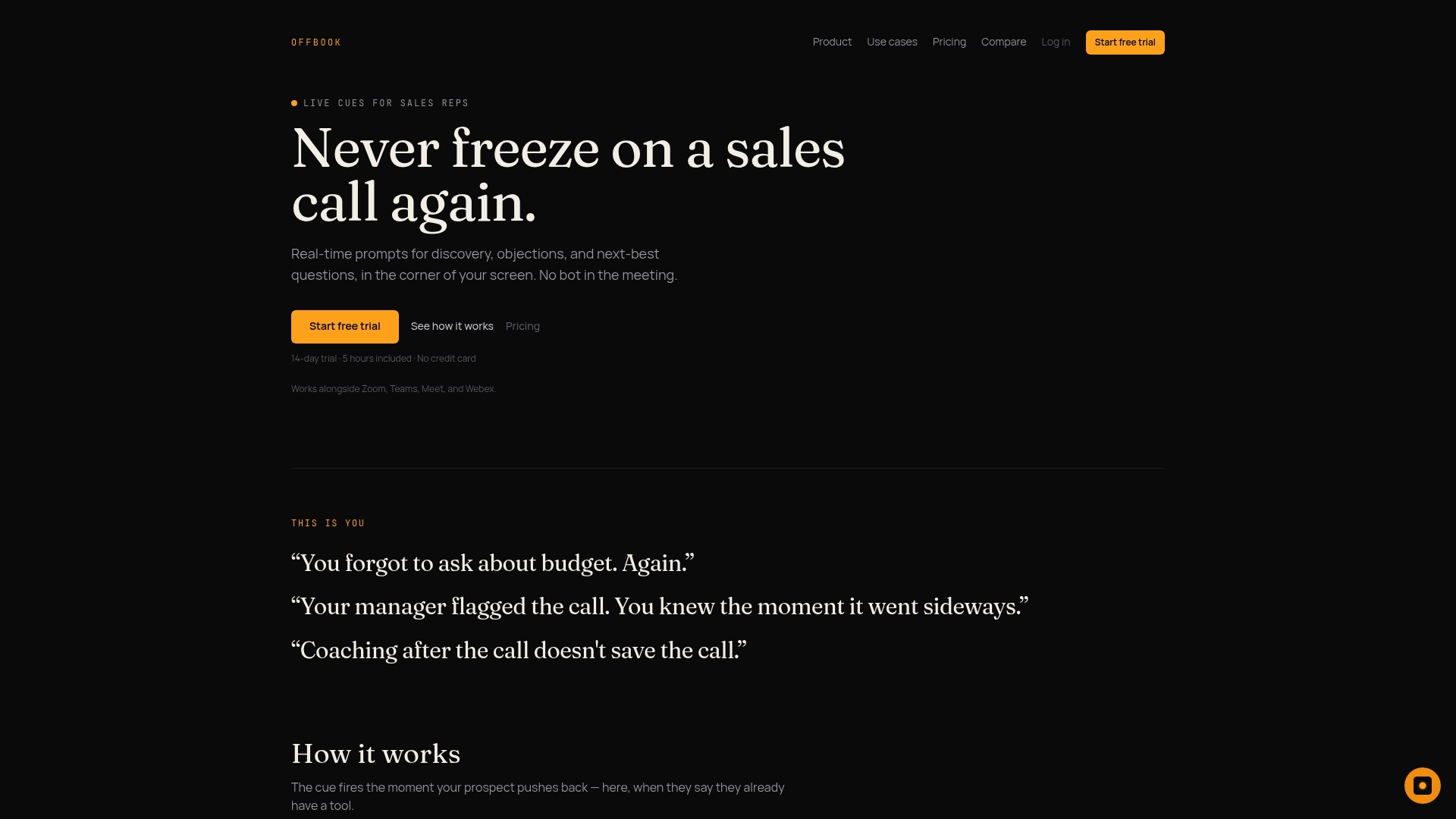
Offbook also generates pre-call briefs on every company and contact you’re about to meet, so you walk in knowing the firmographic fit, likely objections, and open qualification gaps before the first word is spoken. For founder-led B2B SaaS teams running high-stakes calls at seed or Series A, that preparation is the difference between a disciplined qualification conversation and another stalled deal. See how Offbook works at offbook.pro.
FAQ
What is a B2B sales red flags checklist?
A B2B sales red flags checklist is a structured scoring tool with 7 to 12 criteria that helps reps identify unqualified or at-risk deals early. Each criterion covers a key qualification dimension such as budget, decision authority, or buyer engagement.
How many red flags should trigger disqualification?
Three or more red flags after a qualification call indicate a deal is not real in its current state and should move to a nurture sequence rather than stay in active pipeline.
What are the most common B2B sales warning signs?
The most common warning signs are an unknown contract signatory, no confirmed budget, a missing compelling event, and declining buyer response velocity. Any combination of two or more signals warrants immediate investigation.
How does MEDDIC relate to a sales red flags checklist?
MEDDIC is a qualification framework covering Metrics, Economic Buyer, Decision Criteria, Decision Process, Identify Pain, and Champion. A red flags checklist operationalizes MEDDIC by turning each dimension into a scored checkpoint that reps evaluate after every call.
How often should I audit my pipeline against a red flags checklist?
Audit your full pipeline monthly. A monthly review removes deals that have accumulated disqualifying scores and keeps your forecast grounded in real buyer behavior rather than optimism.