How Discovery Questions Work to Close More B2B Deals
Discover how discovery questions work to engage buyers and close more B2B deals. Unlock their needs and drive effective sales conversations.
Published: June 2, 2026
Author: OffBook Editorial Team

Discovery questions are strategic, open-ended inquiries that sales professionals use to uncover a buyer’s real needs, priorities, and urgency before proposing any solution. Unlike qualification questions, which filter prospects by budget or authority, discovery questions build a map of the buyer’s world. They reveal the pain beneath the surface, the business impact of inaction, and the personal stakes driving a decision. When used correctly, they shift a sales conversation from interrogation to genuine dialogue. This article explains how discovery questions work, how to sequence them, and how to use them to improve both engagement and close rates.

How discovery questions work in a structured sales call
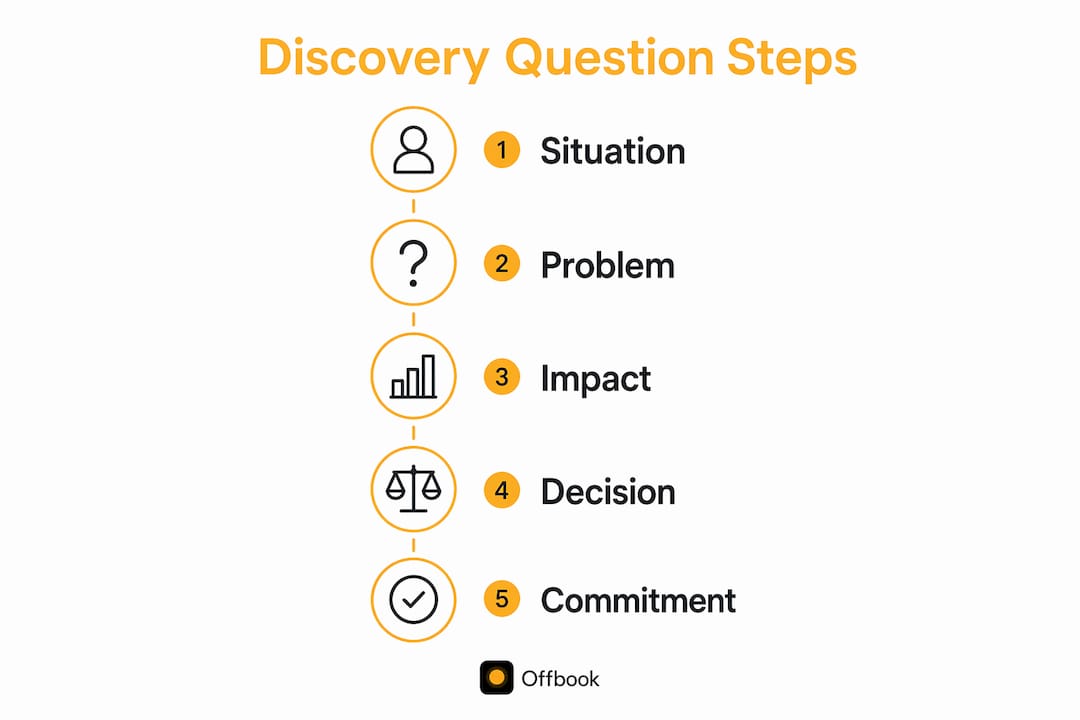
Discovery questions follow a progressive five-stage sequence: Situation, Problem, Impact, Decision, and Commitment. Each stage builds on the last, moving the buyer from describing their context to articulating urgency and agreeing on next steps.
Here is what each stage does in practice:
- Situation questions establish context quickly. “How is your team currently managing onboarding?” These should be brief. Spending too long here signals you did not prepare.
- Problem questions surface friction. “Where does that process break down most often?” The goal is to get the buyer talking about pain in their own words.
- Impact questions are where the most time belongs. “What does that cost you in hours per week, or in deals lost?” Quantifying pain converts a complaint into a business case.
- Decision questions map the buying process. “Who else weighs in on a decision like this?” Skipping this stage is one of the most common reasons deals stall.
- Commitment questions close the call with a concrete next step. Securing a dated next step at the end of every call is the single most reliable way to prevent pipeline stalls.
Two frameworks guide this sequencing in practice. MEDDIC structures discovery around Metrics, Economic Buyer, Decision Criteria, Decision Process, Identify Pain, and Champion. Each element maps directly to a question objective. The Sandler Pain Funnel takes a different approach, drilling through three levels: Level One surfaces specifics, Level Two explores business impact, and Level Three uncovers personal urgency and stakes. Together, these frameworks prevent reps from stopping at surface-level answers.
| Framework | Core focus | Best used when |
|---|---|---|
| MEDDIC / MEDDPICC | Qualification and decision mapping | Complex enterprise deals with multiple stakeholders |
| Sandler Pain Funnel | Deepening pain from surface to personal stakes | Mid-market deals where urgency needs to be built |
| Five Whys | Root cause analysis through sequential probing | Any stage where the buyer’s stated problem feels shallow |
Pro Tip: Never treat the Impact stage as optional. Buyers who cannot articulate the cost of their problem rarely have the urgency to buy. Your job is to help them calculate it.
How many discovery questions should you ask per call?
The answer is specific and research-backed. Top-performing reps ask 11 to 14 questions per discovery call, based on analysis of over 519,000 B2B sales calls. Fewer than 11 questions produces a shallow call that misses critical qualification gaps. More than 14 starts to feel like an interrogation, and buyers disengage.
That number matters less than how the questions are distributed. Frontloading all your questions in the first ten minutes is a common mistake. It creates a rapid-fire dynamic that puts buyers on the defensive. Spreading questions evenly across the call maintains a natural rhythm and gives buyers space to elaborate.
Talk time is the other variable most reps get wrong. Top performers talk 43% of the time on discovery calls, leaving 57% for the buyer. Reps who dominate the conversation gather less information and build less trust. The math is simple: if you are talking, you are not learning.
A few practical implications follow from this data:
- Aim for one to two questions per five-minute segment of the call, not a burst at the start.
- After each answer, pause. Let silence do work. Buyers often add the most revealing detail after a brief pause.
- Track your own talk time. Most reps who think they listen well are actually talking 60% or more.
- In senior executive calls, question depth outweighs quantity. One well-placed strategic question beats five shallow ones.
Techniques for crafting better discovery questions
High-performing reps engineer questions to create buyer narration, not just buyer answers. The difference is significant. A narrating buyer is telling you a story. An answering buyer is completing a form. Stories contain urgency, emotion, and context that answers never do.
Open-ended questions are the foundation. “What does your current process look like?” beats “Do you have a process?” every time. The first invites a story. The second invites a yes or no. The Harvard Program on Negotiation confirms that open and probing questions build trust and openness, while loaded or leading questions trigger defensiveness.
Follow-up questions tied directly to buyer answers are where top performers separate themselves. Probes like “You mentioned X. What led to that?” reduce the interrogation feel because they show you were listening. They also go deeper than any pre-planned question could, because they follow the buyer’s actual narrative rather than your script.
Two additional techniques add structural depth:
The 5W1H method (Who, What, When, Where, Why, How) gives you six angles on any problem. If a buyer says their sales cycle is too long, you can ask who owns the delay, what specifically slows it down, when it started, where in the process it happens, why it has not been fixed, and how it affects their targets. Each angle surfaces a different dimension of the problem.
The Five Whys method follows root causes through sequential probing. A buyer says deals are stalling. Why? Procurement gets involved late. Why? No one briefs them early. Why? The sales team does not know when to loop them in. Three questions in, you have found a process problem that a product can solve. Sequential “why” probes convert surface complaints into fundable business cases.
Pro Tip: Personalize questions to the buyer’s role. A CFO cares about cost and risk. A VP of Sales cares about pipeline and quota. The same problem looks different from each seat. Tailor your framing accordingly.
Common pitfalls that kill discovery call quality
Most discovery calls fail not because reps ask the wrong questions, but because they stop too soon or talk too much. These are the patterns that consistently undermine call quality.
Chasing obvious signals instead of digging deeper. A buyer says “we need better reporting.” Most reps pivot to a demo. Top reps ask what decisions are being made badly because of poor reporting, and what that has cost the business. The obvious signal is the door. The root cause is the room you actually need to enter.
Skipping the Impact and Decision stages. These two stages are where deals are won or lost. Impact converts pain into urgency. Decision reveals whether you are talking to the right person and whether a buying process even exists. Reps who rush to the commitment stage without covering both are building proposals on sand.
Asking too many shallow questions instead of fewer deep ones. Volume is not depth. Asking fifteen surface-level questions produces less insight than asking eight questions with strong follow-ups. Skilled reps modulate their questioning cadence and seek permission before probing into sensitive territory.
Failing to adapt to the buyer’s responses. Discovery is not a script. If a buyer reveals something unexpected, the best next question is rarely the one you planned. Reps who stick rigidly to a question list miss the most important signals in the conversation.
Overtalking after asking a question. Asking a strong question and then immediately filling the silence with context, caveats, or product features is one of the most common and damaging habits in sales. Ask the question. Stop. Wait.
Key takeaways
Discovery questions work because they move buyers from describing symptoms to articulating urgency, giving reps the insight needed to position solutions that actually close.
| Point | Details |
|---|---|
| Use a five-stage sequence | Progress from Situation through Problem, Impact, Decision, and Commitment on every call. |
| Ask 11 to 14 questions per call | This range maximizes qualification depth without triggering interrogation fatigue. |
| Talk less than your buyer | Top performers hold their talk time to 43%, leaving 57% for the buyer to narrate. |
| Follow up on buyer answers | Probes tied to what the buyer just said go deeper than any pre-planned question. |
| Never skip Impact and Decision | These stages convert pain into urgency and map the buying process. Skipping either stalls deals. |
Why discovery is a mindset, not a checklist
I have reviewed hundreds of sales calls, and the pattern is consistent. The reps who struggle with discovery treat it as a form to complete. They have their list of questions, they work through it, and they move on. The reps who consistently close treat discovery as the most interesting part of the conversation. They are genuinely curious about why a business is stuck, who is feeling the pressure, and what solving the problem would actually mean for the person across the screen.
That distinction sounds soft, but it produces hard results. Genuine curiosity changes the quality of follow-up questions. It changes how long you pause after an answer. It changes whether a buyer feels interviewed or understood. And buyers who feel understood are far more likely to share the information you actually need to close.
The other thing I have learned is that discovery does not end after the first call. The most effective discovery mindset is one of ongoing curiosity that carries through every touchpoint in the sales cycle. New information surfaces in follow-up emails, in champion conversations, in procurement calls. Reps who keep asking and keep listening keep refining their understanding of what the buyer actually needs. That is what separates a proposal that lands from one that gets ignored.
One more thing worth saying directly: discovery is where you earn the right to present a solution. Skipping or rushing it does not save time. It wastes it, because you end up pitching to the wrong person, solving the wrong problem, or losing to a competitor who took the time to actually understand the buyer.
How Offbook helps you run sharper discovery calls
Running a disciplined discovery call is hard when you are also managing rapport, taking notes, and tracking qualification gaps in real time. Offbook is built for exactly this moment.
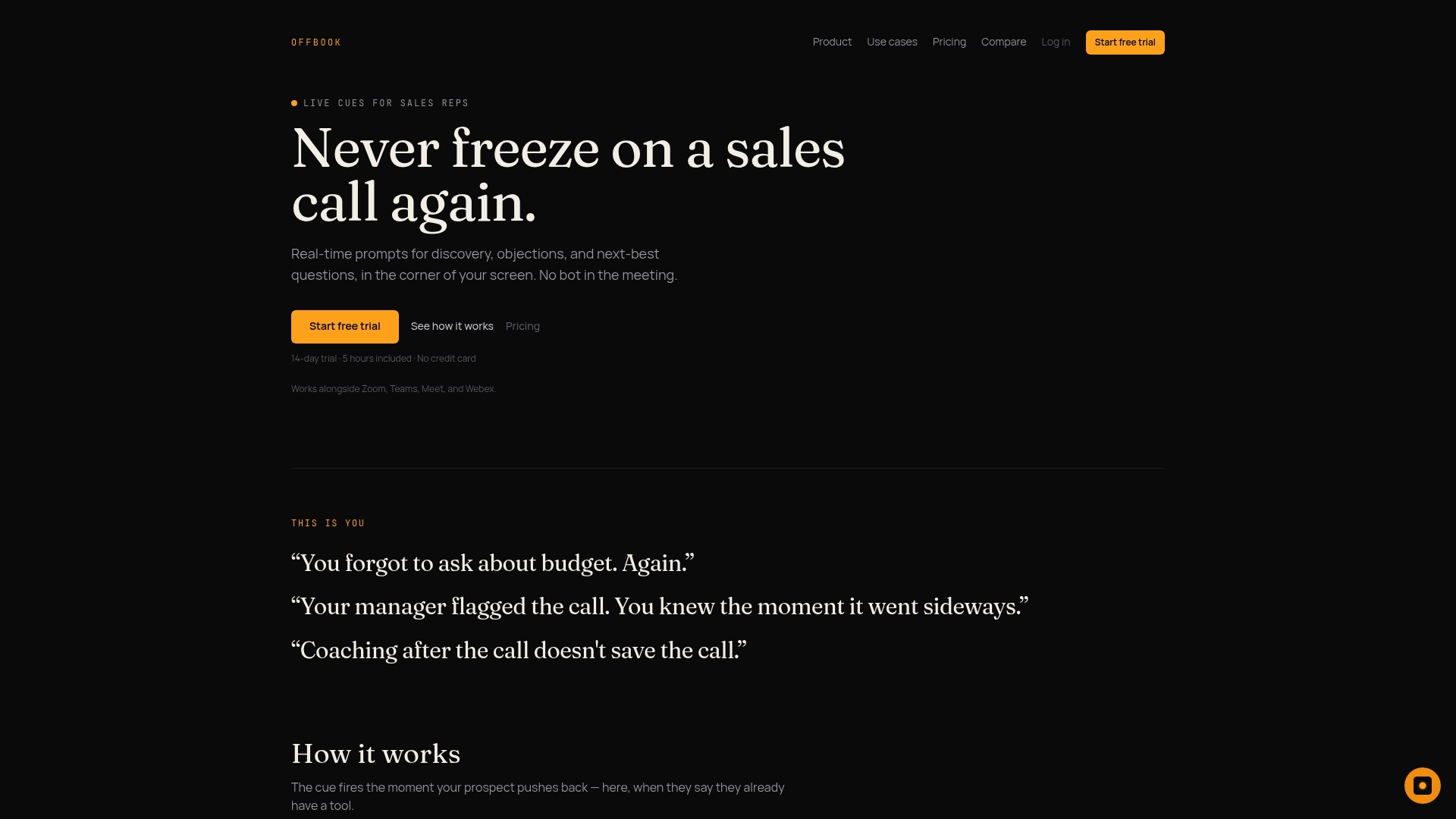
Offbook’s AI call coaching for sales surfaces live prompts on your screen during video calls, without a bot ever joining the meeting. When a buyer mentions a pain point you have not explored, Offbook cues the follow-up question. When you have not covered a MEDDIC element, it flags the gap. When the call is running long without a commitment question, it prompts you to close. For B2B founders running sales calls without a full sales team behind them, Offbook acts as the experienced coach in the room. You stay present with the buyer. Offbook keeps you on track.
FAQ
What are discovery questions in sales?
Discovery questions are open-ended, sequenced inquiries used in sales conversations to uncover a buyer’s real needs, pain points, business impact, and decision process. They go beyond qualification to build genuine understanding and trust.
How many discovery questions should I ask per call?
Analysis of over 519,000 B2B sales calls shows that 11 to 14 questions per call is the optimal range. Fewer misses critical qualification gaps; more feels like an interrogation.
What is the difference between discovery and qualification questions?
Qualification questions determine whether a prospect meets basic criteria like budget, authority, and timeline. Discovery questions go deeper, uncovering the root causes of pain, the business impact of inaction, and the personal stakes driving a decision.
What frameworks guide discovery question sequencing?
MEDDIC and the Sandler Pain Funnel are the two most widely used frameworks. MEDDIC maps questions to Metrics, Economic Buyer, Decision Criteria, Decision Process, Identify Pain, and Champion. The Sandler Pain Funnel moves through three levels from surface specifics to business impact to personal urgency.
What is the ideal talk-to-listen ratio on a discovery call?
Top-performing reps talk approximately 43% of the time on discovery calls, leaving the majority of airtime to the buyer. Higher rep talk time correlates with lower win rates.