How to Follow Up After a Discovery Call and Close More Deals
Learn how to effectively follow up after a discovery call to boost your sales. Discover key tips for rapid responses and higher conversions.
Published: June 30, 2026
Author: OffBook Editorial Team

The most effective way to follow up after a discovery call is to send a concise, personalized recap email within two hours of hanging up. That window matters more than most sales reps realize. Emails sent within 2 hours of a call achieve significantly higher open and reply rates because the prospect’s mental model is still fresh and competitors have not yet stepped in. For B2B SaaS founders and sales reps running MEDDIC or MEDDPICC qualification frameworks, the post-call follow up is where deal momentum either holds or collapses. A great discovery call means nothing if the follow-up is slow, generic, or unclear.
When should you send your first follow-up email after a discovery call?
Send your first follow-up email within two hours of the call ending. That is not a suggestion. Waiting beyond 48 hours enters what practitioners call the “deal-killing window,” where the prospect’s memory of your conversation fades and competing vendors fill the gap. The urgency is real, not manufactured.
The difference between a same-day follow-up and a next-day attempt is measurable. A same-day email lands while the prospect is still in the headspace of the problem you discussed. A 72-hour delay lands when they have moved on to three other priorities. At the seed and Series A stage, where your prospect is often a busy founder or VP making decisions without a formal procurement process, speed signals professionalism.

Pro Tip: Block 15 minutes on your calendar immediately after every discovery call. Use that time to write and send the follow-up before you do anything else. Treat it as part of the call itself, not an afterthought.
The practical rule is simple. Send within two hours. If something prevents that, send before end of business the same day. Never let the sun set twice on an unsent follow-up.
How do you write a follow-up email that actually gets a response?
The best discovery call follow-up email does three things: it recaps the prospect’s situation in their own words, it provides one piece of relevant value, and it names a single clear next step. Keep the email under 200 words for scannability, especially since most prospects read on mobile. Long emails get deferred. Deferred emails become ignored emails.
Structure your email around the buyer, not your product. Use the exact language the prospect used to describe their pain points. If they said “our onboarding is a mess,” write “onboarding friction” in your recap, not “user activation challenges.” That mirroring proves you listened. Recaps focused on the buyer’s situation build deeper trust than recaps that pivot quickly to product features.
A strong follow-up email contains these elements:
- Subject line: Reference the call directly. “Quick recap from our call today, [First Name]” outperforms generic subject lines.
- Opening line: Name the specific problem they described. “You mentioned your team loses roughly two hours per rep per week on manual CRM updates.”
- Recap: Two to three bullet points summarizing their goals, constraints, and the gap you identified together.
- One resource: A relevant case study, a short article, or a data point that speaks to their specific situation. Not three resources. One.
- Next step: Name who does what and by when. “I’ll send a proposed agenda for a 30-minute demo by thursday. Does that work, or would you prefer I schedule it now?”
Avoid CTA stacking, which means asking for multiple actions in a single email. Stacking a demo request, a referral ask, and a resource download into one message cuts reply rates sharply. One ask. One email. Sequence additional asks three to five days apart.
Pro Tip: End your email with an invitation to correct your understanding. Something like “If I’ve missed anything or gotten the wrong impression, please push back.” This costs you nothing and dramatically increases prospect engagement because it signals confidence and openness.
Top-performing reps treat their CRM as a private memory layer for capturing subtle details from calls. Internal deadlines, the name of a skeptical stakeholder, a budget cycle tied to a board meeting. These details make the follow-up feel personal rather than templated. Log them immediately after the call, before you write the email.
What is the right follow-up cadence after a discovery call?
Industry standards recommend three follow-up emails after a warm discovery call. That number balances persistence with respect for the prospect’s inbox. Here is how to space them:
- Email 1 (within 2 hours): Personalized recap with one resource and one clear next step. This is the most important email in the sequence.
- Email 2 (3–5 days later): Add new value. Share a relevant insight, a short case study, or a question that advances the conversation. Do not simply re-send email 1 with “just checking in.”
- Email 3 (7–10 days later): A short, direct note. Acknowledge that timing may be off and offer to reconnect when it makes sense. Keep it under five sentences.
80% of sales require at least five touches to close, yet most reps stop after one or two attempts. That gap between persistence and reality is where deals die. Three follow-ups is not aggressive. It is the minimum for a warm lead.
After three unanswered emails, stop emailing. Switch communication channels instead. Try LinkedIn with a short, direct message. Try a brief phone call. Involve a colleague if you have a mutual connection. A channel change often revives a stalled conversation that more emails never would. The goal is to reopen a dialog, not to flood an inbox.
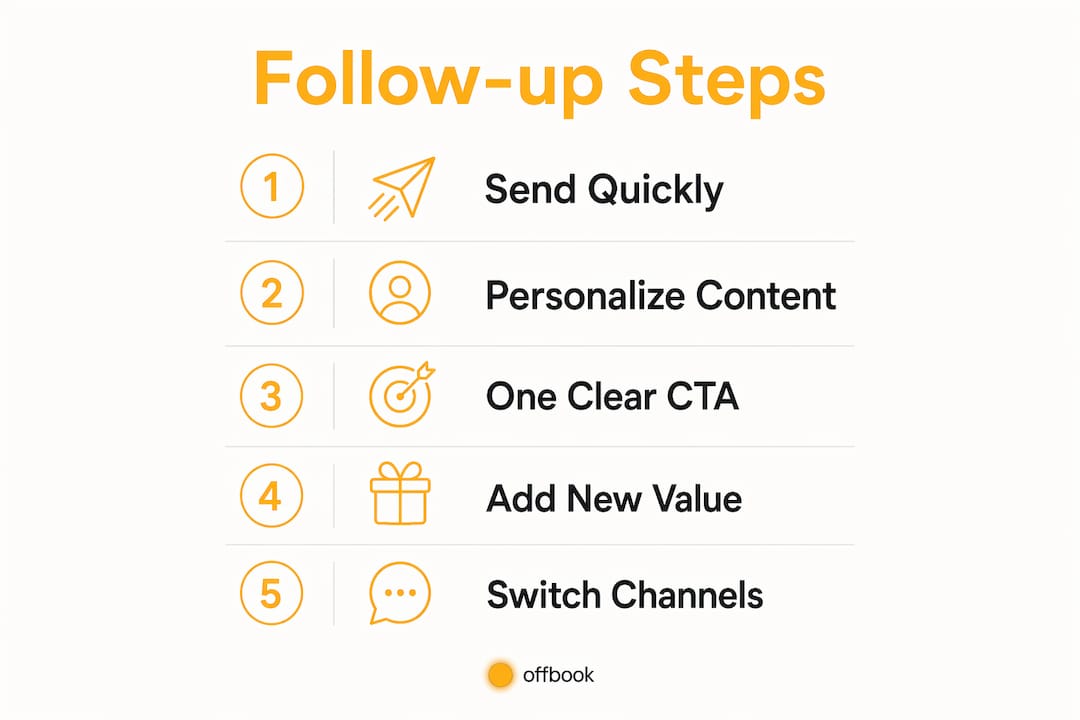
Each follow-up after the first must add something new. A repeated message with no new value reads as desperation. A message with a fresh insight reads as a trusted advisor staying in touch. The difference is everything at the early-stage startup level, where relationships drive decisions as much as product fit does.
What mistakes kill your follow-up after a discovery call?
The most common mistake is rushing a proposal into the first follow-up email. A proposal sent before a recap signals that you did not fully process the prospect’s specific situation. Send the recap first. Follow with a proposal one to two days later, once the prospect has confirmed your understanding is correct. That sequence demonstrates genuine customization.
Other mistakes that stall deals:
- Ignoring CRM notes: Failing to log call details means your second and third follow-ups feel generic. Prospects notice when you forget what they told you.
- Vague next steps: “Let me know if you want to chat” is not a next step. Name the action, the owner, and the deadline.
- Using your language, not theirs: Writing “our platform addresses scalability challenges” when the prospect said “we can’t keep up with new hires” creates distance. Mirror their words.
- Continuing to email after silence: Three unanswered emails is a signal. Respect it. Change channels or pause the sequence.
- Multiple CTAs in one email: Asking for a demo, a referral, and feedback in the same message overwhelms the reader. One ask per email, always.
Pro Tip: Before sending any follow-up, read it aloud and ask: “Does this sound like I was listening, or like I was waiting to talk?” If it sounds like the latter, rewrite the opening.
Understanding how to structure the discovery call itself directly improves the quality of your follow-up. The more disciplined the call, the more specific and compelling the recap email becomes. Weak calls produce weak follow-ups. Strong calls give you the raw material to write something the prospect actually wants to read.
Key Takeaways
The most effective post-call follow up combines speed, specificity, and a single clear next step to keep deals moving forward.
| Point | Details |
|---|---|
| Send within two hours | Emails sent within 2 hours of the call achieve significantly higher open and reply rates. |
| Keep emails under 200 words | Short, scannable emails get read; long emails get deferred, especially on mobile. |
| Use the prospect’s own words | Mirroring the buyer’s language in your recap proves attentiveness and builds trust. |
| Follow a three-email cadence | Send three follow-ups spaced 2 hours, 3–5 days, and 7–10 days apart before switching channels. |
| One CTA per email | Asking for a single action per message doubles effectiveness compared to stacking multiple requests. |
The follow-up is where the real selling happens
Most sales training obsesses over the discovery call itself. The questions to ask, the objections to handle, the qualification framework to follow. That focus is right. But the follow-up is where you either confirm or squander everything you built in the call.
I have reviewed hundreds of follow-up emails over the years, and the pattern is consistent. The ones that convert do not sound like sales emails. They sound like a thoughtful person completing a conversation. They reference something specific the prospect said. They offer one genuinely useful thing. They make the next step obvious and easy to say yes to.
The ones that fail do the opposite. They open with “I wanted to circle back.” They attach a 12-slide deck. They ask for a demo, a referral, and a reply all in the same paragraph. They feel like the rep moved on from the conversation the moment it ended.
Reframing the follow-up as conversation completion rather than chasing changes how you write it. You are not pestering someone. You are honoring the time they gave you by doing something useful with it. That mindset shift shows up in the tone, and prospects feel it.
One habit I recommend to every early-stage founder running their own sales: log three non-obvious details from every call before you close your laptop. Not the pain points. Those are obvious. Log the internal deadline tied to a board meeting. Log the name of the skeptical CFO who was not on the call. Log the fact that the prospect mentioned they evaluated a similar tool two years ago and it failed. Those details are what separate a follow-up that feels personal from one that feels like a mail merge.
Knowing what to propose as a next step before the call ends also sharpens your follow-up significantly. When you close the call with a named next step, your email simply confirms it. That confirmation email is the easiest follow-up you will ever write.
— Neil
How Offbook helps you run better calls and follow-ups
The quality of your follow-up email is a direct reflection of how well you ran the discovery call. If you missed a key pain point or forgot to ask about the buying committee, your recap will be thin and your next steps will be vague. Offbook’s AI call coaching surfaces live cues during your video calls, prompting you on-screen with the right questions to ask, qualification gaps to close, and objections to address, all structured around MEDDIC and MEDDPICC. No bot joins the meeting. No one on the other side knows it is there. Offbook also generates pre-call briefs so you walk into every discovery call already knowing the company, the stakeholders, and the context. Better calls produce better follow-ups. See how Offbook works for B2B SaaS sales teams.
FAQ
How soon should you follow up after a discovery call?
Send your first follow-up email within two hours of the call. Waiting beyond 48 hours enters a deal-killing window where prospect memory fades and competitors gain ground.
What should a discovery call follow-up email include?
A strong follow-up email includes a personalized recap in the prospect’s own words, one relevant resource or case study, and a single clear next step with named ownership and a deadline. Keep it under 200 words.
How many follow-up emails should you send after a discovery call?
Send three follow-up emails spaced at two hours, three to five days, and seven to ten days after the call. After three unanswered emails, switch to a different channel such as LinkedIn or phone.
What is CTA stacking and why does it hurt follow-up emails?
CTA stacking means asking for multiple actions in a single email, such as requesting a demo, a referral, and a resource download at once. It lowers reply rates significantly. One clear ask per email is the standard best practice.
When should you send a proposal after a discovery call?
Send a recap email first and wait for the prospect to confirm your understanding. Follow with a proposal one to two days later. Rushing a proposal into the first follow-up signals a lack of genuine customization and can stall the deal.