How to Implement MEDDIC Across Your Sales Team
Unlock your sales team's potential by implementing MEDDIC effectively. Discover practical steps to drive real adoption and success.
Published: August 12, 2026
Author: OffBook Editorial Team

The fastest path to implement MEDDIC across your sales team: run verbal deal reviews using MEDDIC language for two weeks before touching your CRM, then add just two fields (Champion and Economic Buyer), and let manager coaching drive the rest. That sequence, backed by a phased rollout, is what separates teams that actually adopt the framework from teams that fill out fields and forget it.
Three actions you can take this week:
- Pick 5 live deals and run a MEDDIC deal review on each one. Ask reps to answer every element out loud. Write nothing in the CRM yet.
- Run those reviews for two weeks. The CRO Report’s MEDDPICC implementation guide calls this the single most important step to prevent reps from treating the framework as busywork.
- After two weeks, add Champion and Economic Buyer as CRM fields in Salesforce. Gate nothing else yet.
MEDDPICC and MEDDPICC variants follow the same logic. Offbook’s live in-call coaching accelerates the behavior change by surfacing MEDDIC prompts during the call itself, not after. The phased rollout, CRM build-vs-buy decision, training playbook, and measurement framework are all covered below.
Key Takeaways
Implementing MEDDIC across a B2B SaaS sales team requires verbal deal reviews before CRM changes, a phased rollout over 9–12 weeks, and manager-led coaching as the primary adoption engine.
| Point | Details |
|---|---|
| Start with deal reviews, not CRM | Run verbal MEDDIC reviews for 2–3 weeks before adding any Salesforce fields. |
| Phase in elements and fields | Add Champion and Economic Buyer fields first; gate other fields only after reps show fluency. |
| Manager coaching drives adoption | Weekly MEDDIC questions in every pipeline call internalize the framework faster than any training event. |
| Score deals to reduce subjectivity | Use a 0–3 scale per element; scores below 7 should not appear in the current quarter’s forecast. |
| Offbook compresses time-to-fluency | Live in-call prompts reinforce MEDDIC behaviors between coaching sessions, where most learning happens. |
Table of Contents
- What does MEDDIC actually stand for?
- How to implement MEDDIC across your sales team: the phased rollout
- Should you build MEDDIC fields in Salesforce or buy a native app?
- How to build a training program that actually changes behavior
- How to operationalize MEDDIC in your weekly rhythm
- Why MEDDIC rollouts fail and how to fix them
- Ready-to-use MEDDIC templates and discovery questions
- How Offbook accelerates MEDDIC adoption during live calls
- What really makes MEDDIC stick
- Run a MEDDIC pilot with Offbook in 4–8 weeks
- Sources
What does MEDDIC actually stand for?
MEDDIC is a B2B sales qualification framework built around six elements that, together, tell you whether a deal is real.
- Metrics: The quantifiable business impact your solution delivers. What does the buyer gain or save, and can they put a number on it?
- Economic Buyer: The person with budget authority. Not the champion, not the committee. The one who can say yes and make it stick.
- Decision Criteria: The formal and informal criteria the buying team uses to evaluate vendors. Technical requirements, security standards, pricing structure.
- Decision Process: The steps, approvals, and stakeholders involved in moving from evaluation to signed contract.
- Identify Pain: The specific business problem driving urgency. Vague dissatisfaction is not pain. A problem with a cost attached to it is.
- Champion: An internal advocate who has influence, wants your solution to win, and will sell for you when you are not in the room.
When to use MEDDICC or MEDDPICC instead
Choosing between MEDDIC, MEDDICC, and MEDDPICC comes down to what most commonly kills your deals. Add Competition (the second C) if you are regularly losing to a named competitor and your reps are not surfacing that risk early. Add Paper Process (the P) when procurement and legal delays routinely push close dates by weeks or months. For most seed and Series A SaaS teams, starting with core MEDDIC and adding elements as deal complexity grows is the right call.
Pro Tip: Start with just Champion and Pain. Those two elements alone will sharpen your pipeline reviews faster than any other pair. Once reps can answer both confidently on every deal, layer in the rest.
How to implement MEDDIC across your sales team: the phased rollout
The goal of a phased rollout is to build the habit before you build the infrastructure. Reps who understand MEDDIC as a thinking tool will fill CRM fields accurately. Reps who encounter it as a form will fill it retroactively and badly.
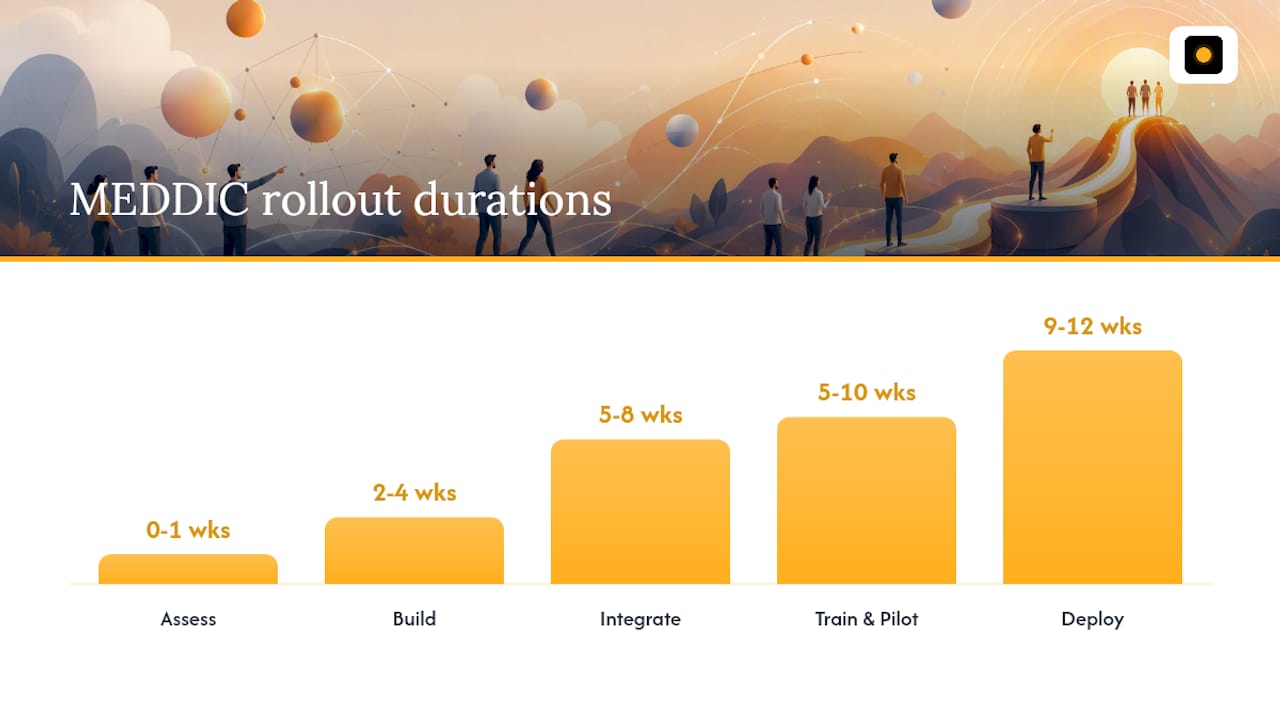
Phase overview and timeline
| Phase | Weeks | Objective | Owner | Key Deliverable |
|---|---|---|---|---|
| Assess | 0–1 | Baseline current qualification quality | VP of Sales | Loss review, deal audit, variant selection |
| Build | 2–4 | Create playbook, question bank, field specs | Enablement | MEDDIC playbook pages, CRM field spec doc |
| Integrate | 5–8 | Add CRM fields in Salesforce, stage gates | Revenue Ops | Champion + Economic Buyer fields live |
| Train & Pilot | 5–10 | Workshop, role-play, live deal application | Managers | 3 reps, 5 deals each, recorded reviews |
| Deploy | 9–12 | Full team rollout, manager coaching cadence | VP of Sales | All reps running MEDDIC deal reviews |
| Iterate | Ongoing | Score, measure, refresh quarterly | Revenue Ops | Dashboard, quarterly workshop |
Phase checklists
Assess (Weeks 0–1)
- Pull the last 10 lost deals and identify the most common failure point (no champion, no metrics, no urgency).
- Decide on MEDDIC vs MEDDICC vs MEDDPICC based on that loss review.
- Survey reps: can they name the economic buyer and champion on their top 5 deals right now?
Build (Weeks 2–4)
- Write one playbook page per MEDDIC element: definition, discovery questions, evidence standard, and what “good” looks like.
- Draft CRM field specs (field name, type, required stage) for Champion and Economic Buyer.
- Build a manager question bank: 3–5 questions per element for pipeline calls.
Integrate (Weeks 5–8)
Embedding MEDDIC into discovery scripts, meeting agendas, and the sales playbook materially increases adoption. Add Champion (lookup field) and Economic Buyer (status dropdown: Identified / Engaged / Confirmed) to Salesforce first. Gate nothing at this stage. Require these two fields only at the proposal stage, not at opportunity creation.
Train & Pilot (Weeks 5–10)
Run the pilot with 3 reps across 5 live deals each. Success criteria: reps can answer all six MEDDIC elements verbally with evidence, forecast accuracy improves on piloted deals, and managers report higher-quality deal conversations. If two of three reps hit those criteria, proceed to full deploy.
Deploy (Weeks 9–12)
Full team rollout with a weekly manager coaching cadence. Every pipeline call uses MEDDIC language. No exceptions.
Iterate (Ongoing)
Score deals quarterly, run a refresh workshop, and add CRM fields for additional elements only when reps demonstrate fluency with the existing ones.
Should you build MEDDIC fields in Salesforce or buy a native app?
Both paths work. The right choice depends on your team size, Salesforce admin capacity, and how much customization you actually need.
Build vs. buy at a glance
Build custom fields in Salesforce
- Pros: Full control over field names, picklist values, and stage-gate logic. No additional license cost. Easier to align with your existing Salesforce data model.
- Cons: Requires Salesforce admin time (typically 8–20 hours for a clean build). Reporting requires custom report types. No built-in MEDDIC scoring logic.
Buy a native MEDDIC/MEDDPICC app
- Pros: Pre-built field sets, scoring, and dashboards. Faster to deploy. Some apps include deal health visualizations out of the box.
- Cons: Additional license cost. May not match your exact variant (MEDDIC vs MEDDPICC). Can create data silos if not integrated carefully with your existing pipeline stages.
For most early-stage SaaS teams, building in Salesforce is the right call. The field set is small, the logic is straightforward, and you avoid adding another tool to your B2B sales tech stack before you know what you actually need.
Minimal field spec
The warning against a “wall of red asterisks” is real. Requiring too many mandatory fields too early produces retroactive, low-quality data entry. Require only Champion and Economic Buyer Status at the Proposal stage to start. Add gates for other fields only after reps demonstrate they can answer them verbally.
Dashboard metrics to monitor
Track MEDDIC completeness (percentage of fields populated) against win rate by completeness bucket. A deal with Champion and Economic Buyer confirmed should close at a meaningfully higher rate than one without. If it does not, your definitions need tightening, not your field count. Also track stage-conversion velocity by MEDDIC score and economic buyer engagement rate (percentage of deals where the economic buyer has been directly contacted).
How to build a training program that actually changes behavior
A one-day MEDDIC workshop does not create fluency. Full fluency typically takes two full sales cycles of sustained practice in deal reviews. Plan your training program accordingly.
Training curriculum (weeks 1–6)
- Week 1: Theory and context. 90-minute session covering MEDDIC elements, why the framework exists, and what “good evidence” looks like for each element. Use real lost deals as examples.
- Week 2: Role-play and discovery practice. Pair reps for 30-minute role-plays. One rep plays the buyer, one plays the seller. Focus on Champion and Pain discovery first. Record sessions for review.
- Week 3: Live deal application. Each rep brings their top 3 deals to a group review. Manager asks MEDDIC questions. Rep answers with evidence. No CRM required yet.
- Week 4: CRM field walkthrough. Introduce the Salesforce fields. Show reps how to populate them from their deal notes. Emphasize that the field captures what they already know, not new work.
- Weeks 5–6: Manager calibration. Managers run MEDDIC deal reviews independently. Calibrate on scoring standards. Identify reps who need additional coaching.
Manager coaching cadence
The most effective implementations use MEDDIC as the primary language of every pipeline call. Managers who ask the same questions in every review internalize the framework by repetition, and so do their reps. For detailed cadence guidance, the sales manager coaching cadence best practices resource covers the weekly rhythm in depth.
Weekly pipeline call checklist for managers:
- Who is the champion, and what have they done to prove it?
- Has the economic buyer been directly engaged? What was their reaction?
- What is the quantified business impact (Metrics)?
- What does the decision process look like, and who owns each step?
- What is the identified pain, and what happens if they do nothing?
Pro Tip: Demand evidence, not assertions. “I think the CFO is the economic buyer” is not an answer. “The CFO attended our last call and asked about ROI” is. Train managers to push for the second kind of answer every time.
Certification and reinforcement
After the initial 6-week program, require reps to pass a certification: a recorded role-play where they run a full MEDDIC discovery on a fictional deal. Score it on the 0–3 scale per element (covered in the next section). Reps who score below 12 of 18 repeat the role-play. Run a quarterly refresh workshop to prevent decay, using collaborative tools like Miro for decision-process mapping exercises.
How to operationalize MEDDIC in your weekly rhythm
Training creates awareness. The weekly operating rhythm creates behavior. MEDDIC has to show up in deal reviews, pipeline calls, QBRs, and forecasting conversations, or it fades within 60 days.
MEDDIC scorecard template
Score each element 0–3 at every deal review. Use this as the standard:
A total score of 12–18 supports a commit forecast. Scores of 7–11 belong in best-case. Below 7, the deal should not be in the current quarter’s forecast at all. Scoring with thresholds reduces the subjectivity that makes pipeline reviews feel like negotiation sessions.
KPIs and reporting cadence
| KPI | Owner | Cadence |
|---|---|---|
| MEDDIC completeness rate | Revenue Ops | Weekly |
| Win rate by completeness bucket | Revenue Ops | Monthly |
| Forecast accuracy (commit vs closed) | VP of Sales | Weekly |
| Economic buyer engagement rate | Managers | Weekly |
| Deal velocity by MEDDIC score | Revenue Ops | Monthly |
Reps own the data quality. Managers own the coaching. Revenue Ops owns the dashboard and the trend analysis. VP of Sales owns the forecasting rules and the consequence when a deal without a confirmed economic buyer lands in commit.
Why MEDDIC rollouts fail and how to fix them
Most MEDDIC implementations fail for the same five reasons. Each one has a direct fix.
Treating MEDDIC as a CRM form. Reps fill fields after the fact to satisfy a manager, not because the framework changed how they think. Fix: run verbal deal reviews for two to three weeks before adding any CRM fields. The CRO Report’s implementation guide makes this the first step for a reason.
Training once and moving on. A single workshop creates awareness, not fluency. Fix: build a 6-week curriculum with role-plays, live deal application, and manager calibration. Run quarterly refreshes.
Overcomplicating the framework too early. Launching with all six elements plus Competition and Paper Process overwhelms reps who have never used structured qualification before. Fix: start with Champion and Pain. Add elements in phases as reps demonstrate fluency.
Making too many fields mandatory too early. A wall of required fields at opportunity creation produces garbage data and rep resentment. Fix: require only Champion and Economic Buyer Status at the Proposal stage. Gate other fields at later stages only.
Ignoring leadership reinforcement. VPs of Sales who do not use MEDDIC language in QBRs and board reviews send a clear signal that the framework is optional. Leadership modeling drives institutional adoption faster than any mandate. Fix: VP of Sales uses MEDDIC language in every pipeline review, every QBR, every board update.
Weekly decay-prevention checklist for leaders:
- Did every pipeline call this week include MEDDIC questions?
- Can every rep in commit name their champion and economic buyer with evidence?
- Did any deal advance a stage without a MEDDIC score above 10?
- Did the VP use MEDDIC language in the forecast call?
Pro Tip: The fastest way to kill a MEDDIC rollout is to let one deal close without a champion and say nothing. Reps watch what you reward, not what you say.
Ready-to-use MEDDIC templates and discovery questions
MEDDIC discovery question bank
Metrics
- What does success look like in numbers for this project?
- What is the cost of the current problem per quarter?
- How will you measure ROI at the 6-month mark?
Economic Buyer
- Who controls the budget for this decision?
- Has that person been involved in similar purchases before?
- What does their approval process look like?
Decision Criteria
- What are the top three things your team will evaluate vendors on?
- Are there any non-negotiable technical or security requirements?
- How does price factor into the decision relative to capability?
Decision Process
- Walk me through the steps from “we’ve chosen a vendor” to a signed contract.
- Who else needs to be involved before you can move forward?
- What has caused deals like this to stall in the past?
Identify Pain
- What happens to the business if this problem is not solved in the next 90 days?
- Who feels this problem most acutely inside your organization?
- Has this been attempted before? What stopped it?
Champion
- Who inside your organization is most invested in seeing this succeed?
- What would it mean for them personally if this project delivers?
- Are they willing to introduce us to the economic buyer?
Manager deal-review checklist
Use this at every pipeline call. Green means advance. Red means coach before advancing.
| Question | Green | Red |
|---|---|---|
| Champion named with evidence of advocacy? | Yes, with specific action | Named only, no evidence |
| Economic buyer directly engaged? | Yes, direct contact made | Assumed or secondhand |
| Metrics quantified with buyer’s numbers? | Confirmed ROI figure | Vague benefit stated |
| Decision process documented with owners? | Steps and timeline confirmed | Verbal description only |
| Pain quantified with cost of inaction? | Dollar or time cost confirmed | General dissatisfaction |
Pre-call preparation checklist
Before any discovery or follow-up call, a rep should confirm:
- What MEDDIC elements are already known for this deal?
- Which element has the weakest evidence? Plan to address it on this call.
- Who is attending? What is each person’s likely role in the decision process?
- What is the one question that, if answered, would most advance the deal?
For startup sales reps running MEDDIC discovery for the first time, the pre-call prep habit is often the difference between a productive call and a demo that goes nowhere.
How Offbook accelerates MEDDIC adoption during live calls
The hardest part of MEDDIC adoption is not the training. It is the moment a rep is live on a call, the conversation goes somewhere unexpected, and they forget to ask about the economic buyer. That gap is where deals slip.

Offbook addresses this directly. It listens to the call in real time and surfaces on-screen prompts tied to MEDDIC elements, without joining the meeting as a bot. The rep sees the cue. The buyer never knows it is there.
What Offbook does during a MEDDIC-structured call:
- Surfaces a prompt when a rep has not yet asked about the economic buyer or champion by a certain point in the call.
- Flags qualification gaps in real time: if the conversation has covered pain but not metrics, Offbook prompts the rep to quantify the impact.
- Generates a post-call debrief that maps what was learned to each MEDDIC element, ready to populate Salesforce notes.
- Delivers a pre-call brief before the meeting: company context, known stakeholders, and which MEDDIC elements still need evidence based on the current deal record.
How Offbook fits into the phased rollout:
During the Train & Pilot phase (Weeks 5–10), Offbook gives pilot reps a live safety net. Instead of relying entirely on memory and habit, they get real-time reinforcement of the exact behaviors the training covered. Managers can review post-call debriefs to see which elements were covered and which were missed, making coaching conversations more specific.
Pilot success metric: after 4 weeks with Offbook, pilot reps should show measurably fewer MEDDIC gaps per call compared to their pre-pilot baseline. That is a concrete, measurable signal that the framework is becoming a habit, not just a checklist.
Pro Tip: Use Offbook’s post-call debrief as the input for your Salesforce MEDDIC fields. Reps copy from the debrief into the CRM instead of reconstructing the call from memory. Data quality improves immediately.
For AI call coaching built around MEDDIC and MEDDPICC, Offbook is the tool built for exactly this use case.
What really makes MEDDIC stick
Most articles on MEDDIC implementation focus on the framework itself. The real variable is leadership behavior, and it is almost always underweighted.
Here is what I have seen work, and what I have seen fail. Teams that treat MEDDIC as an enablement project, hand it to a sales trainer, and check in quarterly do not get adoption. They get compliance theater: fields filled, language parroted, behavior unchanged. The deals that should not be in forecast are still there. The champions are still unconfirmed. The economic buyers are still assumptions.
What actually works is when the VP of Sales makes MEDDIC the language of every conversation that matters. Not just pipeline calls. Board updates. QBRs. One-on-ones. When a rep hears “who is your champion and what have they done?” from their manager every single week, they stop thinking of MEDDIC as a framework and start thinking of it as how deals work.
The second thing that works is patience with the timeline. Two full sales cycles is the honest answer for when you will see fluency. For a team with a 60-day average sales cycle, that is four months. For a team with a 90-day cycle, it is six. Leaders who expect fluency in 30 days will declare the rollout a failure and move on to the next initiative. The teams that stick with it past the awkward phase, where reps know the questions but do not yet know how to ask them naturally, are the ones that see the pipeline quality improvement.
The third thing: use live coaching to compress that timeline. Offbook’s in-call prompts do not replace manager coaching. They reinforce it between coaching sessions, which is where most of the learning actually happens.
For the operational steps that support all three of these, the phased rollout and training program sections above are the place to start.
Run a MEDDIC pilot with Offbook in 4–8 weeks
The cleanest way to prove MEDDIC’s impact before a full rollout is a focused pilot: 3–6 reps, 4–8 weeks, with Offbook surfacing live MEDDIC prompts during every discovery and follow-up call.
Set three success metrics at the start: MEDDIC completeness rate on piloted deals, forecast accuracy for those deals, and manager-reported improvement in deal-review quality. Involve one enablement lead, one revenue ops contact to track the Salesforce data, and one or two managers who will run the weekly coaching reviews.
Offbook’s AI call coaching for sales is built for exactly this kind of pilot. Reps get live prompts during calls, pre-call briefs that surface which MEDDIC elements still need evidence, and post-call debriefs that feed directly into CRM notes. No bot in the meeting. No disruption to the call. Just the right question, at the right moment, when it can still change the outcome.
Start your pilot and see what your pipeline looks like when every rep runs MEDDIC on every call.
Sources
- How to Implement MEDDPICC Without Killing Your Sales Team’s Soul | CRO Report
- How to Implement the MEDDIC Framework: A Full Guide
- The MEDDIC Sales Framework Guide That Works
- MEDDIC sales process explained | Miro