Startup Sales Rep Best Practices for B2B SaaS in 2026
Discover essential startup sales rep best practices for B2B SaaS in 2026. Boost pipeline, shorten cycles, and close more deals today!
Published: June 29, 2026
Author: OffBook Editorial Team

Startup sales rep best practices are defined as the repeatable, data-driven behaviors that increase qualified pipeline, shorten sales cycles, and improve closing rates in early-stage B2B SaaS environments. The industry term for this discipline is sales methodology, and it covers everything from how you define your ideal customer to how you run a discovery call. Reps who follow structured methodologies like MEDDIC or MEDDPICC consistently outperform those who rely on instinct alone. This guide covers the most effective techniques for 2026, built specifically for seed and Series A teams where every deal counts.
1. Startup sales rep best practices start with a sharp ICP
An Ideal Customer Profile (ICP) is the single most important targeting tool a startup sales rep has. It defines the specific company type most likely to buy, get value, and stay. Without a clear ICP, you waste time on prospects who will never close.
A strong ICP includes:
- Industry and vertical: Where does your product create the most measurable impact?
- Company size: Headcount and revenue range that matches your deal size and sales cycle.
- Pain points: The specific problems your product solves better than any alternative.
- Buying triggers: Events like funding rounds, leadership changes, or product launches that signal readiness.
Treat your ICP as a hypothesis, not a fixed rule. Revisit it every quarter using closed-won data. The patterns in your best customers reveal who you should be targeting next. Channel selection matters too. Go where your buyers actually spend time, not where you feel comfortable. If your ICP is VP-level at Series B SaaS companies, LinkedIn outreach and warm introductions will outperform cold calling every time.
Pro Tip: Pull your last 10 closed-won deals and list three things they had in common. That overlap is your sharpest ICP signal.

2. Why consultative selling beats pitching for early-stage reps
Consultative selling is the most effective approach for startup reps because it positions you as a problem-solver rather than a vendor. That distinction matters enormously when your brand is unknown and your prospect has no reason to trust you yet.
The core shift is simple: lead with questions, not features. Instead of opening with “Here’s what our product does,” you open with “What’s the biggest friction in your current workflow?” This approach does three things at once. It builds trust, surfaces real pain, and filters out bad-fit leads before you waste hours on them.
Consultative selling also changes how you frame outreach. Treating initial contact as discovery rather than a sales pitch lowers buyer resistance significantly. Framing a meeting as “I’d love your feedback on a problem we’re solving” converts better than “I’d like to show you our demo.”
Key behaviors that define consultative selling in practice:
- Ask open-ended questions before presenting any solution.
- Summarize the prospect’s pain back to them before moving forward.
- Only introduce your product after confirming the problem is real and urgent.
- Disqualify early if the fit is weak. It protects your time and your credibility.
Pro Tip: Before each discovery call, write down three questions specific to that prospect’s industry and recent company news. Generic questions signal you didn’t prepare.
3. How to structure your sales pipeline to avoid fiction
Businesses that actively manage their pipeline with clear stages and touchpoints see 28% higher revenue growth. That number reflects a simple truth: a pipeline without clear stage definitions is not a pipeline. It’s a wish list.
Every stage in your pipeline needs an entry criterion. “Prospect showed interest” is not a criterion. “Prospect confirmed budget exists and agreed to a second call” is. The difference between these two definitions is the difference between a healthy pipeline and a fiction pipeline.
| Pipeline metric | What it measures | Why it matters |
|---|---|---|
| Stage conversion rate | % of deals moving from one stage to the next | Reveals where deals stall or die |
| Deal aging | Days a deal has sat in a stage | Flags deals going cold before they’re lost |
| Qualified meetings booked | Meetings that meet ICP criteria | Separates real pipeline from noise |
| Pipeline coverage | Total pipeline value vs. quota | Shows whether you have enough to hit your number |
Tracking stage conversion and deal aging over vanity metrics like total pipeline value keeps your forecast honest. A deal that has been in “proposal sent” for 45 days is not a live deal. Treat it accordingly.
Pro Tip: Set a maximum age for each pipeline stage. If a deal exceeds it without movement, move it to a nurture sequence or close it as lost. This keeps your CRM accurate and your focus sharp.
4. Personalizing outreach to hit the 30% reply rate benchmark
Highly targeted cold outreach achieves a 30% reply rate as a baseline. A batch of 30 highly targeted emails regularly outperforms 300 generic ones. Volume is not a strategy. Relevance is.
Personalization at the message level means referencing something specific to that prospect’s world. That could be a recent funding announcement, a LinkedIn post they wrote, a competitor they just lost to, or a hiring trend visible on their careers page. Each of these signals tells the prospect you did your homework.
Effective personalized outreach includes:
- A specific trigger: Reference a real event or signal relevant to them.
- A clear problem statement: Name the pain without assuming they have it.
- A low-friction ask: Request a 15-minute conversation, not a demo.
- One clear next step: Never end a message without a specific proposed action.
After a call, follow-up speed matters as much as follow-up quality. Send a recap within two hours. Include a summary of what you heard, what you proposed, and the exact next step with a date. Reps who present tailored next steps at the end of each call convert 20–30% of free consultations into paid pilots. That conversion rate collapses when next steps are vague.
Pro Tip: Use buying signals like job postings, press releases, and LinkedIn activity to personalize the first line of every outreach message. One specific sentence outperforms three paragraphs of generic copy.
5. Using in-person networking and founder-led sales as a force multiplier
Warm introductions convert 5 to 10 times better than cold messages. That gap exists because trust transfers. When someone your prospect respects vouches for you, the credibility barrier disappears before you say a word.
Startup events, industry meetups, and founder communities are underused sales channels for early-stage reps. Face-to-face interaction builds trust faster than any digital channel. One conversation at a relevant event can open doors that months of cold email cannot.
Founder-led sales adds a different kind of credibility. When a founder joins a sales call, they bring product depth, company vision, and authentic passion that a rep alone cannot replicate. The most effective early-stage teams blend founder insight with sales discipline. The founder handles the “why we built this” narrative. The rep handles qualification, next steps, and pipeline management.
Key ways to build your warm network as a rep:
- Attend two to three industry events per quarter and follow up within 24 hours.
- Ask every closed-won customer for two introductions to peers with similar problems.
- Build relationships with investors and advisors who can make warm intros at scale.
6. How to run discovery calls that actually qualify deals
A well-structured discovery call is the highest-leverage activity in a startup rep’s week. It either confirms a deal worth pursuing or saves you from wasting three months on a prospect who will never buy.
The goal of discovery is not to sell. It is to understand. You are trying to confirm four things: the problem is real, the pain is urgent, budget exists, and the right people are in the room. If any of these are missing, you do not have a qualified deal.
MEDDIC and MEDDPICC give you a framework for this. MEDDIC stands for Metrics, Economic Buyer, Decision Criteria, Decision Process, Identify Pain, and Champion. Each element maps to a question you need answered before moving a deal forward. Reps who follow this framework consistently produce more accurate forecasts and shorter sales cycles.
Pro Tip: Record your discovery calls and review them weekly. You will catch qualification gaps you missed in the moment and sharpen your discovery questions over time.
7. How to train startup sales reps for repeatable performance
Training startup sales reps means building a system before you build a team. Hiring reps before a repeatable process exists drains resources and produces inconsistent results. Reps are hired to scale a working sales motion, not to invent one from scratch.
A repeatable training system includes a documented call framework, a library of objection responses, and a clear onboarding path that gets new reps to their first qualified meeting within two weeks. Without these, every rep improvises. Improvisation does not scale.
Improving sales performance in startups also requires ongoing coaching, not just onboarding. Weekly call reviews, pipeline inspections, and live feedback loops are the difference between a rep who plateaus at 60% quota and one who consistently closes. The best training programs treat every call as a data point and every loss as a lesson.
8. Handling objections without losing momentum
Common B2B sales objections follow predictable patterns: “We don’t have budget,” “We’re happy with our current solution,” and “Now isn’t the right time.” Each of these is a signal, not a dead end. Your job is to understand what is underneath the objection before you respond to it.
The most effective objection handling technique is the clarifying question. When a prospect says “We don’t have budget,” the right response is not to defend your price. It is to ask, “Is that a timing issue or a priority issue?” The answer tells you whether the deal is real.
Objection handling is a skill that improves with repetition and review. Reps who study their own calls and catalog the objections they encounter build a personal playbook over time. That playbook becomes a competitive advantage that no generic sales script can replicate.
Key Takeaways
Startup sales reps who combine a sharp ICP, consultative discovery, honest pipeline tracking, and personalized outreach consistently outperform peers who rely on volume and instinct alone.
| Point | Details |
|---|---|
| ICP drives targeting efficiency | Revisit your ICP quarterly using closed-won data to keep outreach relevant. |
| Consultative selling builds trust faster | Lead with questions, not features, to qualify and convert early-stage prospects. |
| Pipeline health requires honest metrics | Track stage conversion rates and deal aging to avoid forecasting fiction. |
| Personalized outreach beats volume | Targeted messages achieve a 30% reply rate baseline; generic volume does not. |
| Warm introductions accelerate deals | In-person networking and founder involvement convert at 5 to 10 times the rate of cold outreach. |
What I’ve learned about building sales systems that actually last
The most common mistake I see at seed and Series A is founders hiring sales reps before they have a repeatable process. They assume a good rep will figure it out. Sometimes one does. More often, the rep spins for three months, burns through pipeline, and leaves. Then the founder blames the hire.
The real problem is not the rep. It is the absence of a system. A rep needs a clear ICP, a documented call framework, defined pipeline stages, and a feedback loop. Without those four things, even a talented rep is guessing. And guessing does not compound.
The other thing I have seen consistently is that reps who track truth over busyness build better pipelines. Busyness metrics are calls made, emails sent, and meetings booked. Truth metrics are stage conversion rates, deal aging, and qualified pipeline coverage. A rep with 50 deals in their CRM and a 10% stage conversion rate has a worse pipeline than a rep with 15 deals and a 40% conversion rate. The numbers do not lie if you are willing to look at them honestly.
Consultative selling is the one technique I would never trade away. It feels slower at first because you are not pitching. But the deals you close through genuine discovery are stickier, larger, and faster to expand. The rep who sounds like a consultant closes more than the rep who sounds like a salesperson. That is not a theory. It is a pattern I have watched repeat across dozens of early-stage teams.
— Neil
How Offbook helps startup sales reps execute these practices live
Real-time coaching is the missing layer in most startup sales training programs. Offbook surfaces live AI cues to reps during video calls, prompting the right discovery questions, flagging qualification gaps, and suggesting objection responses at the exact moment they are needed.
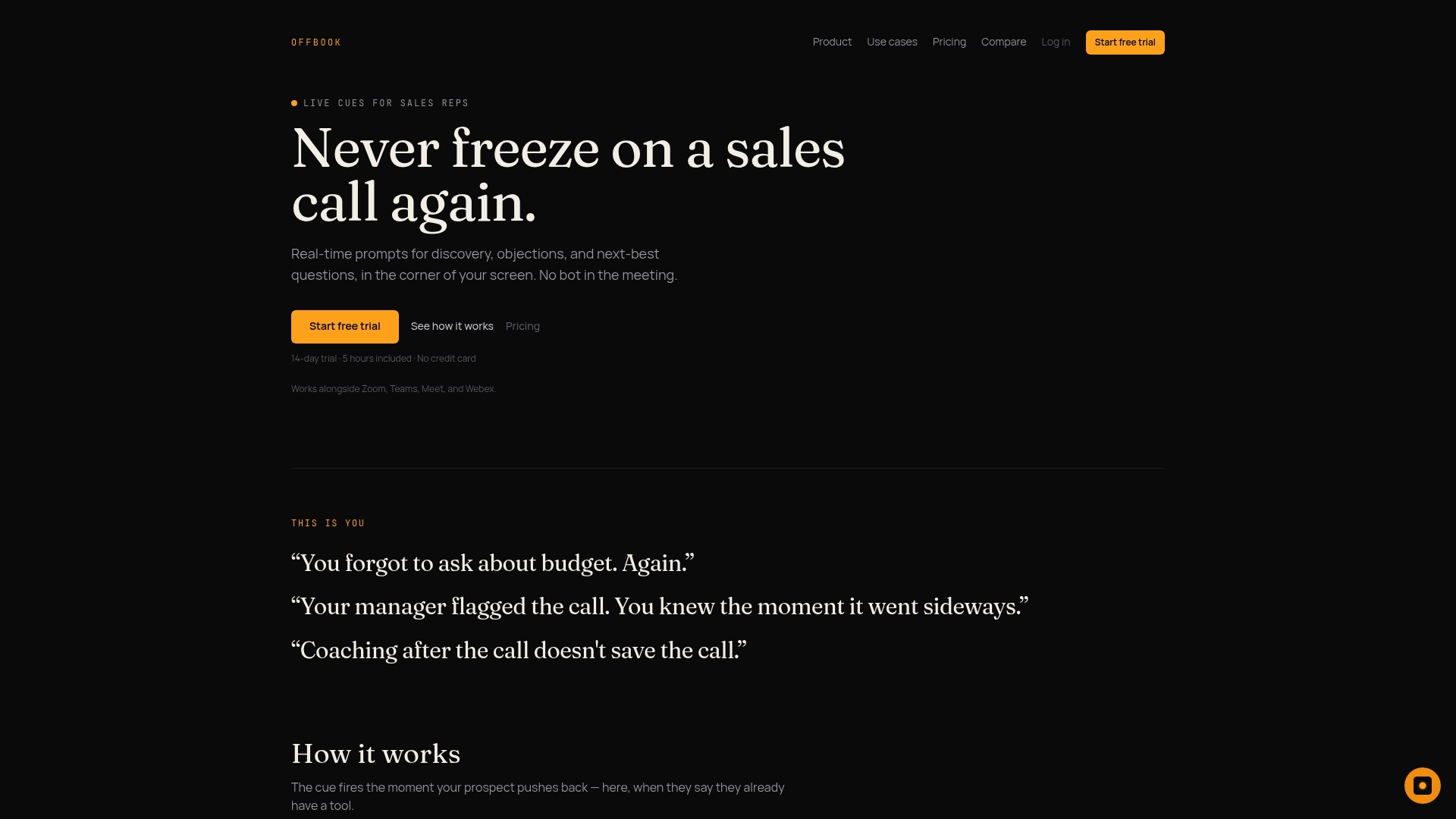
Offbook is built around MEDDIC and MEDDPICC, so every prompt maps directly to the frameworks that produce accurate forecasts and shorter cycles. It also generates pre-call briefs so reps walk into every conversation prepared. For seed and Series A teams, Offbook’s AI call coaching replaces the post-call debrief with in-the-moment guidance that actually changes outcomes. If you are building a sales team and want every rep to perform like your best one, Offbook is where that starts.
FAQ
What are the most important skills for a startup sales rep?
The top skills are active listening, structured discovery, objection handling, and pipeline discipline. Reps who combine consultative questioning with honest CRM tracking consistently outperform those who rely on volume or charisma alone.
How do I improve my closing rate in B2B SaaS?
Closing rates improve when qualification improves. Use a framework like MEDDIC to confirm budget, decision process, and pain before investing time in a proposal. Reps who present tailored next steps at each call convert 20–30% of consultations into paid pilots.
How many cold emails should a startup sales rep send?
Quality beats quantity. A batch of 30 highly targeted cold emails regularly outperforms 300 generic ones, with targeted outreach achieving a 30% reply rate baseline. Focus on relevance, not volume.
When should a startup hire its first sales rep?
Hire a sales rep only after the founder has closed deals personally and documented a repeatable process. Bringing in a rep before that process exists produces inconsistent results and wastes resources.
What is the difference between MEDDIC and MEDDPICC?
MEDDIC covers Metrics, Economic Buyer, Decision Criteria, Decision Process, Identify Pain, and Champion. MEDDPICC adds Paper Process and Competition, making it more suited for complex enterprise deals with longer procurement cycles.