MEDDPICC Discovery Questions: 8 Pillars B2B Reps Can Score Live
Use MEDDPICC discovery questions to qualify complex B2B deals, score evidence across all eight pillars, sequence live calls, and capture findings in your CRM.
Published: October 16, 2026
Author: OffBook Editorial Team

This is a ready-to-use bank of MEDDPICC discovery questions, mapped to each pillar, with short guidance on asking them on live calls and turning answers into scored deal evidence. Use the questions verbatim or as prompts. We built our own templates and scorecard at OffBook to make that capture faster, and we link them where they fit.
TL;DR:
- Treat every MEDDPICC pillar as an evidence requirement: record a named source and date, and mark unsupported assumptions as gaps rather than green.
- Test the Champion, Economic Buyer, and Paper Process early: verify advocacy through an introduction, confirm direct approver access, and surface legal and procurement steps.
- A usable Metrics answer needs the KPI, its current baseline, target, deadline, and owner; without those details, the business case cannot be measured.
- Map each decision step to an owner, approval, and date, then ask whether security review, legal review, and business case approval can proceed in parallel.
- Use red for missing evidence, yellow for partial or secondhand evidence, and green for confirmation by a named person and date; review scores weekly.
Table of Contents
- What MEDDPICC is and why it matters for complex deals
- Metrics: questions to quantify the value and baseline
- Economic buyer: discovery questions to identify, access, and validate budget authority
- Decision criteria: questions that reveal how buyers evaluate vendors
- Decision process: mapping steps, stakeholders, and timing to a signed contract
- Paper process: questions to surface procurement, legal, and contract timelines
- Implicate the pain: questions that move buyers to quantify urgency
- Champion: testing for a true internal advocate
- Competition: questions to expose the alternatives without naming vendors
- Putting it together: sequencing pillars across calls and a simple scoring approach
- Recording evidence: CRM fields, template notes, and pre-call briefs
- Using MEDDPICC conversationally, not as an interrogation
- Our take: the questions matter less than the evidence
- How we help you run these questions live
- FAQ
- Sources
What MEDDPICC is and why it matters for complex deals
MEDDPICC is an eight-element qualification framework: Metrics, Economic Buyer, Decision Criteria, Decision Process, Paper Process, Implicate Pain, Champion, and Competition. MEDDIC Academy is the registered source for MEDDPICC training and certification, so use it when you need the formal definitions.
The point to hold onto is that MEDDPICC is a qualification discipline, not a script. Each pillar asks for evidence. If you cannot write down a fact for a pillar, you have a gap, not a green light.

Practitioners also use it to align leadership and reps on what a good deal looks like, scoring pillars and reviewing the pipeline regularly, as HubSpot’s roundup of sales pros describes. That shared standard is what keeps forecast calls honest.
Our related deep dive, MEDDPICC qualification questions, goes wider on stage sequencing. This article stays focused on the questions you will reach for most.
Metrics: questions to quantify the value and baseline
A strong Metrics answer has three parts: the KPI the buyer is measured on, the current baseline, and the target they want to reach. Without all three, you cannot build a business case. Connecting the conversation to quantifiable outcomes is also how Harvard Business Review frames buyer decision-making around business value.
Ask these:
- What KPIs are you measured on this year?
- What is the baseline for that number today?
- What target do you need to hit, and by when?
- How is that number calculated, and who owns the report?
- What has moved it up or down over the last few quarters?
- What would an improvement be worth to your team?
- Who else is judged on this metric?
- How will you know our solution worked after launch?
- What number would make this project a clear win in your next review?
A strong answer sounds like: “We close a share of qualified demos, our target is to improve that rate, and the VP of Sales reviews it regularly.” A weak one sounds like: “We want better conversion.” Record the strong version with the owner, baseline, target, and date. Record the weak one as a red flag and go back with a follow-up.
Pro Tip: Ask for the number, then ask who produces it. A metric nobody owns rarely survives budget review.
Economic buyer: discovery questions to identify, access, and validate budget authority
The Economic Buyer has budget control and final sign-off. They can say yes when everyone else says no, and they can also say no when everyone else says yes. MEDDIC Academy lists them as one of the eight elements you must validate with evidence, not assume from a title.
Use these to find and reach them:
- Who ultimately approves spend like this at your company?
- Where does the budget for this sit, and who controls it?
- Have you purchased something at this size before? Who signed?
- What does the approver need to see before they say yes?
- What is their biggest priority this quarter?
- Would they join a short call to confirm the business case?
- Who can introduce me, or would you rather make the intro?
- If they disagree with your recommendation, what happens next?
- Has this already been budgeted, or does it need to be requested?
When you only have indirect contacts, collect evidence instead of guessing. Ask your contact to describe the last approval they watched, who attended, and how long it took. Then ask for a short executive readout, framed as a chance to confirm the numbers you have gathered. Offering something useful to the approver is easier to say yes to than a generic meeting request.
Decision criteria: questions that reveal how buyers evaluate vendors
Explicit criteria are documented and scored: security requirements, integrations, price ceilings. Implicit criteria are unwritten: a leader’s past bad experience, a preference for a vendor that feels low-risk. The sales pros quoted by HubSpot stress aligning your approach to both, and the implicit ones usually decide close calls.
Try these:
- What must a solution do for you to even consider it?
- How will you compare the options you see?
- Is there a written scorecard or requirements document? Can I see it?
- Which technical requirements are non-negotiable?
- What commercial terms matter most: price, flexibility, term length?
- What does your team’s culture need from a vendor?
- What did a past vendor do that you want to avoid?
- Who has the strongest opinion on the evaluation?
To test weighting, ask: “If you could only have three of these, which three and in what order?” Then ask which criterion has killed a purchase before. The answers tell you what to emphasize in the proposal and what to leave out.
Decision process: mapping steps, stakeholders, and timing to a signed contract
A complete answer names the steps, the owner of each step, the approvals required, and the expected timing. Anything less is a guess. The stakes are real: a Gartner sales survey found that 74 percent of B2B buyer teams show unhealthy conflict during the decision process, which makes mapping stakeholders early critical.
- Walk me through what happens from today until a contract is signed.
- Who is involved at each step, and what does each person decide?
- Which approvals have to happen in sequence, and which can run side by side?
- When does your team need this live, and what is driving that date?
- What has delayed similar decisions in the past?
- Who might disagree, and what would their concern be?
- What is the earliest realistic signing date if everything goes well?
To cut delay, parallelize. Ask whether security review, legal review, and the business-case sign-off can start at the same time instead of one after another. Many buyers have never asked that question internally, and raising it makes you look like a partner who has done this before.
Paper process: questions to surface procurement, legal, and contract timelines
The paper process is the contract, security, and procurement path between a verbal yes and a signature. Practitioners say it is often ignored until late, then stalls signed deals. Raise it as soon as the Economic Buyer is identified, so the work starts early.
- Who handles procurement for a purchase like this?
- Do you have a standard vendor onboarding or security questionnaire?
- Does legal review every contract, or only above a certain amount?
- What redlines have come up with other software vendors?
- How long did the last software contract take from approval to signature?
- Do you require a specific contract format or our paper?
- Does anyone need to sign off on data handling or privacy?
Our post on procurement questions SaaS reps can copy maps these to MEDDPICC in more detail.
Ask for these documents early: the security questionnaire, the vendor onboarding form, the standard contract template, and the approver list for legal and finance.
Pro Tip: Ask your champion to forward your draft contract to legal while the business case is still being finalized. Waiting for a verbal yes wastes weeks.
Implicate the pain: questions that move buyers to quantify urgency
Implicating the pain means making the cost of the problem visible to the buyer, not just to you. A strong pain answer names who is affected, what it costs in time or money, and why it matters now. Vague dissatisfaction does not survive prioritization.
- What happens if you do not solve this?
- What is this costing the team each month, in time or dollars?
- Who feels this problem most, and how do they describe it?
- What have you tried already, and why did it fall short?
- What other projects are competing with this one for attention?
- What does this delay in terms of revenue or hiring plans?
- What would your leadership say about this problem in a review?
- How long has this been a problem, and why act now?
Harvard Business Review’s elements of value framework ties sales conversations to quantifiable business outcomes, which is exactly what this pillar is for: link buyer pain to measurable value.
Here is how to convert pain into a figure. A buyer says, “Our reps waste time on bad leads.” You ask how many hours a week, and how many reps. Say it comes to 5 hours per rep across 10 reps at an illustrative $60 an hour. That is $3,000 a week, or $156,000 a year in lost selling time. Now you have a number the Economic Buyer can compare against your price.
Champion: testing for a true internal advocate
A champion has access to the Economic Buyer, influence over the decision, and a willingness to escalate on your behalf. A friendly contact who answers your emails but cannot shape criteria or open doors is a coach at best. Testing influence is a key qualification step.
- How do you personally benefit if this project succeeds?
- Who do you need to convince, and how will you do it?
- Can you get me time with the Economic Buyer?
- How have you pushed projects like this through before?
- Will you share the internal criteria and timeline with me?
- What will you do if someone raises an objection I am not there to hear?
- What would make you hesitate to recommend us?
Watch for red flags: they avoid introductions, they cannot explain how decisions get made, or they never share internal information. Score that champion low and follow up with a small test, such as asking them to set up a stakeholder call. Their response tells you more than any answer to a question.
Competition: questions to expose the alternatives without naming vendors
Ask about alternatives in category terms. When you say “other tools,” buyers talk freely about incumbents, spreadsheets, internal builds, or doing nothing. When you name a vendor, they get guarded, and you may plant ideas they did not have.
- What are you using today to handle this, even if it is manual?
- Which other approaches are you considering, including building it in-house?
- Have you seen enterprise platforms or lighter point tools, and how did they feel?
- What do you like about the current approach?
- What would make you stay with what you have?
- Is there a preferred vendor list or procurement preference?
Capture what you hear in two buckets: who or what the buyer sees as the alternative, and why they might pick it. Then fold it into your positioning. If the incumbent is a spreadsheet, talk about the cost of manual work. If it is a larger platform, talk about speed and focus. Use the buyer’s own words in the proposal so the comparison reads as theirs, not yours.
Putting it together: sequencing pillars across calls and a simple scoring approach
You do not need all eight pillars in the first call. Our guidance on questions per call keeps discovery from becoming an interrogation.
- Call 1: Implicate the pain, Metrics, and a first read on Champion and Competition.
- Call 2: Decision Criteria, Decision Process, Economic Buyer access, and Paper Process.
- Executive readout: Confirm Metrics and the business case with the Economic Buyer, and lock the paper process dates.
- Score every pillar red (no evidence), yellow (partial or secondhand), or green (confirmed with a named person and date), or use a more detailed scale if you want finer distinctions.
- Review scores in pipeline meetings so gaps drive the next action.
- Try our free MEDDIC scorecard generator to set this up quickly.
Here is one scorecard row. Economic Buyer: yellow. Evidence: “VP Finance, Dana, signs purchases above the company’s threshold, per our champion; no direct contact.” Next step: ask the champion to book a readout soon. A row like that turns a feeling into an action.
For deals with several stakeholders, our multi-persona discovery guide maps questions to each role.
Recording evidence: CRM fields, template notes, and pre-call briefs
Give each pillar its own CRM field and store three things: who said it, what they said, and how it will be measured. Keep notes short and factual so a manager can read them in seconds. Our MEDDPICC template for founder-led SaaS shows a setup you can copy.
- Metrics: KPI, baseline, target, owner.
- Economic Buyer: name, title, access status, last contact date.
- Decision Criteria: top three criteria and their weighting.
- Decision Process and Paper Process: steps, owners, expected dates.
- Pain, Champion, Competition: quoted impact, champion test result, alternatives.
Before every meeting, check the attendees and their roles, the last call’s open gaps, the pillar to advance, the question you must ask, and the next step you want. Keep the preparation concise.
Using MEDDPICC conversationally, not as an interrogation
Questions work best as prompts, not a checklist. Pick the one that follows naturally from what the buyer just said. Transitions help: “That makes sense. Can I ask how that number gets reported?” or “You mentioned legal. When do they usually get involved?”
Avoid reading a list top to bottom. Buyers can tell, and they stop sharing.
Here is a short example. A rep asked, “Who handles contract review on your side?” and learned a procurement gate nobody had mentioned. It could have delayed the deal, but because it surfaced early, the contract draft went to legal right away and the signing date held.
Our take: the questions matter less than the evidence
Most MEDDPICC advice stops at the list of questions. That is the easy part. The hard part is being strict about what counts as an answer. A confident rep who hears “we have budget” and writes green has not qualified anything.
I would start with three pillars before touching the rest: Champion, Economic Buyer, and Paper Process. Metrics and Pain feel more exciting, but most late-stage deals die from a missing sponsor, an approver you never met, or a contract path nobody mapped. Test those early and test them hard.
Also be skeptical of scoring systems that are too detailed. A simple red, yellow, green scale that the whole team actually uses beats a detailed grid nobody updates. Pick one, define each color in a sentence, and review it weekly.
— Neil
How we help you run these questions live
We built OffBook to coach you during the call, not after it. Our AI call coaching for sales listens to your video calls and shows on-screen cues for the next MEDDPICC question or unfilled pillar, without a bot joining the meeting. Before each call, we generate a brief on the company and people you are about to meet, so you walk in prepared. After the call, you get a debrief and follow-up draft, which cuts manual note work.
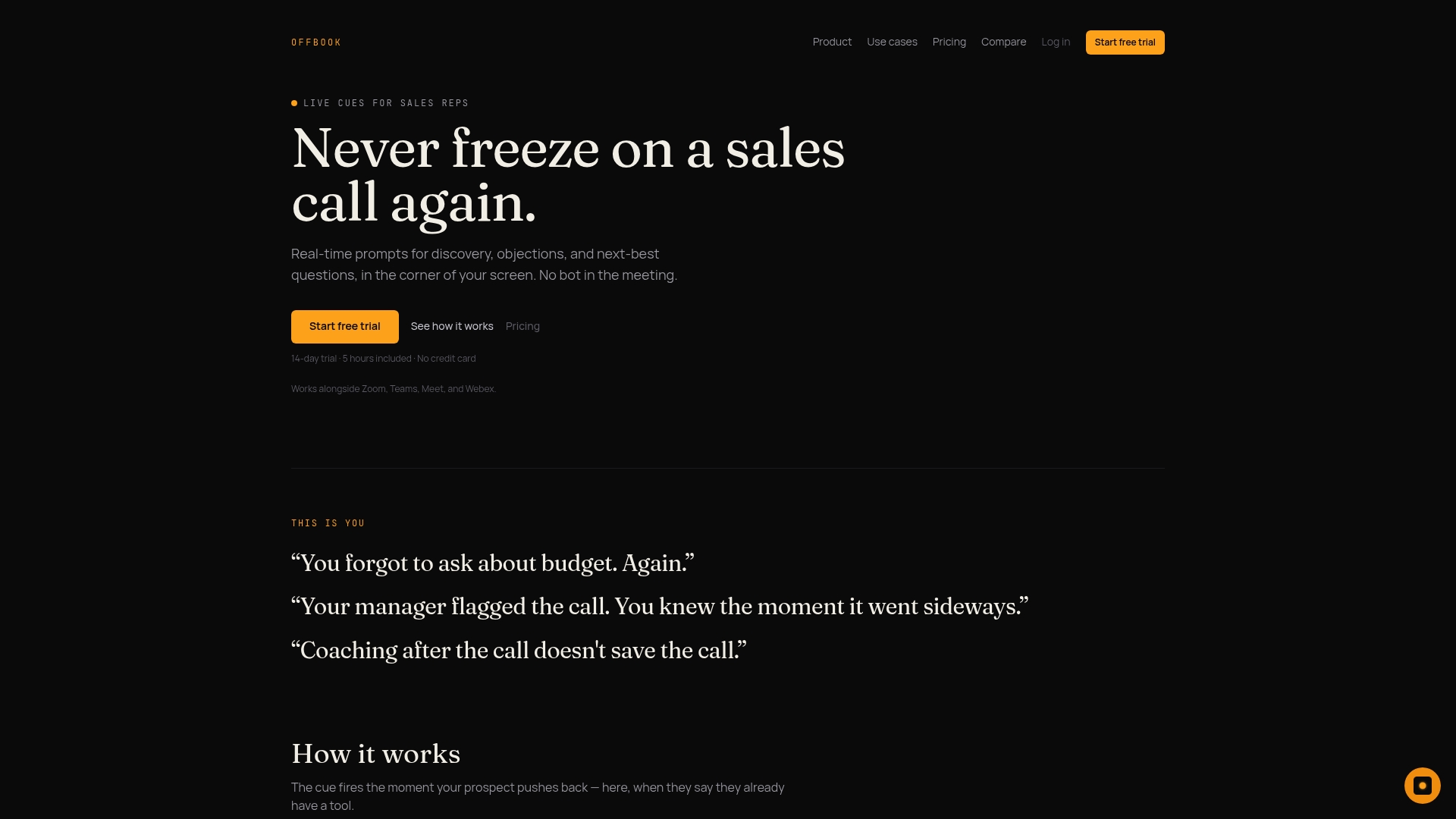
Our Power plan is $59 per month on the pricing page, and the Team plan is $1000 per year per seat on the pricing page. Run your next discovery call with the pillars in front of you.
FAQ
What are some good discovery questions?
Good discovery questions make the buyer explain their reality in their own words, such as “What happens if you do not solve this in six months?” or “Who approves spend like this?” Open-ended questions about metrics, pain, process, and decision-makers give you evidence you can score.
Is MEDDIC outdated?
No. MEDDIC and its extension MEDDPICC remain widely used for complex B2B deals because they force evidence on budget, authority, and process. Practitioners treat them as an operating discipline rather than a script, which is why they still hold up. MEDDIC Academy continues to publish training and certification for the framework.
What are discovery questions?
Discovery questions are the questions you ask early in a sales process to understand the buyer’s problem, goals, stakeholders, and buying process. In MEDDPICC they are organized by pillar so each answer becomes qualification evidence.
What are the 5 W questions in sales?
They are who, what, when, where, and why, applied to the buyer’s situation: who decides, what the problem costs, when they need a fix, where the pain shows up, and why it matters now. They overlap naturally with MEDDPICC and work well as quick follow-ups.
Sources
- MEDDIC Academy Sales Training & MEDDPICC® Certification
- Inside the MEDDPICC methodology — insights from the sales pros who use it
- Gartner
- Hbr