Sales Call Structure for Founders: 2026 Guide
Discover the best sales call structure for founders. Learn how to improve your sales with a proven framework that leads to closing more deals.
Published: June 28, 2026
Author: OffBook Editorial Team

The most effective sales call structure for founders is built around listening first, confirming the prospect’s problem, and closing with a specific next step. Most founders lose deals not because their product is weak, but because they pitch before they diagnose. The discovery call is where deals are won or lost, not the demo. A repeatable, diagnostic call framework is the single most reliable way to move from founder intuition to a predictable sales motion. This guide breaks down the exact structure, preparation steps, execution tactics, and scaling signals you need to close more deals.
What is the optimal sales call structure for founders?
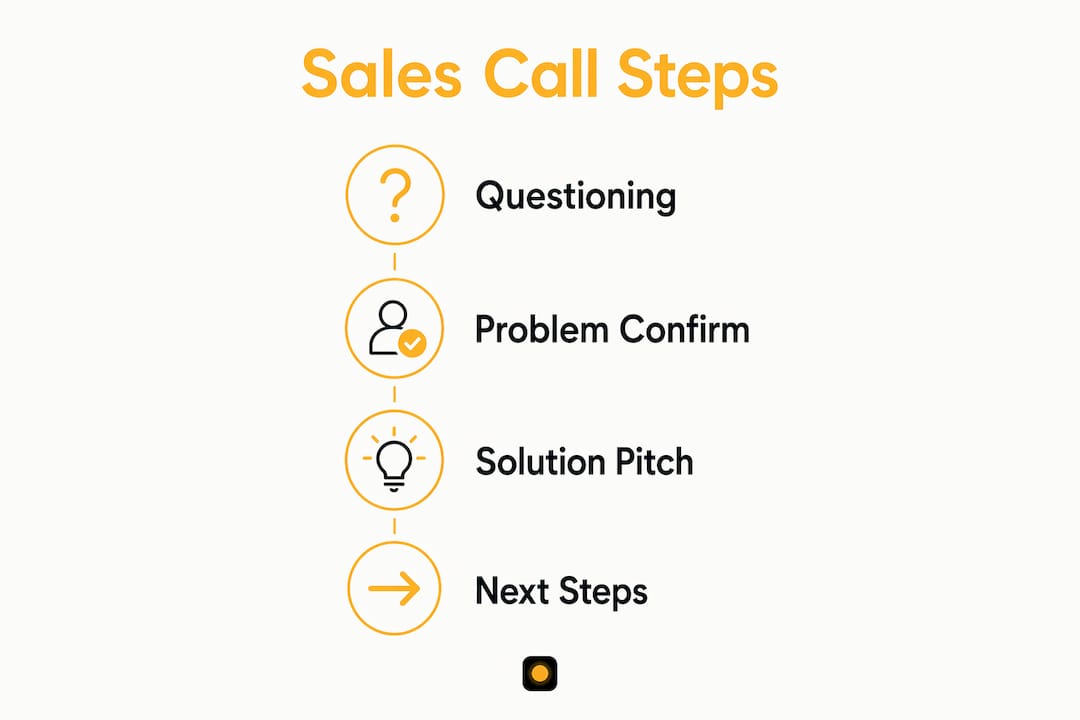
The ideal sales call framework follows a 30-minute format split into four stages: 10 minutes of questioning, 5 minutes of problem confirmation, 10 minutes of solution mapping, and 5 minutes of closing. Analysis of over 350 B2B sales calls shows top-performing teams follow this exact 10-5-10-5 split. That structure forces discipline. It stops founders from spending 25 minutes pitching and 5 minutes asking one rushed question.
The talk ratio matters as much as the time split. Founders should talk no more than 43% of the time, letting prospects drive 57% of the conversation. That ratio is not a soft guideline. It is a measurable signal of whether you are running a diagnostic call or a monologue.
The four stages each serve a distinct purpose.
- Questioning (10 min): Ask open-ended questions about the prospect’s current situation, goals, and frustrations. Do not mention your product yet.
- Problem confirmation (5 min): Paraphrase what you heard. “So it sounds like your team is losing two hours a day to manual reporting, and that’s blocking your quarterly review cycle. Is that right?” This builds trust and sharpens your pitch.
- Solution mapping (10 min): Connect your product directly to the pain points the prospect named. Use their exact language.
- Closing (5 min): Propose a specific next step with two time options. “Can we schedule a 30-minute demo on Tuesday or Thursday this week?”
Pro Tip: Write the prospect’s exact words during the problem confirmation stage. Feeding their language back in the solution mapping phase is the fastest way to make your product feel like it was built for them.
How should founders prepare for a sales call?
Preparation is where most founders underinvest. Walking into a call without knowing the prospect’s role, company stage, or recent news is the equivalent of showing up to a job interview without reading the job description.

The most effective preparation combines research, qualification criteria, and a clear goal for the call. Turn your last three to five closed deals into a qualification checklist. What did those buyers have in common? What pain did they describe first? What objections came up before they signed? That checklist becomes your pre-call filter.
Recording and mapping your best calls to pipeline stages lets you build a playbook that converts individual skills into repeatable frameworks. This is not just useful for training future hires. It forces you to articulate what “good” looks like at each stage.
Pre-call preparation checklist:
- Research the prospect’s company size, funding stage, and recent news
- Review their LinkedIn profile and any prior email or CRM history
- Define the single goal for this call (qualify, book demo, close)
- Prepare two to three open-ended questions tied to their likely pain points
- Set two specific next-step options to propose at the close
- Confirm your tech setup: camera, audio, screen share, and internet connection
| Preparation area | What to do | Why it matters |
|---|---|---|
| Prospect research | Review LinkedIn, company site, and recent news | Tailors your questions to their actual context |
| CRM review | Check prior touchpoints and deal stage | Avoids repeating questions and shows continuity |
| Qualification criteria | Match prospect to your ICP checklist | Saves time on deals unlikely to close |
| Call goal | Define one clear outcome for the call | Keeps the conversation focused and measurable |
| Next step options | Prepare two specific time slots | Removes friction from the close |
| Technical setup | Test audio, video, and screen share | Prevents lost credibility from avoidable tech failures |
For a detailed sales call preparation checklist built specifically for B2B SaaS teams, Offbook’s blog covers each step with examples from seed-stage deals.
What are practical techniques to execute a founder-led sales call?
The opening sets the tone for everything that follows. Start with a collaborative frame, not a pitch. “I’ve done some research on your team, and I have a few hypotheses about what might be slowing you down. I’d love to test them with you.” That sentence signals curiosity, preparation, and respect for the prospect’s time.
The questioning phase is where most founders leave money on the table. Surface-level questions like “What are your biggest challenges?” produce surface-level answers. Go deeper with “why” and cost questions.
- Open with a hypothesis: “I noticed your team scaled from 10 to 40 reps in 18 months. I’m guessing onboarding consistency is a real pain point. Am I close?”
- Ask cost questions: “What does it cost you when a new rep takes four months to ramp instead of two?” This shifts the conversation from feature interest to financial urgency.
- Listen without interrupting: When the prospect is talking, stop forming your next sentence. Write down their exact words. Their phrasing is your pitch.
- Tailor the demo to stated pain: Only show the features that solve the problems the prospect named. A full product tour is a conversion killer.
- Close with a direct ask: Confident, plain requests for the business after discovery are seen as competence, not pushiness. “Based on what you’ve shared, I think we can solve this. Can we move forward with a pilot starting next week?”
- Manage silence: After the close ask, stop talking. Silence is not awkward. It is the prospect thinking. Filling it with nervous chatter is the most common way founders undercut a strong close.
Pro Tip: Avoid pitching product details for the first two-thirds of the call. The prospect’s own language, gathered during questioning, is far more persuasive than any feature description you prepared in advance.
For a deeper look at effective discovery questions that move prospects toward a decision, Offbook’s guide covers the question types that consistently surface buying intent.
How do founders measure sales call effectiveness?
Conversion benchmarks give you a baseline to measure against. Benchmark rates for founder-led funnels are: 30–50% of replies convert to a booked discovery call; 50–70% of discovery calls convert to a demo; 25–40% of proposals convert to a close. If your numbers fall below these ranges, the problem is almost always structural, not product-related.
Talk ratio and call time distribution are the two most diagnostic metrics. If you are talking more than 50% of the time, you are pitching, not diagnosing. If your calls regularly run over 45 minutes without a clear next step, your closing stage is broken.
| Common mistake | What it looks like | Corrective action |
|---|---|---|
| Pitching too early | Describing features before confirming pain | Hold product details until the solution mapping stage |
| Talking too much | Talk ratio above 50% | Ask one question, then stay silent until the prospect finishes |
| Vague next steps | “I’ll follow up next week” | Propose two specific times before ending the call |
| Ignoring decision process | No questions about budget or authority | Ask “Who else needs to be involved in this decision?” |
| Skipping problem confirmation | Moving straight from questions to demo | Paraphrase the problem and get explicit confirmation |
Pro Tip: Review your last five calls and measure your talk ratio. If you do not have recordings, ask a colleague to sit in on your next call and track who is speaking. The data will surprise you.
Tracking how founders measure call effectiveness at each pipeline stage is covered in detail on Offbook’s blog, including which metrics to prioritize at seed versus Series A.
When should founders scale their sales process beyond solo calls?
The right time to hire is determined by volume, not by how tired you are. The hiring sequence for scaling sales is clear: bring in an SDR when you are booking eight or more calls per week; add an Account Executive at five or more demos per week; hire a Head of Sales after 50 customers and a documented playbook. Hiring in the wrong order wastes money and creates churn.
The non-negotiable prerequisite for any hire is owning the full discovery-to-close motion yourself first. If you cannot describe exactly what happens at each stage and what moves a deal forward, you cannot train someone else to do it.
Signals that you are ready to scale:
- You are turning down inbound leads because you lack time
- Your close rate is consistent across at least 20 deals
- You have recorded calls that demonstrate what “good” looks like
- You have documented stage exit criteria in your CRM
| Hire | Trigger | What they own |
|---|---|---|
| SDR | 8+ calls booked per week | Outbound prospecting and meeting booking |
| Account Executive | 5+ demos per week | Discovery to close |
| Head of Sales | 50+ customers, documented playbook | Team management and process ownership |
Building a repeatable sales motion before delegation is the difference between a scalable team and an expensive experiment. Offbook’s guide on early-stage B2B sales covers how to document your process in a format that transfers cleanly to your first hires.
Key takeaways
A disciplined sales call structure for founders requires a diagnostic mindset, a 43:57 talk ratio, and a specific next step at every close.
| Point | Details |
|---|---|
| Follow the 10-5-10-5 framework | Split a 30-minute call into questioning, problem confirmation, solution mapping, and closing. |
| Keep your talk ratio below 43% | Let prospects drive 57% of the conversation to build trust and surface real pain. |
| Prepare a qualification checklist | Turn closed deals into a repeatable filter to qualify prospects before every call. |
| Measure conversion at each stage | Track discovery to demo and proposal to close rates to find where deals break down. |
| Hire by volume, not exhaustion | Bring in an SDR at 8+ calls per week and an AE at 5+ demos per week. |
The diagnostic mindset is the founder’s real advantage
Founders often ask me which part of the call structure matters most. My answer is always the same: the problem confirmation stage. Not the opening, not the demo, not the close. The five minutes where you paraphrase the prospect’s pain and get them to say “yes, that’s exactly it” is where the deal is actually won.
Here is what I have seen repeatedly. Founders who treat discovery as information gathering get polite conversations. Founders who treat it as a diagnostic session get deals. The difference is intent. You are not collecting data to fill out a CRM field. You are trying to understand whether this person has a problem you can solve, whether they feel it urgently, and whether they have the authority and budget to act.
The founder’s real advantage is that you hold three perspectives at once: you know the product deeply, you understand the problem category better than any hired rep, and you are talking to the person experiencing the pain. That combination is rare. A rep hired six months from now will not have it. Use it while you have it.
One more thing on follow-up. Generic check-ins kill momentum. A follow-up that references the specific pain the prospect named, or answers a question they raised on the call, is far more likely to get a response. Value-driven follow-up that ties back to the prospect’s stated priorities sustains deals that would otherwise go cold.
— Neil
How Offbook helps founders run better sales calls
Founders who want to apply this structure consistently face one practical problem: it is hard to stay disciplined in the moment. When a prospect says something unexpected, it is easy to drift into pitching mode or lose track of where you are in the call.
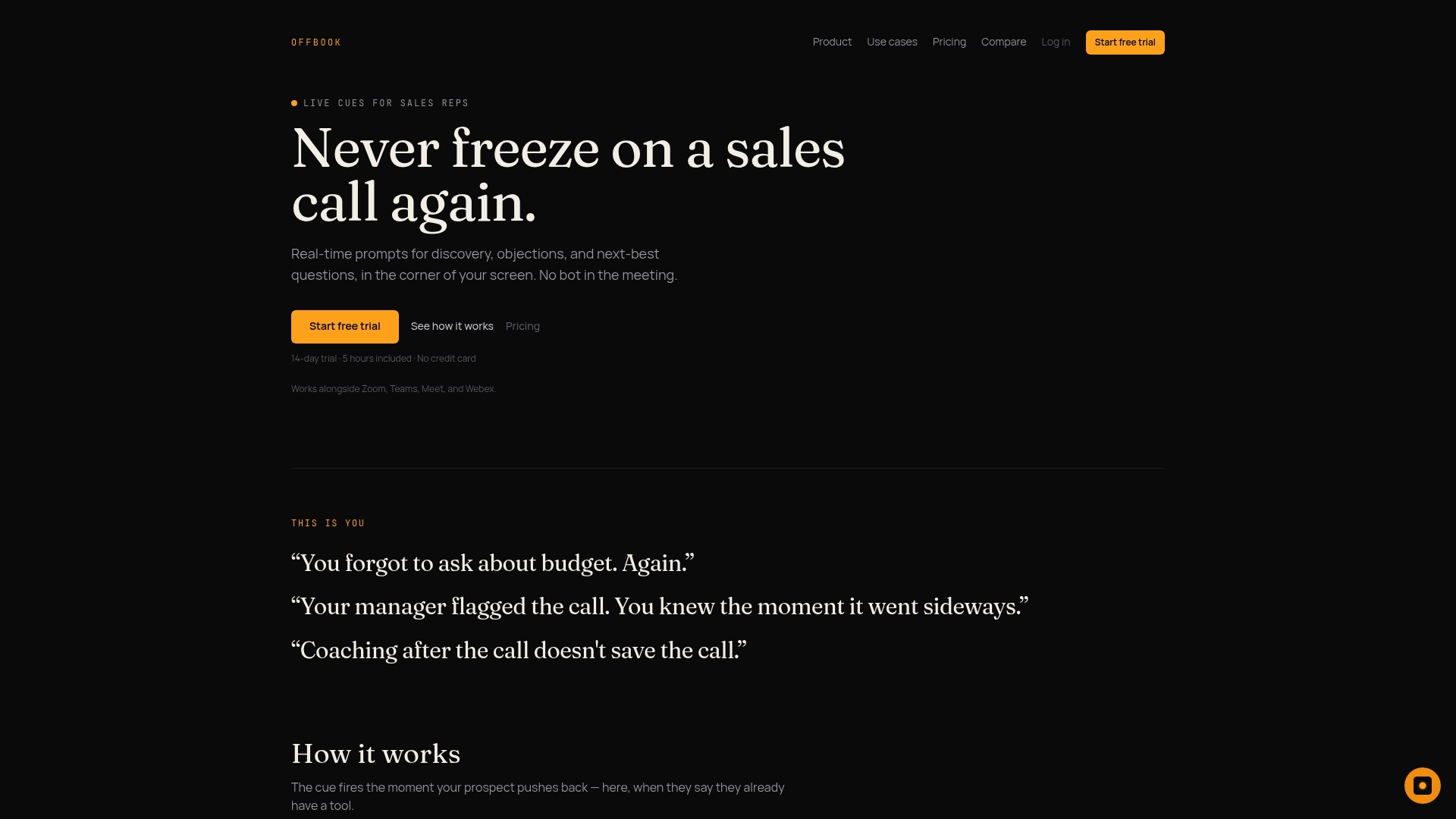
Offbook is real-time AI call coaching built for exactly this situation. It surfaces live prompts on your screen during video calls, without a bot ever joining the meeting. When you are in the questioning phase, Offbook cues you on which gaps to close. When a prospect raises an objection, it prompts the right response. It structures calls around MEDDIC and MEDDPICC so your pipeline data stays clean. Offbook also generates pre-call briefs so you walk in prepared. For seed and Series A founders who want to run tighter calls and close more deals, Offbook’s founder coaching tools are built for your stage.
FAQ
What is the ideal length for a founder sales call?
The ideal discovery call is 30 minutes, split into 10 minutes of questioning, 5 minutes of problem confirmation, 10 minutes of solution mapping, and 5 minutes of closing.
How much should a founder talk on a sales call?
Founders should talk no more than 43% of the time. Letting the prospect drive 57% of the conversation produces better qualification and higher conversion rates.
What conversion rates should founders benchmark against?
Healthy benchmarks for founder-led funnels are 30–50% reply to discovery call booked, 50–70% discovery to demo, and 25–40% proposal to close.
When should a founder stop running all sales calls themselves?
Hire an SDR when you are booking eight or more calls per week. Add an Account Executive at five or more demos per week. Both hires require a documented sales playbook before you delegate.
What is the most common mistake founders make on sales calls?
Pitching too early is the most damaging mistake. Founders who describe product features before confirming the prospect’s pain lose the diagnostic advantage that makes founder-led sales effective.