Sales Handoff Process: A Practical Guide for Sales & CS Teams
Discover how to streamline your sales handoff process with practical steps for smoother transitions and enhanced customer success. Learn more!
Published: August 9, 2026
Author: OffBook Editorial Team

Sales Handoff Process: A Practical Guide for Sales & CS Teams
A sales handoff process is the formal, timed transfer of ownership, context, and responsibility for a lead or closed deal from one role or team to the next. Done right, it runs in four stages: pre-close preparation, internal deal transfer, customer introduction, and kickoff ownership transfer.
Here is the BLUF every sales and CS team should post in their Slack channel:
- Pre-close prep: AE documents the deal narrative, stakeholder map, and open commitments before the contract is signed.
- Deal transfer: Internal handoff record submitted and a 30-minute briefing call with the CSM completed within 24 hours of Closed Won.
- Customer introduction: AE sends a personal warm intro email connecting the customer to their CSM within 48 hours.
- Kickoff ownership transfer: CS-led kickoff call scheduled and completed within 5 business days of close.
The deal is not done when the contract is signed. It is done when the CSM owns a 90-day success plan and the customer has had their first structured conversation with the team that will actually deliver on what was promised.
Key Takeaways
A clean sales handoff process requires four stages, three SLAs, and one non-negotiable rule: the CSM does not get assigned until the handoff record is complete.
| Point | Details |
|---|---|
| Four-stage framework | Run pre-close prep, internal transfer, customer intro, and kickoff in sequence with named owners. |
| SLAs to enforce | Handoff record and briefing call within 24 hours; AE intro email within 48 hours; kickoff within 5 business days. |
| Gate CSM assignment | Make CSM assignment conditional on a completed handoff record to prevent skipped transfers. |
| Capture the deal narrative | Document why the customer bought and what was promised during the sales cycle, not just contract facts. |
| Track lead indicators | Monitor time-to-first-CS-contact and handoff acceptance rate monthly to catch process drift early. |
Table of Contents
- What is the sales handoff process, and where does it happen?
- Why a poor handoff costs you more than you think
- What types of handoffs exist, and what triggers them?
- How to execute the sales handoff process in four stages
- What goes into a handoff record?
- Who owns what, and when?
- What goes wrong in handoffs, and how do you fix it?
- Which metrics tell you if your handoffs are working?
- Which tools make handoffs repeatable?
- The evidence behind the four-stage framework
- How small, founder-led teams can run this without a RevOps team
- A perspective on what most teams get wrong
- Sources
What is the sales handoff process, and where does it happen?
A sales handoff, sometimes called a sales transition, is a structured transfer of three things: information, ownership, and timing. All three must move together. A handoff that transfers information but leaves ownership ambiguous is just a file dump. One that sets a clear owner but skips context forces the customer to repeat themselves, which erodes trust before the relationship has started.
Handoffs happen at several points across the buyer journey, and each one has a distinct character.
Marketing to Sales (MQL to SQL): A marketing-qualified lead crosses a score threshold or takes a high-intent action (books a demo, requests pricing), and ownership moves from the marketing team to a sales development rep or AE. The trigger is usually automated, but the context transfer is not. The SDR needs to know what content the lead consumed, what pain point drove the conversion, and what the lead’s company profile looks like.
SDR to AE: After an SDR qualifies a prospect and books a discovery call, the account executive takes over. This handoff is often underbuilt. A good SDR-to-AE transfer includes a short written brief covering the prospect’s stated problem, the conversation history, and any objections already surfaced. Without it, the AE walks into the discovery call cold, which wastes the credibility the SDR spent weeks building.
AE to CS (Closed Won to Onboarded): This is the handoff that carries the most revenue risk and the most operational complexity. It is the dominant focus of this playbook. The AE transfers a paying customer to the customer success team, and the quality of that transfer directly shapes whether the customer reaches their first value milestone, renews, and expands.
The three core elements of a good handoff are consistent across all three types: complete information transfer (the deal narrative, not just contract facts), unambiguous ownership (one person is accountable at each stage), and a defined SLA (a specific time window, not “soon”).
Why a poor handoff costs you more than you think
The commercial case for investing in handoff quality is straightforward. ReWork reports that poor handoffs can contribute to 30–40% of first-year churn, while clean transitions can lift retention by roughly 25% and expansion by roughly 40%. These are practitioner-sourced estimates, not controlled trial results, but the direction is consistent with what CS leaders observe operationally: customers who experience a disjointed handoff arrive at onboarding skeptical, and skeptical customers churn faster.
The mechanism is not mysterious. When a customer signs a contract, they have just made a bet on your team. A clumsy handoff signals that the team they bet on is not coordinated. The AE who knew their business disappears. A stranger from CS sends a generic welcome email. The customer starts to wonder whether the promises made during the sales cycle will actually be kept.
Forrester frames the ideal handoff as a “baton pass” where the customer experiences a seamless journey and never feels the contact change. Aligning sales and CS on a shared transition framework increases the odds customers gain value, stay loyal, and expand. That alignment does not happen by accident. It requires a documented process, role-specific SLAs, and a shared definition of what “done” means.
The practical implication: invest in process before tooling. A CRM with handoff automation built on top of an undefined process just automates the chaos. Get the stages, owners, and SLAs agreed on first.
Pro Tip: Redefine “closed” for your AE team. A deal is not closed when the contract is signed. It is closed when the handoff record is submitted, the CSM briefing call is done, and the intro email is sent. Tie commission release or quota credit to handoff completion, not signature date, and watch completion rates climb.
What types of handoffs exist, and what triggers them?
Understanding which handoffs your team runs, and what starts each one, is the prerequisite for building repeatable triggers. Vague triggers (“when the deal feels ready”) produce inconsistent handoffs. Specific triggers produce consistent ones.
Common handoff types:
- Marketing to Sales: Triggered by a lead score threshold, a demo request, or a high-intent content action. Ownership moves from marketing ops to SDR or AE.
- SDR to AE: Triggered by a qualified meeting booked, typically after the SDR confirms budget authority, pain, and timeline. The AE receives a written brief before the discovery call.
- AE to CS: Triggered by contract signature (Closed Won stage in CRM). This is the handoff with the highest stakes and the most structured requirements.
What makes a trigger automatic versus human-reviewed?
For low-ACV, high-volume deals, automated triggers work well. When a deal hits Closed Won in the CRM, a workflow fires: the handoff record template populates, the CSM is assigned, and an SLA clock starts. No human needs to initiate it.
For mid-to-high-ACV deals or technically complex integrations, a human-reviewed handoff is worth the extra time; learn more in How to Build a Healthcare SaaS Go-to-Market Strategy. The AE and CSM should have a live briefing call, not just exchange a document. The nuance in a complex deal, the politics around the champion, the unstated priorities of the economic buyer, does not survive a form submission alone.
Automated vs. human-reviewed handoffs:
- Automated: Fast, consistent, low overhead. Best for deals under your internal ACV threshold with standard implementation paths. Risk: context loss if the handoff record is thin.
- Human-reviewed: Slower, higher-touch, better context transfer. Required for deals above your ACV threshold, multi-stakeholder accounts, or any deal with custom commitments. Risk: process drift if the briefing call is skipped under pressure.
A practical rule: set an ACV threshold; many B2B SaaS teams use a rough dividing line, and require a live briefing call for every deal above that threshold. Below that line, a completed handoff record and the AE-written intro email are both required. The AE intro email is non-negotiable for all deals, regardless of size.
How to execute the sales handoff process in four stages
The four-stage Closed-Won to Onboarded framework from ReWork gives every team a repeatable sequence with clear owners and time-bound SLAs. Here is how to run it.
Stage 1: Pre-close preparation (owner: AE)
Before the contract is signed, the AE starts building the handoff record. This is not a post-signature task. The deal narrative is freshest during the sales cycle, and waiting until after close means reconstructing context from memory.
Pre-close prep includes: documenting the champion and economic buyer, capturing the customer’s stated business objectives and success criteria, logging any commitments or promises made during the sales cycle, and flagging open technical or integration questions.
Deliverable: A completed (or near-complete) handoff record in the CRM. SLA: Completed before or at contract signature.
Stage 2: Internal deal transfer (owner: AE + CSM)
Within 24 hours of Closed Won, two things happen: the handoff record is formally submitted, and the AE and CSM hold a 30-minute internal briefing call. The written record captures facts. The call captures tone, relationship dynamics, and the unstated priorities that never make it into a form field.
Deliverable: Submitted handoff record + completed internal briefing call. SLA: Within 24 hours of Closed Won.
Stage 3: Customer introduction (owner: AE)
The AE writes and sends a personal warm intro email to the customer within 48 hours of close. Not a system-forwarded template. Not a CC on a CRM notification. A real email, written by the AE, that introduces the CSM by name, connects the CSM’s role to the customer’s specific goals, and sets the tone for the next conversation.
Sample intro email:
Hi [Customer Name], I wanted to personally introduce you to [CSM Name], who will be your primary point of contact as you get started. [CSM Name] is already up to speed on your goals around [specific objective], and I’ve shared everything we discussed about [key priority]. You’re in great hands. [CSM Name] will reach out shortly to schedule your kickoff call. Don’t hesitate to loop me in anytime.
Deliverable: AE-written warm intro email sent to the customer. SLA: Within 48 hours of Closed Won.
Stage 4: Kickoff ownership transfer (owner: CSM)
The CSM schedules and leads the kickoff call within 5 business days of close. This call formally transfers the customer relationship to CS, confirms the 90-day success plan, and sets the first milestone. After this call, the CSM owns the account.
Deliverable: CS-led kickoff call completed, 90-day success plan confirmed. SLA: Within 5 business days of Closed Won.
SLA summary
| Stage | Owner | Deliverable | SLA |
|---|---|---|---|
| Pre-close prep | AE | Completed handoff record | Before/at contract signature |
| Internal deal transfer | AE + CSM | Handoff record submitted + briefing call | Within 24 hours of Closed Won |
| Customer introduction | AE | Warm intro email to customer | Within 48 hours of Closed Won |
| Kickoff ownership transfer | CSM | Kickoff call + 90-day success plan | Within 5 business days of Closed Won |
What goes into a handoff record?
A handoff record is the structured document that travels from AE to CSM. It is not a contract summary. Its job is to give the CSM everything they need to run a productive first meeting without asking the customer to repeat themselves.
AVOMA’s playbook recommends organizing the record into eight sections, each flagged as Confirmed, Unclear, or Not Discussed. That flagging system is worth adopting: it tells the CSM exactly where the gaps are before the kickoff call, not during it.
| Field | Purpose | Example value |
|---|---|---|
| Champion name and title | Who drove the internal buy decision | “Sarah Chen, VP of Revenue Operations” |
| Economic buyer | Who signed off on budget | “CFO, involved in final negotiation” |
| Business objectives | What the customer is trying to achieve | “Reduce sales cycle length by 20% in 6 months” |
| Success criteria | How they will measure value | “First rep onboarded and running calls in week 2” |
| Commitments made | Promises from the AE during the sales cycle | “Custom onboarding session for the SDR team” |
| Technical requirements | Integrations, security, data needs | “Salesforce CRM integration required at launch” |
| Timeline and go-live | Target dates and milestones | “Go-live by end of Q2” |
| Risks and open items | Unresolved questions or concerns | “Legal review of data processing agreement pending” |
The champion description should be one sentence: who they are, what they care about, and what political capital they spent to get the deal done. The 90-day success criteria should be equally specific: not “they want to see ROI” but “they want three reps running structured calls using MEDDIC by day 60.”
Pro Tip: Capture the deal narrative during the sales cycle, not after. The story of why the customer bought, what alternatives they considered, and what finally tipped the decision is the most valuable context you can give a CSM. JB Barrows argues that this narrative matters more than any checklist field because it helps the CSM understand unstated priorities and run a first meeting that feels like a continuation, not a restart. Tools that surface context in real time during calls, like deal advancement techniques built into your sales workflow, make this capture far less painful.
Who owns what, and when?
Clear role ownership is what separates a handoff process from a handoff hope. Every stage needs a named owner, a specific deliverable, and an acceptance gate.
Core roles and responsibilities:
- SDR: Delivers a qualified meeting brief to the AE before the first discovery call. Responsible for documenting conversation history, stated pain, and any objections already surfaced.
- AE: Owns the handoff record, the internal briefing call, and the warm intro email. The AE’s job is not done at signature.
- AE Manager: Reviews handoff record completeness before CSM assignment is confirmed. Acts as the escalation point if the AE misses SLAs.
- CSM: Accepts the handoff by confirming the record is complete and the briefing call has happened. Owns the kickoff call and the 90-day success plan from that point forward.
- Onboarding/Implementation Lead: Joins the kickoff call for technically complex deals. Owns the technical workstream from kickoff through go-live.
- RevOps: Maintains the CRM workflow, SLA tracking, and handoff record template. Runs monthly ops reviews using handoff quality metrics.
Acceptance criteria for the CSM:
Before accepting a handoff, the CSM should confirm:
- The handoff record is complete (no critical fields blank or marked “Not Discussed” without explanation).
- The internal briefing call has occurred or is scheduled within the SLA window.
- The champion and economic buyer are identified by name.
- At least one business objective and one success criterion are documented.
- All commitments made during the sales cycle are logged.
If a blocking gap exists, the CSM should return the handoff to the AE with a specific list of what is missing. This is not a bureaucratic move. It protects the customer from a kickoff call where the CSM is guessing.
Conditional handoffs by ACV:
For deals above your internal ACV threshold, require a joint pre-close call between the AE and CSM before the contract is signed. This gives the CSM a chance to ask questions while the AE still has the customer’s ear, and it surfaces integration or implementation concerns before they become post-close surprises.
What goes wrong in handoffs, and how do you fix it?
Most handoff failures are not caused by bad intent. ReWork identifies process drift, missing context, and unclear accountability as the dominant failure modes, all of which are fixable with the right gates and incentives.
Common failures and their fixes:
- AE goes dark after close. The AE considers the deal done and stops responding. Fix: make the warm intro email a required step before quota credit is released. The AE cannot move on until the intro is sent.
- Incomplete handoff record. The record is submitted with blank fields or vague entries. Fix: gate CSM assignment on a complete record. If the record is incomplete, the CRM workflow does not assign a CSM and the SLA clock does not start.
- Missing internal briefing call. The AE submits the record but skips the call. Fix: require the CSM to log call completion in the CRM as an acceptance action. No log, no accepted handoff.
- Conflicting promises. The customer arrives at kickoff expecting something the CSM has never heard of. Fix: add a “commitments made” field to the handoff record and make it mandatory. Any promise the AE made during the sales cycle goes there, no exceptions.
The single most effective operational rule: make CSM assignment conditional on a completed handoff record. This one gate removes the option to skip the transfer and forces the AE to treat documentation as part of closing, not as optional paperwork.
Pro Tip: Run a monthly “handoff audit” with your RevOps or CS lead. Pull the last 10 Closed Won deals and check: Was the record complete? Was the intro sent within 48 hours? Did the kickoff happen within 5 business days? Three data points per deal, ten minutes of review, and you will spot process drift before it shows up in churn numbers.
Which metrics tell you if your handoffs are working?
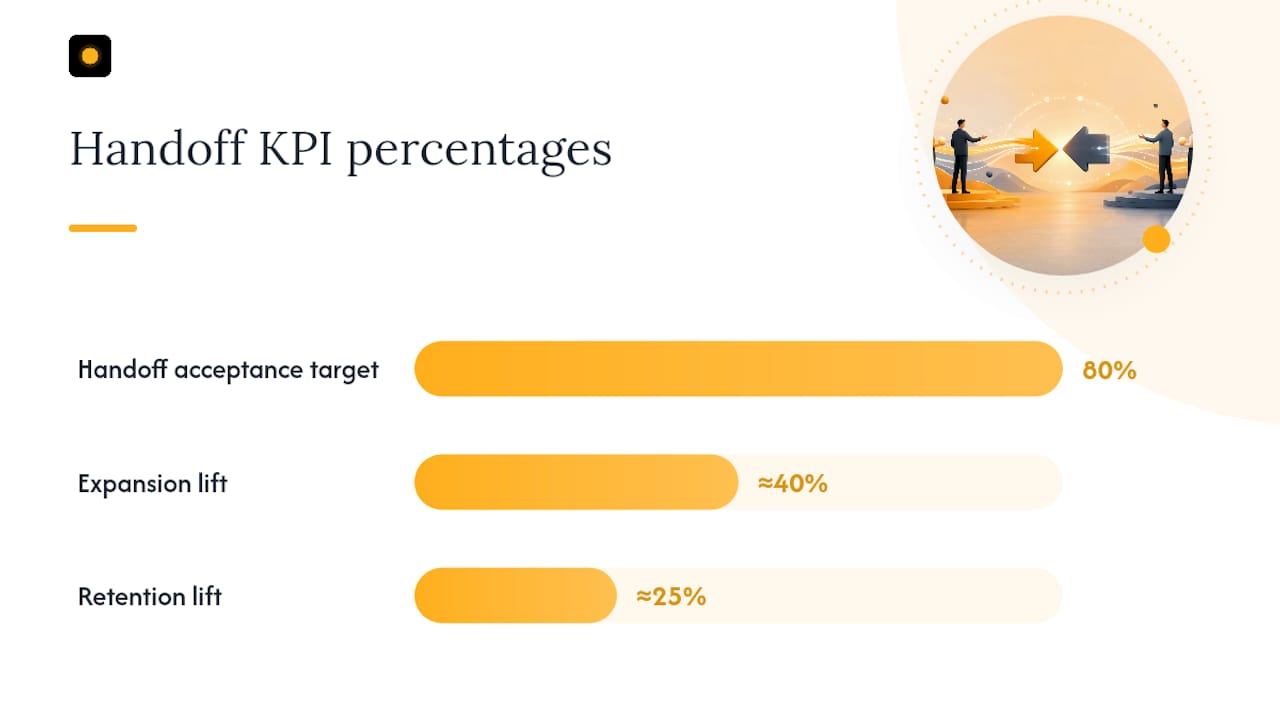
Tracking handoff quality requires a small, focused set of KPIs. More than six metrics and the dashboard becomes noise. Fewer than three and you miss early signals of process drift.
Core KPIs:
- Time-to-first-CS-contact: How long from Closed Won until the CSM makes first contact with the customer. Target: within 48 hours (intro email) and within 5 business days (kickoff call).
- Handoff acceptance rate: Percentage of handoffs accepted by the CSM without being returned for missing information. A rate below 80% signals a systemic documentation problem.
- Onboarding completion rate: Percentage of customers who complete the defined onboarding milestones within the agreed timeline. Low completion often traces back to a poor handoff.
- 30/90-day NPS: Customer satisfaction scores at 30 and 90 days post-close. A sharp drop between 30 and 90 days often indicates the kickoff set wrong expectations.
- Churn attributed to poor handoff: Track the stated reason for early churn (first 90 days). If “poor onboarding experience” or “unmet expectations” appear repeatedly, the handoff is the upstream cause.
- Time from Closed Won to kickoff: The total elapsed time from contract signature to the CS-led kickoff call. Target: 5 business days or fewer.
Secondary signals worth watching:
- Number of clarification questions the CSM sends to the AE after accepting the handoff. More than two or three per deal means the record is consistently thin.
- Reopened handoffs (handoffs returned to the AE for missing information). Track by AE to identify who needs coaching.
- Average handoff record completion time. If AEs are spending more than 20 minutes on the record, the template is too long or the fields are unclear.
For monthly ops reviews, pull time-to-first-CS-contact and handoff acceptance rate as the lead indicators. They tell you whether the process is running before the lagging indicators (NPS, churn) have time to surface.
Practitioner data from ReWork suggests that clean handoffs can lift retention by roughly 25% and expansion by roughly 40% compared to unstructured transitions. These figures come from aggregate practitioner estimates, not a controlled study, but they align with what CS leaders consistently observe: customers who experience a smooth transition arrive at onboarding ready to engage, not ready to doubt.
Which tools make handoffs repeatable?
The right tool stack for handoffs is smaller than most teams think. The goal is to make the right thing the easy thing: completing the record, scheduling the call, sending the intro. Complexity in the tooling usually means complexity in the process underneath it.
Tool categories that matter:
- CRM workflow automation (HubSpot, Salesforce): Trigger handoff record creation on Closed Won, assign the CSM, start the SLA clock, and send reminder notifications when deadlines approach. HubSpot Academy’s handoff playbook covers documentation practices and internal workflow setup in detail.
- Internal handoff forms: A structured form (built in the CRM or a shared doc) that the AE completes before the briefing call. Fields map directly to the handoff record template.
- Shared docs and wikis: For teams not yet running everything in a CRM, a shared Google Doc or Notion template works. The key is a single canonical location, not email threads.
- Scheduled internal sync calls: A standing 30-minute slot between AE and CSM within 24 hours of close. Block it in the calendar at deal stage, not after signature.
- AI-assisted pre-call briefs and live coaching: Tools that capture deal context during the sales cycle, not after, reduce the reconstruction problem significantly. Offbook’s pre-call briefs and live in-call coaching surface the right questions and qualification gaps during discovery and negotiation calls, so the deal narrative is built in real time rather than assembled from memory at close. That context flows directly into the handoff record without the AE having to reconstruct it.
Automation recipes worth building:
- Trigger-based handoff record creation: When a deal moves to Closed Won in the CRM, a workflow creates the handoff record and assigns it to the AE with a 24-hour deadline.
- SLA escalation notifications: If the handoff record is not submitted within 24 hours, the AE manager gets an automatic alert.
- Intro email draft generation: Some CRM workflows can pre-populate a draft intro email with the customer name, CSM name, and key objective pulled from the handoff record. The AE personalizes and sends.
- Acceptance gating: The CSM cannot move the deal to “Onboarding” stage in the CRM until they log handoff acceptance. This creates an auditable trail.
When not to automate: High-ACV deals and accounts with sensitive technical integrations need a human briefing, not just a workflow. Automation handles the logistics. It cannot replace the judgment call about which risks to flag and how to frame the customer relationship for the incoming CSM. For those deals, the briefing call is the handoff. The record is the backup.
For teams building out their sales coaching technology stack, the principle is the same: use tools that capture context when it is generated, not tools that ask you to reconstruct it later.
The evidence behind the four-stage framework
The four-stage Closed-Won to Onboarded approach is not a theoretical construct. It is grounded in practitioner research and operational playbooks from teams that have run it at scale.
ReWork’s step-by-step handoff process provides the structural backbone: pre-close prep, deal transfer within 24 hours, intro within 48 hours, kickoff within 5 business days. These SLAs are not arbitrary. They reflect the window during which customer confidence is highest and the cost of a gap is lowest. A customer who waits two weeks for their first CS contact has already started to doubt.
AVOMA’s playbook adds the operational rigor: a gap and risk log with assigned owners and severity levels, formal acceptance criteria, and the option to return handoffs with blocking gaps. This acceptance gate is what prevents the process from becoming a rubber stamp.
JB Barrows makes the case that documentation alone is insufficient. The deal narrative, the story of why the customer bought, what alternatives they considered, and what finally tipped the decision, matters more for CSM readiness than any checklist field. A CSM who understands the narrative can run a first meeting that feels like a continuation. One who only has the contract facts has to start over.
“Aligning sales and CS on a shared transition framework increases the odds customers gain value, stay loyal, and expand.” Forrester frames this as the “baton pass” principle: the customer should never feel the contact change.
The SLAs in this playbook of 24 hours, 48 hours, and 5 business days map directly to the evidence. The 24-hour internal transfer prevents the post-close vacuum. The 48-hour intro preserves relationship momentum. The 5-business-day kickoff keeps the customer engaged before skepticism sets in.
How small, founder-led teams can run this without a RevOps team
Most of this playbook was written with a RevOps function in mind. But founder-led teams at seed and Series A can run a clean handoff process with a fraction of the infrastructure. The principles are the same. The tools are lighter.
Start with a single Google Doc or Notion template that covers the eight handoff record fields. Share it in your sales channel. Every AE (or founder doing sales) fills it out before the kickoff call. No CRM automation required at first. The discipline of filling out the form is more valuable than the automation that enforces it.
For the internal briefing call, block a standing 30-minute slot in the calendar the moment a deal reaches late-stage. Do not wait for Closed Won. If the deal closes, the slot is already there. If it does not, cancel it. This removes the scheduling friction that causes the 24-hour SLA to slip.
The AE intro email is non-negotiable even for small deals. Write it yourself. Two paragraphs. Name the CSM, connect them to the customer’s specific goal, and signal continuity. A system-generated welcome email does the opposite of what you want.
For deals above your internal ACV threshold (even if that threshold is $5,000 ARR for an early-stage team), require a live briefing call. Below that line, a completed handoff record plus the intro email is enough. As you scale, add CRM gating and SLA automation. Keep manual checks in place for your highest-value accounts regardless of how automated the rest of the process becomes.
Offbook’s AI coaching for customer success is built for exactly this kind of resource-constrained environment: live cues and pre-call briefs that capture deal context during the call, so the handoff record writes itself rather than requiring a separate documentation session after close.
A perspective on what most teams get wrong
The handoff process gets treated as a documentation problem. Teams build longer templates, add more fields, and wonder why completion rates stay low and churn stays high.
The real problem is incentive misalignment. AEs are measured on closed revenue. The moment the contract is signed, their attention moves to the next deal. Everything that happens after signature, the briefing call, the intro email, the handoff record, competes with the next quota target. No amount of template design fixes that.
The teams that run clean handoffs have solved the incentive problem first. They tie commission release or quota credit to handoff completion. They make the CSM’s acceptance a required CRM step before the deal moves to “Onboarded.” They treat the AE’s job as ending at kickoff, not at signature.
The second thing most teams underestimate is the value of the deal narrative. JB Barrows is right that a CSM who understands why a customer bought can run a completely different first meeting than one who only has the contract terms. The narrative is not a nice-to-have field. It is the difference between a kickoff call that builds momentum and one that restarts the sales process from scratch.
For founder-led teams, the shortcut is to capture the narrative during the sales call itself, not after. Tools that surface context in real time, during the discovery call, the negotiation, the final close conversation, make the handoff record a byproduct of good selling rather than a separate documentation burden. That is the shift worth making.
Sources
The sources below form the research backbone of this playbook. Each one is worth reading in full if you are building or rebuilding your handoff process.
- From sprint to marathon: passing the baton from sales to CS for seamless account transitions — Forrester
- Sales handoff — JB Barrows
- Sales-to-CS handoff: The Final Step in Deal Closing — ReWork Resources
- Managing Your Sales to Customer Success Handoff — HubSpot Academy