B2B Discovery Call Questions List for Sales Pros
Unlock successful sales with our B2B discovery call questions list. Diagnose needs and drive conversations that close deals effectively.
Published: July 9, 2026
Author: OffBook Editorial Team

A B2B discovery call questions list is a curated set of open-ended questions designed to diagnose buyer needs, reveal pain points, and guide the sales conversation toward qualification and closing. The best reps don’t wing it. Top performers ask 11–14 questions per call and hold a 30/70 to 40/60 talk-to-listen ratio, based on analysis of over 500,000 sales calls. The most effective call structure follows a five-part sequence: Situation, Problem, Implication, Vision, and Decision Process. Each stage builds on the last, turning a conversation into a diagnostic session that moves deals forward.
1. How to prepare for a B2B discovery call
Preparation is the single biggest predictor of call quality. A rep who walks in cold asks generic questions. A rep who researches first asks questions that make the buyer feel understood.

Industry-standard pre-call research takes 10–15 minutes for SMB and mid-market accounts and 15–20 minutes for enterprise deals. That time investment directly shapes how specific and relevant your questions will be. Skipping it is the fastest way to lose credibility in the first two minutes.
Five research areas cover everything you need before a call:
- Company snapshot: Revenue range, headcount, industry, and recent growth signals
- LinkedIn profiles: Roles, tenure, and career history of every attendee
- Trigger events: Recent funding rounds, executive hires, product launches, or press coverage
- Pain point hypothesis: A working theory about the problem you expect them to have
- CRM and call history: Notes from any prior conversations, objections raised, or commitments made
Trigger event research is the most underused of the five. A company that just raised a Series B has different pressures than one that just lost its VP of Sales. Knowing that before the call lets you frame questions around what actually matters to them right now.
Pro Tip: Build a simple stakeholder map before each call. List every attendee, their role, and their likely priority. This tells you whose pain to probe first and whose approval you will need later.
Offbook automates this step by generating pre-call briefs on the companies and people a rep is about to meet, so reps walk in with context already loaded.
2. What is the right number of questions to ask?
The number of questions matters less than most reps think. The sequence and depth matter far more.
Top performers ask 11–14 questions per call, with roughly 80% of those being open-ended. That ratio is not accidental. Open-ended questions give buyers room to reveal information you did not know to ask for. Closed questions shut that door.
The five-part sequence that produces the best results:
- Situation questions to understand the current state
- Problem questions to surface pain and friction
- Implication questions to measure the cost of that pain
- Vision questions to explore what success looks like
- Decision Process questions to map stakeholders, criteria, and timelines
Effective discovery calls follow this structured sequence because each stage logically sets up the next. You cannot ask a meaningful implication question until you have confirmed the problem exists. Skipping ahead creates confusion and makes buyers feel interrogated rather than understood.
Modern B2B discovery guidance is clear: avoid BANT-style yes/no questions. “Do you have a budget?” kills momentum. “How does your team typically evaluate and fund initiatives like this?” opens a conversation. The best questions start with “What,” “How,” or “Walk me through.”
Pro Tip: After every short answer, ask one probing follow-up before moving to the next topic. “Tell me more about that” is the most underrated phrase in B2B sales. It signals that you are listening and often surfaces the real pain.
3. B2B discovery call questions list by stage
The most effective way to use a discovery call checklist is to organize questions by intent, not by topic. Here is a curated list structured around the five-stage sequence.
Situation questions
These establish current context. Keep them brief. You are not interrogating; you are orienting.
- “Walk me through how your team currently handles [relevant process].”
- “What does your tech stack look like for [relevant function]?”
- “How long have you been running things this way?”
- “Who owns this process day to day?”
Problem questions
These surface friction. The goal is to get the buyer to name the pain in their own words.
- “What is the biggest challenge you are running into with [current process]?”
- “Where does the current approach break down most often?”
- “What have you tried before to fix this, and what happened?”
- “What keeps you up at night about this area of the business?”
Implication questions
These are the most powerful questions on any B2B call. They connect the problem to real business cost.
- “What does it cost you when [problem] happens?”
- “How does this affect your team’s ability to hit [relevant goal]?”
- “If this problem continues for another year, what does that mean for the business?”
- “How much time does your team lose to this each week?”
Vision questions
These shift the conversation from pain to possibility. Buyers start to picture the outcome.
- “What would success look like six months from now if this were solved?”
- “How would fixing this change how your team operates?”
- “What would you be able to do that you cannot do today?”
Decision Process questions
These are the questions most reps avoid because they feel uncomfortable. They are also the questions that separate deals that close from deals that stall.
- “Who else needs to be involved in a decision like this?”
- “What does your evaluation process typically look like?”
- “What criteria matter most when you are choosing a solution?”
- “What would need to be true for you to move forward in the next 30 days?”
Grouping questions by intent increases call effectiveness because it keeps the conversation coherent. Buyers follow a logical thread instead of feeling like they are jumping between topics. Asking about cost, stakeholders, and blockers is what moves deals forward, not just confirming that a problem exists.
| Stage | Purpose | Example question |
|---|---|---|
| Situation | Understand current state | “Walk me through how you handle X today.” |
| Problem | Surface pain points | “Where does the current approach break down?” |
| Implication | Measure business cost | “What does it cost when this problem happens?” |
| Vision | Explore desired outcomes | “What would success look like in six months?” |
| Decision Process | Map stakeholders and timeline | “Who else needs to be part of this decision?” |
4. How to tailor questions to different buyer personas
The same question lands differently depending on who is in the room. A CFO cares about cost and risk. A VP of Engineering cares about implementation and reliability. A frontline manager cares about daily friction. Your questions need to reflect that.
Expert reps use discovery diagnostically to validate a pain hypothesis linked to measurable outcomes. That means entering each call with a working theory about what the buyer’s problem is, then using questions to test it. This is fundamentally different from running through a generic list.
Three persona types require different question approaches:
- Executive stakeholders: Focus on business impact, risk, and strategic priorities. Ask about goals and what happens if the problem is not solved. Avoid operational detail unless they bring it up.
- Technical stakeholders: Go deeper on current systems, integration requirements, and implementation concerns. Ask about what breaks and how often.
- Operational stakeholders: Focus on day-to-day friction. Ask about workarounds, time lost, and what a better process would feel like.
Before asking a sensitive question, use a brief permission frame. “Can I ask you something that might feel direct?” signals respect and almost always gets a yes. It also makes the buyer more likely to answer honestly. For more on tailoring questions by persona, the approach differs significantly across deal types and company stages.
Avoid treating your question list as a script. Discovery calls succeed when reps follow a flexible thinking sequence, probing answers before moving to the next topic. The list is a map, not a railroad track. You need to know where you are going, but the path adjusts based on what the buyer tells you.
For reps who want a full pre-call preparation checklist, building one around these persona categories is the fastest way to improve call consistency across the team.
Understanding your buyer’s internal decision-making structure also matters. Mapping key stakeholders and decision makers before the call tells you which questions to prioritize and who controls the final yes.
Key takeaways
The most effective B2B discovery call questions list follows a five-stage sequence, uses 11–14 open-ended questions, and is tailored to the specific persona and pain hypothesis before the call begins.
| Point | Details |
|---|---|
| Prepare before every call | Spend 10–20 minutes on company research, trigger events, and a pain hypothesis. |
| Ask 11–14 open-ended questions | Top performers maintain an 80% open-ended question ratio per call. |
| Follow the five-stage sequence | Situation, Problem, Implication, Vision, and Decision Process keep calls coherent. |
| Tailor questions to persona | Executives need impact questions; technical buyers need operational depth. |
| Probe before moving on | Follow short answers with “Tell me more” before advancing to the next stage. |
What I have learned from years of discovery calls
The reps I have seen close the most deals are not the ones with the longest question lists. They are the ones who listen well enough to know which three questions actually matter in any given call.
The biggest mistake I see is treating discovery as a data-gathering exercise. You ask your questions, you fill in your fields, you move to the next stage. That approach produces surface-level answers and zero rapport. The best calls feel like a conversation between two people solving a problem together, not a rep running through a checklist.
What changed my own approach was learning to enter every call with a hypothesis. Not a guess, but a specific, testable theory: “I think this company is losing revenue because their sales team lacks consistent qualification.” Then I use the call to confirm or disprove it. That discipline forces me to ask sharper questions and listen more carefully to the answers.
The other thing I would tell any rep: record your calls and review them. Not to critique your tone, but to notice which questions produced the most useful answers. You will find patterns quickly. Certain phrasings open buyers up. Others shut them down. Refining your question list based on real call data is the fastest path to improvement, and it is something most reps never do.
— Neil
How Offbook helps you run better discovery calls
Running a disciplined discovery call is hard when you are managing the conversation, tracking what has been covered, and thinking about what to ask next.
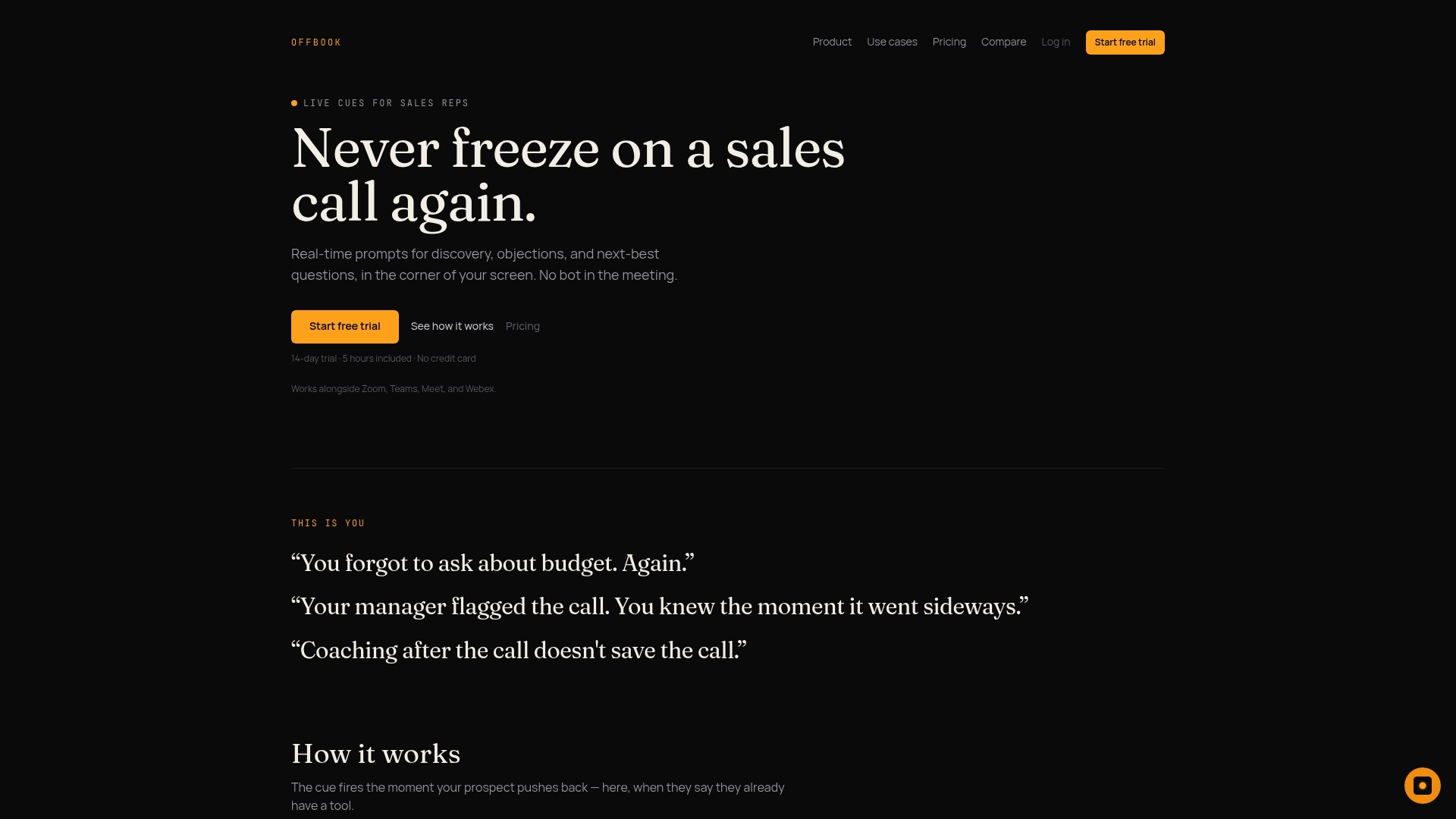
Offbook is real-time AI call coaching built for B2B SaaS sales teams. It listens to your call and surfaces live prompts on your screen, including the right questions to ask, qualification gaps to close, and objections to handle, all structured around frameworks like MEDDIC and MEDDPICC. No bot joins the meeting. No one on the other side knows it is there. Offbook also generates pre-call briefs so you walk into every conversation with context already prepared. If you want to run more consistent, better-prepared discovery calls, Offbook is built for exactly that.
FAQ
How many questions should I ask on a B2B discovery call?
Top-performing reps ask 11–14 questions per call. Prioritize depth over breadth by probing each answer before moving to the next topic.
What types of questions work best in B2B discovery?
Open-ended questions that start with “What,” “How,” or “Walk me through” produce the most useful answers. Leading or yes/no questions reduce authenticity and limit what buyers share.
How long should I spend preparing for a discovery call?
Pre-call research takes 10–15 minutes for SMB and mid-market accounts and 15–20 minutes for enterprise deals. Focus on company context, trigger events, and a clear pain hypothesis.
What is the best structure for a discovery call?
The five-stage sequence of Situation, Problem, Implication, Vision, and Decision Process gives calls a logical flow. Each stage builds on the previous one and keeps the buyer engaged.
How do I avoid sounding scripted during discovery?
Treat your question list as a map, not a script. Follow a flexible thinking sequence by probing each answer before advancing, and adjust your questions based on what the buyer tells you.