Close Deals Without a Sales Manager: A Rep's Playbook
Learn how to effectively close deals without a sales manager. Use proven strategies and tools to boost your sales success today!
Published: July 31, 2026
Author: OffBook Editorial Team

Close Deals Without a Sales Manager: A Rep’s Playbook
You can close deals below the strategic tier—typically entry and mid-market B2B SaaS deals—without a sales manager in the room. The condition: reps need clear MEDDIC-aligned qualification rules, delegated pricing guardrails, and live coaching support. The single next action is to run one pilot call with an AI coaching tool like Offbook, use a scripted close question, and record the outcome. Two signals that make this work are MEDDIC-qualified discovery and a 60–90 day phased handover that transfers judgment before removing oversight entirely.
Table of Contents
- How do you close deals without a sales manager on the call?
- How do you turn founder judgment into a playbook reps can actually use?
- What guardrails let reps negotiate without blowing up your margin?
- Why does in-call AI coaching outperform post-call coaching for closing?
- Post-call routines that turn every call into a better next call
- How do you roll out autonomous closing in 30, 60, and 90 days?
- Key Takeaways
- The manager bottleneck is real, but so is the edge case
- Offbook gives your reps the coaching they need to close independently
- Useful sources
How do you close deals without a sales manager on the call?
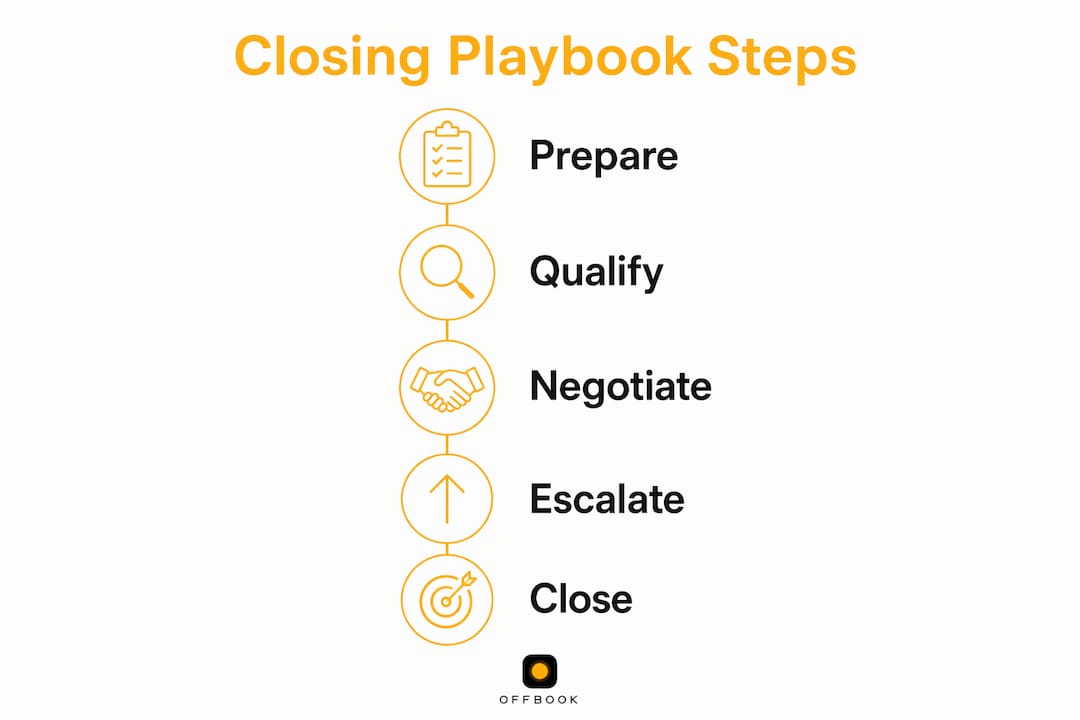
Start with five non-negotiable discovery questions before you attempt any close. These surface the information a manager would otherwise need to validate.
The five MEDDIC-aligned qualifying questions:
- “What is the business cost of your current situation — in dollars or hours per week?”
- “What changed that makes solving this a priority this quarter? Can you name the deadline?”
- “Who else needs to sign off, and what does their approval process look like?”
- “Is budget allocated, or does this need to go through a new approval cycle?”
- “What does success look like in 90 days, and who owns that outcome internally?”
Each question forces a dated, specific answer. Vague answers are disqualifying signals, not invitations to keep selling. A structured closing process depends on these exact answers to reduce stalls and clarify intent.
Phrasing the close without hedging:
Never end a call with “let’s stay in touch” or “I’ll send over some info.” Name the next step with a date and a single commit:
- “If this solves the problem you described, can we get you onboarded by Friday? Shall I send the invoice now?”
- “You mentioned the Q3 deadline. To hit that, we’d need a signed agreement by the 15th. Does that work?”
Top three objection-handling snippets:
- “We need to think about it” → “Totally fair. What’s the one thing that would need to be true for this to be a yes? Let’s address that now.”
- “It’s too expensive” → “Compared to the $X/week you mentioned in lost productivity? What’s the number that works for your budget?”
- “We’re evaluating other options” → “What criteria are you using to decide? I want to make sure we’re being compared on the right dimensions.”
When a deal exceeds your guardrails, use this two-sentence escalation: “This is above my approval threshold, so I want to bring in [name] to make sure we get you the right terms. I’ll stay on the call and own the relationship — this is just to get you the best outcome.”
Pro Tip: Use your discovery question prep before every call. Reps who walk in with pre-researched answers to questions 1 and 3 cut discovery time by half and spend more time on the close.
How do you turn founder judgment into a playbook reps can actually use?
Founder-led sales succeeds early because founders carry product conviction and can read buying intent from curiosity. It fails at scale unless that judgment gets codified into something teachable.
The core transfer is defining what buying intent actually looks like. Write it down as a five-question qualification rubric: the prospect named a specific pain, quantified it, identified a deadline, confirmed budget authority, and described the decision process. Any call that hits four of five moves to close. Three or fewer goes back to nurture.
Build a short decision matrix: what signals move a deal forward, what counts as disqualifying, and which recent wins and losses map to each outcome. Attach two or three real examples from your pipeline. Reps learn faster from annotated real deals than from abstract frameworks.
The handover follows a 60–90 day buffer: founder oversight in weeks one through four, guided autonomy in weeks five through eight, and independent rep ownership from week nine onward. Readiness requires three measurable signals before removing manager oversight: three to five repeatable wins at standard price and scope, documented objection responses that match real outcomes, and a decision matrix that routes only true exceptions upward.
Pro Tip: Documentation follows work, not the other way around. Update the objection library and scripts within hours of each significant call — not at the end of the week. Rapid post-call updates close feedback loops and prevent reps from hitting the same stall twice.
What guardrails let reps negotiate without blowing up your margin?
Manager step-ins above about 25% of deals correlate with underperformance in rep outcomes. The fix is not removing managers; it is defining exactly when they are needed.
Example delegation thresholds:
| Deal tier | Rep authority | Escalation trigger |
|---|---|---|
| Entry (below 1x ACV) | Full close authority, up to standard discount | None required |
| Mid (around 1x ACV) | Close authority, up to standard discount | Legal or procurement complexity |
| Strategic (high ACV) | Discovery and proposal only | Manager joins before close |
The escalation rule is one sentence: if the deal exceeds a high-value threshold or involves a custom MSA, loop in the manager within a few business hours. After escalation, the rep retakes ownership of the relationship and communication. The manager closes the exception; the rep closes everything else.
Margin-protection basics:
- Define a margin floor before any negotiation starts. Reps should know the number they cannot go below.
- Require a one-line written justification for any discount above the standard band.
- Any concession offered after a delay in approvals is a preventable margin leak — customers who wait for approvals often demand more.
Offbook’s live on-screen prompts flag when a rep’s offer drifts outside policy during the call, before the concession is made. That single guardrail reduces the need for post-call corrections.
Why does in-call AI coaching outperform post-call coaching for closing?
Post-call coaching improves the next call. In-call coaching improves the current one. For closing, that distinction is the whole game.

Offbook delivers this without joining the meeting as a bot. It listens to the conversation and surfaces silent on-screen prompts: the next MEDDIC/MEDDPICC qualifying question to ask, the objection response that fits the current stall, and a live flag when the deal crosses an escalation threshold. Reps also get pre-call briefs on the company and attendees, instant post-call debrief drafts, and role-specific profiles for AEs, founders, and CS teams.
Before enabling live coaching, get explicit meeting consent from all participants. A brief verbal disclosure at the call’s start (“I’m using a coaching tool that listens to our conversation”) satisfies most U.S. consent requirements and keeps the process clean.
Post-call routines that turn every call into a better next call
Three steps, done within two hours of hanging up:
- Update the objection library. Log the exact objection phrasing, what worked, and what did not. Tag it by deal stage and persona.
- Add signal tags to the CRM. Mark which MEDDIC criteria were confirmed, which were missing, and what the rep’s next action is.
- Draft and send the follow-up. Assign an owner and a send date. A day-8 value-add message — relevant content tied to the prospect’s stated pain — re-engages without sounding like a check-in.
For team sharing, keep a short searchable log of call insights in a shared doc or Slack channel. One rep’s hard-won objection response becomes the whole team’s asset within hours, not weeks.
Metrics to watch: manager escalations avoided per 100 calls, close velocity (days from first call to signed agreement), and percentage of calls with a follow-up sent within 24 hours.
How do you roll out autonomous closing in 30, 60, and 90 days?
- Days 1–30 (Pilot). Pick five reps. Enable Offbook on all their calls. Run the scripted discovery checklist from Section 2. Collect baseline metrics: manager step-ins per week, close rate, and average call-to-close time.
- Days 31–60 (Scale). Codify the playbook from Section 3. Set the delegation thresholds from Section 4. Train remaining reps on the decision matrix. Finalize escalation SLAs and confirm the two-hour manager response window.
- Days 61–90 (Operate). Remove the manager from routine approvals. Track repeatable wins per rep (target: three to five at standard price and scope). Set a bi-weekly review cadence to update the decision matrix as new objections and deal patterns emerge.
Pilot success criteria: manager step-ins drop, close velocity improves or holds steady, and gross margin stays within two percentage points of the pre-pilot baseline. If all three hold at day 90, the system is working.
Key Takeaways
Reps can close deals without a sales manager when they have MEDDIC-aligned qualification, delegated pricing guardrails, live AI coaching, and a post-call documentation habit that updates the playbook after every call.
| Point | Details |
|---|---|
| MEDDIC discovery first | Five qualifying questions must produce specific, dated answers before any close attempt. |
| Scripted close language | Name a date and a single commit; never end a call with vague next steps. |
| Delegation guardrails | Set ACV-based thresholds so reps own entry and mid-tier deals without approval delays. |
| 60–90 day handover | Phased autonomy with three measurable readiness signals prevents revenue drops during transition. |
| Offbook for live coaching | Offbook surfaces real-time MEDDIC cues and escalation flags during calls, reducing manager step-ins. |
The manager bottleneck is real, but so is the edge case
The playbook above handles the majority of B2B SaaS deals. It does not cover all of them, and pretending otherwise sets reps up to fail on the ones that matter most.
Strategic deals — high ACV, complex procurement, shifted buying committees, custom MSAs — still need a manager. Not because reps cannot handle the conversation, but because those deals carry legal and financial exposure that a two-hour escalation SLA was designed for. The 60–90 day buffer exists precisely to identify which deal types belong in that category before the rep is flying solo.
What Offbook shortens is the transfer itself. Founders spend months trying to explain their instincts about buying intent. Offbook externalizes that instinct as a live prompt, so reps see the qualifying gap in real time instead of learning it from a post-mortem. That compression is where the real leverage is.
Offbook gives your reps the coaching they need to close independently
Reps who close deals without a sales manager need one thing a playbook alone cannot provide: real-time judgment support during the call itself. That is what Offbook delivers.
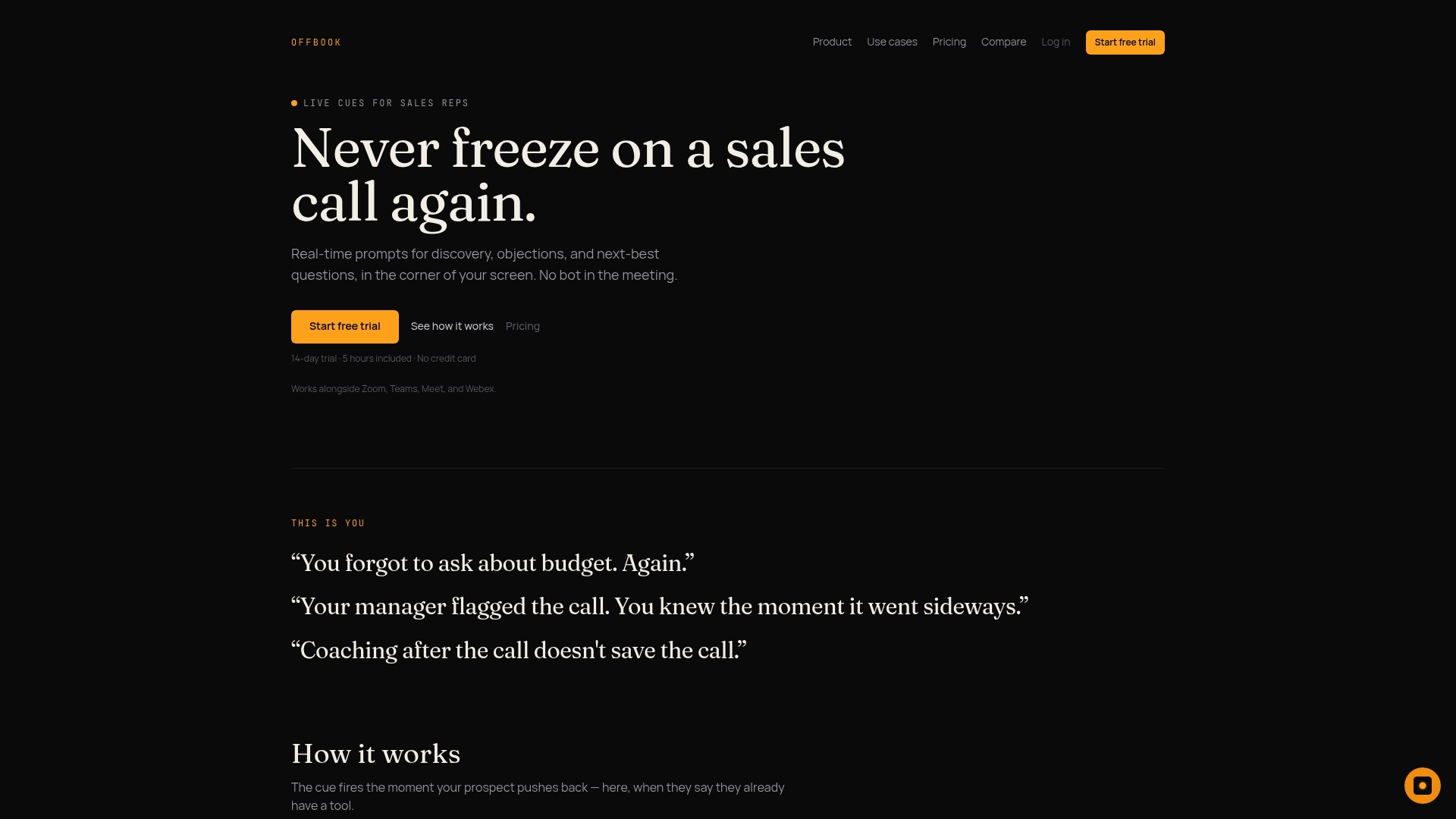
Offbook listens to your video calls and surfaces live on-screen cues tied directly to the MEDDIC/MEDDPICC framework, the objection library you build, and your delegation thresholds. No bot joins the meeting. No one on the other side knows it is running. Reps get the next qualifying question, the right objection response, and an escalation flag the moment a deal drifts outside policy. Pre-call briefs mean reps walk in prepared; instant post-call drafts mean documentation happens before the next call starts.
The recommended pilot: five reps, two weeks, Offbook enabled on every call. Measure manager step-ins, close velocity, and follow-up rate. Most teams see the pattern shift within the first ten calls. Start your Offbook trial and run the pilot this week.
Useful sources
- Founder-led B2B sales strategy — discovery question structure and next-step language
- Founder-led sales: the complete guide — transferable judgment and the 3–5 repeatable wins readiness test
- When does a sales manager need to step in — escalation thresholds and the 25% step-in benchmark
- The Manager Bottleneck — margin protection and empowerment as a closing strategy
- The Founder-Led Sales Playbook — post-call documentation and objection library practices
- Remove yourself from enterprise deals — the 60–90 day phased handover pattern
- Close deals without a sales team — value-add follow-up cadence and day-8 re-engagement
- Offbook: discovery questions that close — MEDDIC-aligned scripts and phrasing
- Offbook: sales call preparation checklist — pre-call brief templates for B2B SaaS reps
- Offbook: early-stage B2B sales motion — playbook readiness and signal definitions