Seed-Stage Sales Differs More Than You Think
Discover how seed-stage sales differ from traditional methods. Learn key strategies to adapt your selling approach for success!
Published: August 14, 2026
Author: OffBook Editorial Team

Seed-stage sales is founder-driven, high-credibility, fast-cadence selling that should become documented once you have enough closed deals at a steady cadence. Until you hit those numbers, you’re still learning what works. Once you do, the absence of a written motion is the risk.
Check two signals right now: Have you closed 15–30 deals with a consistent buyer profile? Are you closing at a cadence of roughly one deal every one to two weeks? If yes to both, you need a documented motion. If not, keep iterating on the pitch before you hire anyone to run it.
Three things to do this week:
- Instrument your last three closed deals: map the decision process, the success metric the buyer named, and every procurement step.
- Write a one-page playbook skeleton from those deals: five to seven stages, one checkable exit criterion per stage.
- Schedule a hire-readiness review: decide whether your calendar or your deal count is the actual bottleneck.
Key Takeaways
Seed-stage sales requires founder-led selling to become a documented, repeatable motion before the first AE hire — deal count and close cadence are the triggers, not ARR milestones.
| Point | Details |
|---|---|
| Document before you hire | Write the five-to-seven-stage playbook from observed deals before posting any sales role. |
| Hire a closer, not a manager | First sales hire should be a senior IC who carries quota and surfaces playbook gaps. |
| Set a deal-threshold rule | Founders stay on deals above a defined ACV; below that, the rep runs it solo. |
| Track six core metrics | Win rate, cycle length, pipeline coverage, lead-to-SQL, CAC, and LTV reveal the rate-limiter. |
| Offbook accelerates the handoff | Live in-call prompts and pre-call briefs transfer founder selling patterns to reps in real time. |
Table of Contents
- How does seed-stage sales actually differ from scaled selling?
- When should you hire your first AE, and then a Head of Sales?
- What minimal playbook artifacts actually work at seed?
- Which metrics matter most at seed, and how do they evolve?
- How do you hand off from founder-led to team-led without losing momentum?
- Common founder mistakes and how to fix them fast
- What tooling actually moves the needle at seed?
- What actually separates the founders who scale from the ones who stall
- Offbook gives seed-stage teams live coaching without the overhead
- Sources
How does seed-stage sales actually differ from scaled selling?
Founder-led selling works because of credibility, not process. When you’re on the call, the buyer knows they’re talking to the person who built the product and can bend the roadmap. That’s a real advantage, and it’s one no first AE can replicate on day one.
The operational pattern is equally distinctive. The founder runs discovery to close end-to-end, handles exceptions personally, and accumulates tacit selling rules that never get written down. Objections get handled differently each week. The pitch shifts based on what the last call surfaced. That’s not chaos — it’s market intelligence gathering at speed.
The problem is that founder-led discovery calls mask a lack of repeatability. Three signals that you’ve crossed that line: your buyer archetypes are inconsistent deal to deal, your pitch is still changing week to week, and your calendar is the chokepoint for every deal in the pipeline.
Pro Tip: Treat every call like an experiment. Capture the same three data points on every discovery call — the buyer’s decision process, their primary success metric, and every procurement step. After 15 deals, those notes become your qualification gates.
According to SaaStr’s founder transition playbook, founders should treat the handoff as a gradual evolution and stay involved in the most strategic, high-value deals long after the first AE hire — both to retain market intelligence and to keep credibility with key accounts.
When should you hire your first AE, and then a Head of Sales?
The trigger is deal count and velocity, not a funding milestone. Repeatable process guidance puts the threshold at 15–30 closed deals with a stable cadence of roughly one close per week. When your calendar is the constraint, not the market, it’s time.
H1 2026 benchmarks show the founder-led window has stretched: many vertical SMB founders are now closing closer to 30 deals before their first AE hire, driven by tighter capital and thinner AE supply. That’s not a failure — it’s the market.
| Hire | Trigger | What they must deliver |
|---|---|---|
| First AE | 15–30 closed deals, weekly close cadence, founder calendar full | Carry quota, validate the playbook, surface what breaks |
| Second AE | First AE at quota for 60+ days | Reduce signal noise, prove motion isn’t one rep’s personality |
| Head of Sales | 2–3 reps proving the motion | Build systems, run pipeline reviews, own rep development |
Hire two AEs simultaneously when you can afford it (advice consistent with operator analysis) — one rep’s results are a data point, two reps’ results are a pattern. Ramp time for a first AE at seed is typically a few months to first close, longer if the playbook isn’t written before they start.
In interviews, test the candidate’s track record at your specific ACV. Ask them to walk through the last three deals they closed at that price point: who the economic buyer was, what objection nearly killed the deal, and how long the cycle ran.
What minimal playbook artifacts actually work at seed?
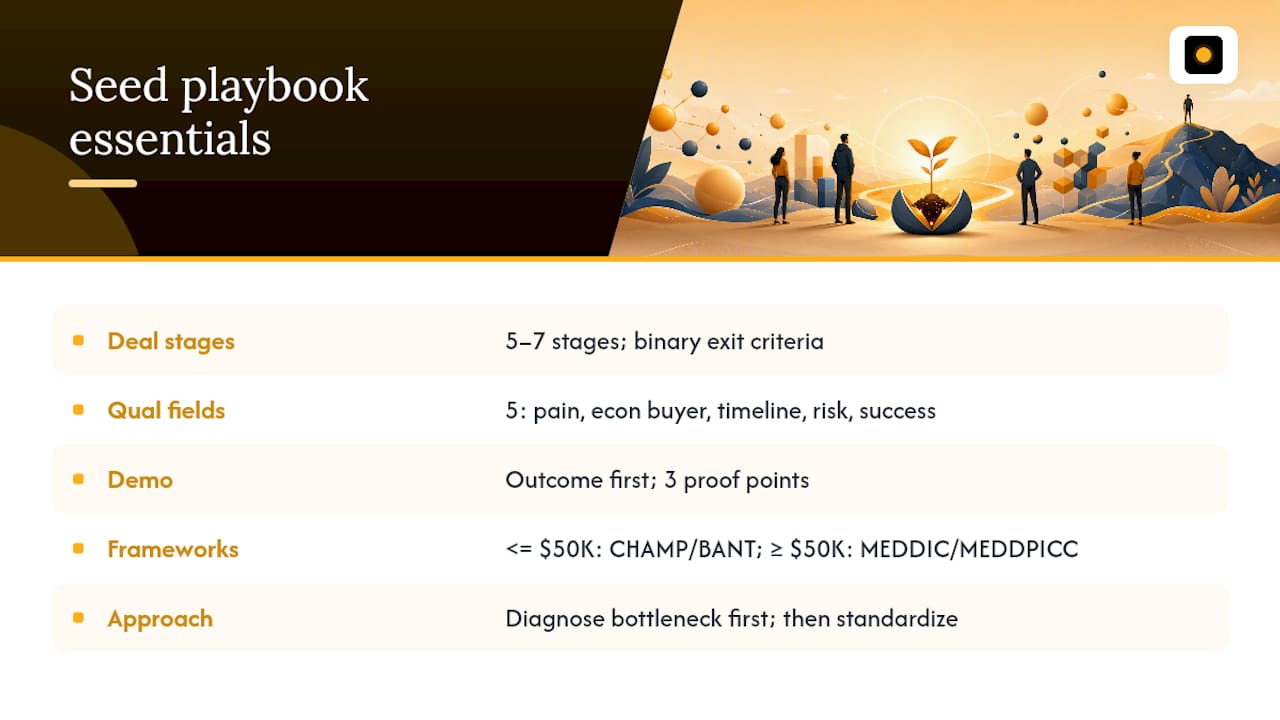
Write process from observed deals, not from a template. Name five to seven stages and give each one a single, checkable exit criterion — not a description of what the stage feels like, but a binary gate a rep can confirm.
A qualification checklist for a seed-stage discovery call needs five fields: the pain the buyer named in their own words, the economic buyer’s name and title, the timeline and what’s driving it, the implementation risk they raised, and the success metric they’ll use to judge the product. Capture those five on every call. Nothing else is required yet.
For demo structure, map your proof points to buyer success metrics rather than feature lists. If the buyer said their success metric is “cutting onboarding time by half,” your demo should show that outcome first, not your UI. Three proof points per demo is enough at seed.
Match your qualification framework to your ACV. CHAMP or BANT work well for sub-$50K motions. MEDDIC and MEDDPICC are worth the overhead at $50K+ where stakeholder complexity justifies the rigor. Applying MEDDPICC to a $12K deal is over-engineering that slows you down.
A diagnostic-first approach — identifying whether motion, message, or market is the rate-limiter before standardizing any methodology — is more useful at seed than importing an enterprise framework wholesale. Fix the bottleneck first, then build the process around what’s working.
For templates, keep it to two emails: a discovery follow-up that restates the buyer’s pain and next step, and a proposal nudge that references the success metric they named. Both should be short enough to read on a phone.
Which metrics matter most at seed, and how do they evolve?
Track six numbers weekly. Win rate by rep and by deal size tells you whether the motion works or whether one person is carrying it. Sales cycle length flags when deals are stalling. Pipeline coverage (ideally 3x quota) tells you whether you have enough at-bats. Lead-to-SQL conversion shows whether your top-of-funnel is qualifying or just passing bodies through. CAC and LTV are early unit economics diagnostics — you don’t need precision yet, but you need the ratio to be moving in the right direction.
| Metric | What it diagnoses | Action when it breaks |
|---|---|---|
| Win rate by rep | Motion vs. individual skill | Shadow the outlier rep; extract what’s different |
| Sales cycle length | Deal stall points | Add a stage gate at the stall; tighten follow-up cadence |
| Pipeline coverage | Volume of opportunities | Fix top-of-funnel or increase outbound activity |
| Lead-to-SQL conversion | Qualification discipline | Tighten ICP definition; add one disqualification gate |
| CAC / LTV ratio | Unit economics health | Adjust pricing or reduce cycle length before scaling spend |
When win rate drops, look at rep behavior before blaming the market. When cycle length expands, find the stage where deals are sitting longest and add a gate. When pipeline looks thin, the fix is almost always top-of-funnel volume, not a better deck.
How do you hand off from founder-led to team-led without losing momentum?
The sequence matters more than the speed.
- Document the motion first. Write the playbook before you hire. A rep can’t validate a process that doesn’t exist yet.
- Hire a senior IC closer. One rep who can carry quota and surface what breaks in the playbook.
- Shadow, then let them run. Sit in on the first five to ten deals. Then step back and let the rep run deals under $25K (or whatever your ACV threshold is) independently.
- Founder keeps strategic closes. Set a deal-threshold rule: founder joins any deal above a defined ACV or with a named strategic account. Write that rule down so it’s not ad hoc.
- Transition to on-demand SME. Once the rep has closed five deals solo, the founder moves from default attendee to subject matter expert on request.
A practical meeting rhythm during the handoff: a 30-minute weekly pipeline review, a 15-minute pre-call brief for any deal above threshold, and a 20-minute debrief after every lost deal. That’s it. The early-stage B2B sales motion guide covers how to structure these rhythms as the team grows.
Codify the deal-threshold rule in writing. “Founder joins any deal above $40K ACV or any Fortune 1000 prospect” is a rule. “Founder joins when it feels important” is not.
Common founder mistakes and how to fix them fast
| Pitfall | Quick fix |
|---|---|
| Hiring a VP as first sales hire | Hire a senior IC closer first; the VP role comes after 2–3 reps prove the motion |
| Not documenting the motion before hiring | Extract playbook from 3 recent wins before posting the job |
| Re-closing the rep’s deals | Set a deal-threshold rule and enforce it; coach after the call, not during |
| Applying enterprise frameworks too early | Use CHAMP or BANT at seed; add MEDDIC only when ACV and complexity justify it |
| Hiring before PMF is clear | If your buyer archetype is still changing, fix that before you hire anyone to run the pitch |
The 30-minute fix: pull your last three won deals and write down the one thing each buyer said that made them sign. That’s your value prop. The 60-minute fix: set one disqualification gate — a single criterion that, if missing, removes a deal from the pipeline. The 90-minute fix: write the five-stage process with one exit criterion per stage.
Pro Tip: The right first hire profile is a senior IC who will carry a bag and document what works. They should be able to run deals independently within 60 days and tell you what’s missing from the playbook by day 45.
What tooling actually moves the needle at seed?
Keep the stack minimal; for teams in healthcare SaaS, knowing how to build a healthcare SaaS go-to-market strategy can guide essential early-stage sales planning. Four categories matter: pre-call briefs on the company and buyer, call recording with indexed notes, a lightweight CRM with stage gates enforced, and live in-call coaching.

Pre-call prep is the highest-leverage investment most seed teams skip. A rep who walks into a call knowing the buyer’s recent funding, their tech stack, and their stated priorities closes differently than one who’s reading the LinkedIn profile in the waiting room.
Live in-call coaching is where the founder-to-rep transfer actually happens at speed. When a rep hears an objection they haven’t handled before, a post-call debrief doesn’t help — the moment is already gone. In-call prompts surface the right question or reframe in real time, preserving the founder’s selling patterns in the rep’s hands without requiring the founder to be on every call.
Offbook is built specifically for this handoff. It listens to video calls without joining as a bot, surfaces live on-screen prompts for objection handling and qualification gaps structured around MEDDIC and MEDDPICC, generates pre-call briefs on meeting participants, and produces instant post-call debriefs and follow-up drafts. For a founder and a first AE running deals together in the first 60–90 days, the workflow is straightforward: the founder runs the first five deals with Offbook active, the rep shadows and sees the prompts, then the rep runs the next five with the founder reviewing the debrief. The startup sales rep best practices guide covers how to structure that ramp in detail.
For teams building out their sales coaching program, live coaching reduces the founder calendar drain that typically kills early handoffs — escalating only the strategic issues that genuinely need founder judgment.
What actually separates the founders who scale from the ones who stall
Most founders I’ve seen stall at the handoff make the same mistake: they treat documentation as something to do after hiring, not before. By the time the first AE is ramping, the founder is too busy to write the playbook, the rep is guessing, and the founder ends up re-closing deals they were supposed to hand off. The calendar never frees up.
The founders who scale cleanly do three things differently. They write the motion from observed deals before posting the job. They hire a closer, not a manager. And they set a deal-threshold rule on day one so the handoff has a clear boundary.
The hardest part isn’t the process. It’s resisting the urge to jump back in when a deal gets complicated. Staying involved in the highest-value deals is right — SaaStr’s guidance is clear on that. But jumping in below the threshold because it feels faster than coaching is how founders become the permanent bottleneck.
Budget your time explicitly: two to three hours per week on strategic deals, one hour on pipeline review, and the rest on coaching. When you’re spending more than that on individual deals below your threshold, the playbook needs work, not more founder hours.
Offbook gives seed-stage teams live coaching without the overhead
Most seed teams can’t afford to have the founder on every call, and they can’t afford to wait until post-call to fix what went wrong. Offbook’s real-time AI coaching solves both problems at once.
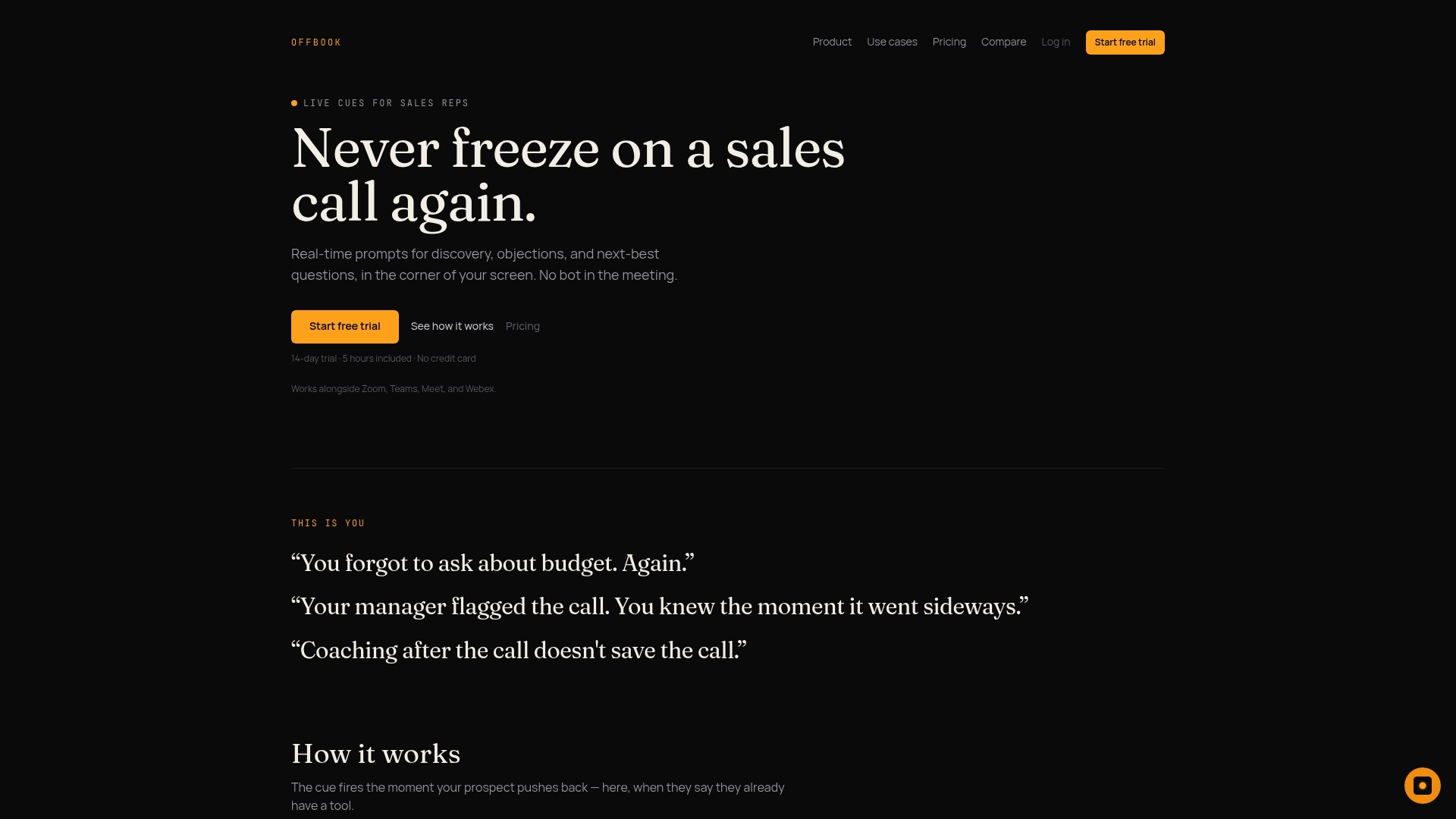
Pre-call briefs mean your rep walks in prepared. In-call prompts surface the right qualification question or objection handle the moment it’s needed, structured around MEDDIC and MEDDPICC without requiring the rep to have memorized either. Post-call debriefs and follow-up drafts are ready before the rep closes their laptop.
The recommended experiment: run Offbook with one founder and one new AE for 60 days. Measure rep close rate, sales cycle length, and how many hours per week the founder spent on deals below threshold. The signal is usually clear within the first month.
Start a free trial or book a team demo at Offbook.
Sources
- The founder’s guide to transitioning from founder-led sales: why most get it wrong and how to get it right
- Repeatable B2B sales process at seed (2026) | Causo Hub
- SaaS Sales Framework: Seed to Series A — Dave Rubinstein