SPIN Selling: A Practical Playbook for B2B Sellers
Discover SPIN Selling, a powerful questioning framework that transforms vague needs into clear business solutions for B2B sellers.
Published: August 18, 2026
Author: OffBook Editorial Team

SPIN Selling is a consultative questioning framework built on four question types, Situation, Problem, Implication, and Need‑Payoff, designed to guide a buyer from a vague, implied need to a specific, self-articulated one. Neil Rackham developed it after Huthwaite International studied roughly 35,000 sales calls, and it remains the default framework for complex, high-ticket B2B deals where the buyer has to talk themselves into the business case before anyone signs anything. Use it on discovery calls, multi-stakeholder demos, and any sale where the check size demands more than a features pitch.
That’s the short version. The rest of this guide breaks down each stage, gives you question banks you can use today, and shows you why the third stage, Implication, is the one that actually separates closers from order-takers.
Key Takeaways
SPIN Selling works because buyers commit to solutions they articulate themselves, and the Implication stage is what makes that articulation happen.
| Point | Details |
|---|---|
| Sequence matters | Move from Situation to Problem to Implication to Need‑Payoff; don’t pitch before the buyer states urgency. |
| Implication is the lever | Spend coaching time here first; it’s what separates top performers from average reps. |
| Buyers build their own case | Need‑Payoff questions should get the buyer, not the rep, to state the value of solving the problem. |
| Track question ratios | Watch the Implication-to-Problem ratio and the percentage of calls with a buyer-stated need over the first 60 to 90 days. |
| Pair coaching with live cues | Tools like Offbook surface SPIN prompts during the call itself, closing the gap between training and real behavior. |
Table of Contents
- What Is SPIN Selling and How Do the Four Stages Work?
- SPIN Question Bank: Ready-to-Use Scripts for Every Call Type
- Why SPIN Selling Works in Complex B2B Deals
- How to Implement SPIN Selling Across a Sales Team
- Why Implication Questions Separate Top Performers from Average Reps
- Turning Objections Into Need‑Payoff Language
- Common Mistakes That Undercut SPIN Selling
- Tailoring SPIN Questions to Different Buyers and Industries
- SPIN Selling Compared to Other Sales Methodologies
- Bringing SPIN Into Your CRM and Sales Enablement Stack
- A Sales Coach’s Take on Rolling Out SPIN
- How Live Coaching Helps You Run SPIN on Real Calls
- Frequently Asked Questions
- Sources
What Is SPIN Selling and How Do the Four Stages Work?
SPIN stands for Situation, Problem, Implication, and Need‑Payoff. Each letter is a category of question, and the categories are meant to be asked roughly in that order, moving the conversation from neutral fact-finding toward the buyer stating, out loud, why they need to act.
Situation questions establish context. They’re necessary but low-value: “What tools are you using now for X?” or “How is your team structured?” Ask too many of these and you sound like you’re filling out a form instead of running a conversation. Rackham’s research found that top performers keep this category short and move on fast.
Problem questions surface dissatisfaction. “What’s frustrating about your current process?” or “Where do things break down?” This is where a buyer names a pain point, but at this stage the pain is still theoretical. It hasn’t cost them anything yet, at least not in their own head.
Implication questions are where the real work happens. They take a stated problem and multiply it: “What happens to your onboarding timeline when that breaks down?” “How does that delay affect revenue recognition for the quarter?” This is the stage that converts a shrug into urgency, and Huthwaite’s own framework documentation treats it as the hinge point of the entire sequence.
Need‑Payoff questions ask the buyer to state the value of solving the problem, in their own words. “If you could cut that onboarding delay in half, what would that mean for your Q3 numbers?” The buyer, not the rep, builds the business case. That’s the whole point of the method: buyers defend decisions they voice themselves far more than decisions pitched at them.
| Stage | Purpose | Sample question focus | Buyer outcome |
|---|---|---|---|
| Situation | Establish factual context | Current tools, team size, process | Baseline understanding, low emotional engagement |
| Problem | Surface dissatisfaction | Pain points, bottlenecks, friction | Buyer names a problem, still theoretical |
| Implication | Expand consequences | Cost, delay, risk, downstream effects | Problem feels urgent and expensive |
| Need‑Payoff | Articulate value of solving it | Benefits of a fix, in buyer’s language | Buyer states their own business case |
The SPIN methodology was built specifically to move a prospect from an implied need, something they’d admit if pressed, to an explicit need, something they’d champion internally without you in the room.
SPIN Question Bank: Ready-to-Use Scripts for Every Call Type
Here’s a working set you can adapt. These aren’t generic templates. They’re grouped by SPIN category, then packaged into short sequences for three common B2B scenarios.
Situation questions (keep these brief):
- “Walk me through how your team currently handles [process].”
- “Who else touches this workflow before it reaches your desk?”
- “What’s your current stack for [category]?”
Problem questions:
- “What’s the part of this process that eats the most time?”
- “Where do handoffs tend to break down?”
- “If you could fix one thing about this today, what would it be?”
Implication questions:
- “When that bottleneck happens, what’s the downstream effect on your team’s targets?”
- “How much does that delay cost you in a typical month?”
- “Who else in the company feels that pain besides you?”
Need‑Payoff questions:
- “If that bottleneck disappeared, what would that free your team up to do instead?”
- “How would solving this change the conversation with your leadership team?”
- “What would it mean for your quarter if this were no longer a problem?”
Mini-script: discovery call opening
- Situation: “Before we dig in, tell me how deals move through your pipeline today.”
- Problem: “Where does that process tend to stall?”
- Implication: “What happens to your forecast accuracy when deals stall there?”
- Need‑Payoff: “If your forecast were reliable to the week, what would that change for your board conversations?”
Mini-script: SDR outbound (mini-SPIN)
A compressed version works well in a short call or even a voicemail. One framework for outbound suggests a signal, a hypothesis, a brief consequence, and an ask: “Noticed your team just doubled headcount (Situation signal). Teams that size usually hit onboarding friction around month three (Problem hypothesis). That usually shows up as slower time-to-productivity for new reps (brief Implication). Worth 15 minutes to see if that’s on your radar (Need‑Payoff ask)?”
Mini-script: executive briefing
Executives don’t want Situation questions; they’ve read the one-pager. Open closer to Implication: “Your team mentioned onboarding delays cost roughly a month of ramp time per new rep. At your headcount, what does that translate to in lost quota-carrying time this year?” Then land on Need‑Payoff: “If that ramp time were cut by half, how would that change your hiring plan?”
Role-specific note: AEs typically run the full four-stage sequence over a 30-45 minute discovery call. SDRs compress it into 60-90 seconds of outbound messaging or a short qualifying call. Sales engineers lean hardest on Implication during technical demos, tying a feature gap directly to a cost or risk the buyer already named. For SaaS discovery specifically, a checklist built around pre-call prep helps you walk in already knowing which Situation questions you can skip.
Why SPIN Selling Works in Complex B2B Deals
Huthwaite’s original research, drawn from observing tens of thousands of sales calls across industries, found that the sequence of questions mattered more than the pitch that followed it. SPIN Selling’s ultimate guide points to that same study of roughly 35,000 calls as the empirical backbone behind the method, and it’s a rare case in B2B sales where a widely repeated framework actually traces back to field observation rather than a consultant’s hunch.
The psychology is simple: people defend what they say out loud. A rep who tells a buyer “this will cost you $200,000 a year in lost productivity” gets skepticism. A buyer who calculates that number themselves, in response to an Implication question, walks into their next internal meeting ready to defend it. That’s the mechanism SPIN is built on, and it’s why the Need‑Payoff stage exists at all: it forces the buyer to say the value proposition in their own words before you ever say it in yours.
The practical benefits show up in three places. Qualification gets sharper, because a buyer who can’t answer an Implication question honestly probably isn’t feeling enough pain to buy. The business case gets stronger, because it’s written in the buyer’s language, which travels better inside their organization than your language does. And qualified deals tend to move faster, because the internal selling work, convincing a VP or a budget holder, has already happened inside the call instead of after it.
SPIN has real limits, though. It’s built for complex, multi-touch, considered purchases, not for transactional, short-cycle sales where a buyer already knows exactly what they want and just needs a price. Running a full four-stage sequence on a $200 self-serve signup is overkill. It’s also not built to replace deal-qualification frameworks like MEDDIC or MEDDPICC. SPIN tells you what to ask; those frameworks tell you what to track once you’ve asked it.
How to Implement SPIN Selling Across a Sales Team
Rolling SPIN out across a team is a coaching problem, not a training problem. A single workshop won’t stick. Behavior change happens on calls, over weeks, with feedback loops tight enough that reps can actually adjust.
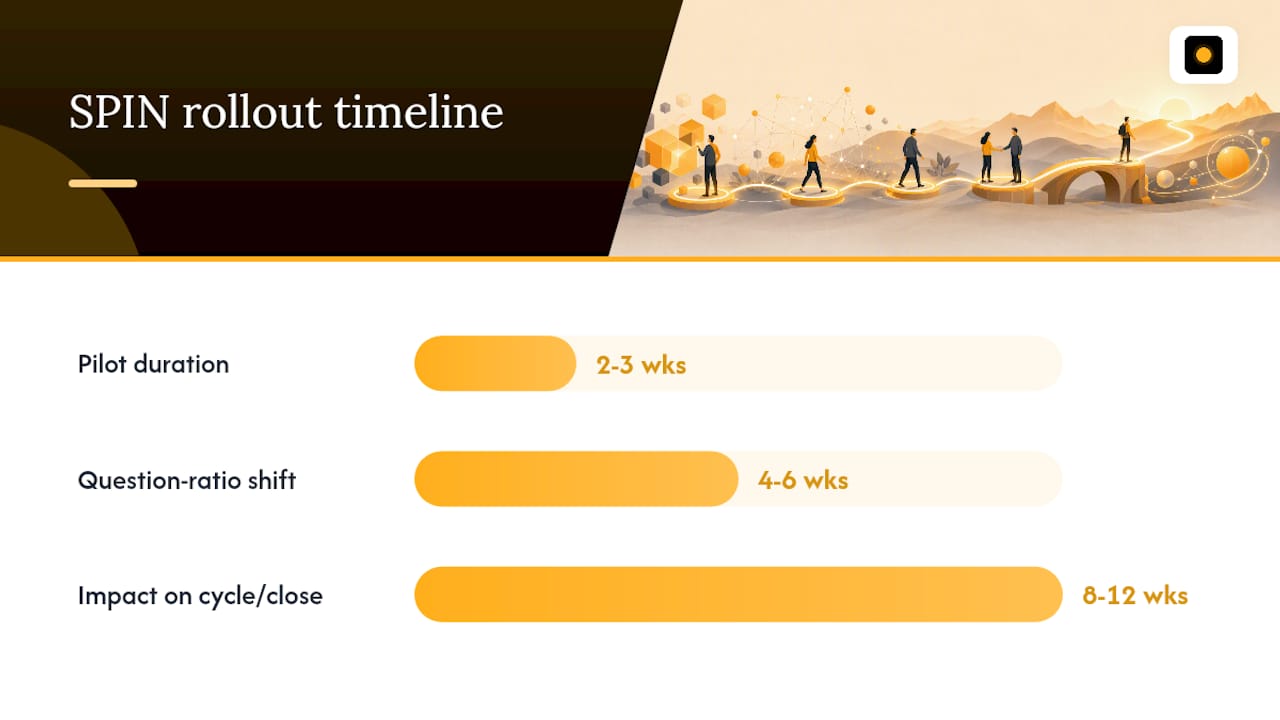
- Pilot with two or three reps for two to three weeks. Pick reps who already ask good questions naturally; you want proof the framework works before you scale it.
- Record and review calls specifically for question ratios. Don’t grade the whole call. Just tag Situation, Problem, Implication, and Need‑Payoff questions and count them.
- Set a target ratio. A healthy discovery call should skew toward Problem, Implication, and Need‑Payoff, with Situation questions kept to the first few minutes only.
- Roll out to the full team with live examples from the pilot, not hypothetical scripts. Real transcripts land better than made-up ones.
- Coach weekly for the first month, then biweekly. The skill that decays fastest is Implication questioning; reps default back to Problem questions because they’re easier to ask.
- Track KPIs, including the ratio of Implication to Problem questions per call, the percentage of calls where a buyer articulates their own need without prompting, and time-to-close on deals that hit that benchmark versus deals that don’t.
Pro Tip: Run a “silent minute” drill in coaching sessions. After a rep asks an Implication question, have them count to five before speaking again. Reps rush to fill silence, and that silence is often where the buyer does the calculating that makes the Need‑Payoff answer land.
Timeline-wise, expect four to six weeks before question ratios shift meaningfully, and eight to twelve weeks before you see it show up in cycle time or close rate. Sales leaders who want the coaching loop tighter than a weekly call review often turn to real-time coaching tools that flag when a rep skips Implication and jumps straight from Problem to pitch, catching the mistake mid-call instead of in a review three days later.
Why Implication Questions Separate Top Performers from Average Reps
If you only fix one thing about how your team runs SPIN, fix this stage. Research on implied needs identifies the Implication phase as the lever that separates average reps from top performers, because it’s the step that turns a theoretical problem into something urgent and expensive enough to act on. Reps who skip it, or rush through it, end up pitching to buyers who technically have a problem but don’t feel it yet.
| Behavior | Average reps | Top performers |
|---|---|---|
| Problem-to-Implication transition | Jump straight to pitch after naming the problem | Ask 2-3 follow-up questions expanding the consequence |
| Consequence framing | Stay vague (“that sounds tough”) | Tie the problem to a specific metric (cost, time, risk) |
| Stakeholder awareness | Address only the person on the call | Ask who else in the org feels the same pain |
The fix is a drill, not a lecture. Take any stated problem and practice translating it into three separate consequences: financial, operational, and strategic. A coaching approach built around this exact exercise has reps practice tying each consequence to a measurable metric, so “onboarding is slow” becomes “onboarding delays cost roughly $40,000 in lost productivity per cohort, push your CS team’s ramp targets back a full quarter, and put renewal risk on any account that churns before value is realized.”
Role-play this in fifteen-minute blocks. One person states a generic problem, the other has sixty seconds to ask three Implication questions that expand it into cost, time, and risk. Do it weekly for a month and most reps stop sounding hesitant asking these questions, which is usually the real barrier, not lack of knowledge.

Pro Tip: Implication questions can sound like fearmongering if you stack too many in a row. Alternate an Implication question with a brief empathetic statement (“that makes sense, a lot of teams hit that wall”) so the conversation still feels like a dialogue, not an interrogation.
Turning Objections Into Need‑Payoff Language
Objections are usually a sign that the Implication work didn’t land hard enough. The fix isn’t a rebuttal script, it’s pivoting the objection back into a question that gets the buyer talking about value again.
“It’s too expensive.” Don’t defend price. Ask: “Compared to what it’s currently costing you to live with this problem, where does that number land?” If the buyer hasn’t quantified the cost of inaction, that’s a sign to go back to Implication before you go anywhere near Need‑Payoff again.
“We’re not ready right now.” Ask: “What would need to be true for this to become a priority?” That question often surfaces a hidden Implication, a deadline, a board meeting, a renewal, that the rep didn’t know about.
“We’re fine with what we have.” This is a Problem-stage failure, not a Need‑Payoff failure. Go back further: “What made you take this call in the first place?” There’s almost always a reason, and reconnecting to it re-opens the Implication conversation.
A short transcript shows the pivot in action:
Buyer: “Honestly, our current process works. It’s just slow.” Rep: “How slow, roughly, from lead to close?” Buyer: “Maybe six weeks longer than it should be.” Rep: “What does that six weeks cost you in pipeline coverage each quarter?” Buyer: “We probably lose a few deals to competitors who move faster.” Rep: “If you could close six weeks faster across the board, what would that mean for your quota attainment this year?”
That last line is Need‑Payoff. The rep never stated a benefit. The buyer did.
Two pitfalls show up constantly here. The first is pitching too early, jumping to a product pitch the moment a buyer names any pain, before the Implication work has made that pain feel expensive. The second is overusing fear-based Implication questions until the call feels like a threat assessment instead of a conversation; balance every consequence question with genuine curiosity about the buyer’s world.
Common Mistakes That Undercut SPIN Selling
The most common failure isn’t asking the wrong questions. It’s asking them in the wrong order, or skipping straight to a pitch before the buyer has said anything that sounds like urgency.
Pitching before the need is explicit. Huthwaite’s own analysis of the framework calls this the most common failure mode: reps present a solution before the buyer has recognized, out loud, why they need one. If you catch yourself talking about your product before the buyer has stated a consequence in their own words, you’re early.
Over-asking Situation questions. Five minutes of “tell me about your team” feels like due diligence to the rep and an interrogation to the buyer. Cap Situation questions at two or three and move on.
Treating the four stages as rigid script order. Real conversations loop back. A buyer might raise a new problem mid-Implication; that’s fine, follow it. SPIN is a sequence of intent, not a checklist to march through in order every time.
Skipping Need‑Payoff entirely. Some reps get a strong Implication answer and jump straight to their pitch, assuming the urgency alone will close the deal. It won’t, not as reliably. The buyer still needs to say the value out loud themselves.
Using SPIN on the wrong deal size. Running a full four-stage sequence on a low-stakes, fast-decision purchase slows the buyer down and can read as padding a simple conversation.
Tailoring SPIN Questions to Different Buyers and Industries
A VP of Engineering and a VP of Finance will answer the same Implication question completely differently, so the question itself has to shift.
For technical buyers, tie Implication questions to system reliability, technical debt, or engineering hours lost to workarounds. For financial buyers, tie them to budget variance, cost per unit, or forecast accuracy. For a founder or CEO, tie them to competitive risk or time-to-market.
In SaaS-specific buying contexts, the Problem stage often surfaces around integration friction or data silos, and the Implication follow-up should quantify the engineering hours or lost deal velocity that friction creates. In more consultative, relationship-driven verticals like medical aesthetics, the same four-stage logic applies, but Situation and Problem questions lean more heavily on lifestyle and outcome language than on hard metrics, since the buying decision is often personal rather than organizational.
Industry vocabulary matters more than most reps assume. Asking a healthcare buyer about “throughput” lands differently than asking a logistics buyer the same question. Spend fifteen minutes before any call researching the specific metrics that industry already tracks internally, then frame your Implication questions around those exact terms.
SPIN Selling Compared to Other Sales Methodologies
SPIN is a questioning framework, not a full deal-management system, and that distinction matters when you’re deciding what to run alongside it.
Solution Selling, developed around the same era as SPIN, focuses heavily on mapping a buyer’s pain to a specific solution capability early in the conversation. SPIN is more patient. It holds off on solution talk until Implication and Need‑Payoff have done their work, which tends to produce a stronger buyer-owned business case, though it can feel slower on shorter sales cycles.
The Challenger Sale takes almost the opposite posture. It argues reps should teach buyers something they don’t already know about their own problem, then push, sometimes uncomfortably, toward a specific point of view. SPIN stays purely buyer-led throughout; it never tells the buyer what to think, it only asks questions that help them arrive there themselves. Many sales organizations blend the two: Challenger-style insight to open a conversation, then SPIN questioning to build the internal case.
MEDDIC and MEDDPICC aren’t competitors to SPIN at all, they’re qualification and forecasting frameworks that answer a different question: given this opportunity, how do we know it’s real and track it accurately? SPIN generates the conversation; MEDDIC tells you what to record from it. A rep can run a flawless SPIN sequence and still lose the deal if nobody identifies the Economic Buyer or maps Decision Criteria, which is exactly why most disciplined B2B teams run both simultaneously rather than choosing one.
Bringing SPIN Into Your CRM and Sales Enablement Stack
SPIN lives or dies on consistency, and consistency is a tooling problem as much as a coaching one. If your CRM has custom fields, build fields for “stated problem,” “quantified implication,” and “buyer-stated need‑payoff” directly into your opportunity record. That forces reps to actually capture the answers instead of letting them evaporate after the call.
Call recording and conversation intelligence tools can tag SPIN question categories automatically if you train them on your team’s transcripts, giving you the Implication-to-Problem ratio without manual review. That data becomes your coaching backlog: any rep whose ratio skews heavily toward Problem with few Implication follow-ups is your next coaching priority.
The harder gap is timing. Most conversation intelligence tools review calls after the fact, which means the coaching moment happens days after the mistake, once the deal has already moved on. Live, in-call cueing closes that gap by surfacing the next SPIN question type on-screen while the rep is still talking to the buyer, not in a debrief three days later. That shift, from retrospective coaching to in-the-moment coaching, is where most of the actual behavior change happens.
A Sales Coach’s Take on Rolling Out SPIN
Most teams that try SPIN give up on it after two weeks, and it’s almost always for the same reason: they expect reps to sound natural asking Implication questions immediately, and nobody does. It feels awkward the first dozen times. You’ll hear reps ask a Problem question, get a real answer, and then just move on to their pitch anyway, because pausing to dig into consequences feels like slowing down a deal that’s finally moving.
That awkwardness is the actual work. Give it four to six weeks before judging whether it’s working, and judge it by question ratios on recorded calls, not by gut feel. The reps who stick with it past that early discomfort tend to end up asking better questions across the board, not just in the SPIN categories, because the underlying skill is curiosity, and curiosity generalizes.
One thing worth saying plainly: SPIN isn’t a replacement for a qualification framework like MEDDICC. It’s the conversational engine that feeds one. SPIN gets you the answers; a framework like MEDDICC tells you what to do with them once you have them. Teams that treat SPIN as their entire sales methodology usually have great conversations and messy pipelines. The two are meant to run together.
The hardest part to coach isn’t the questions themselves, it’s catching the moment a rep skips Implication in real time, while the call is still happening, rather than three days later in a recording nobody has time to watch closely.
How Live Coaching Helps You Run SPIN on Real Calls
Knowing the four SPIN stages is one thing. Remembering to ask an Implication question instead of pitching, in the middle of a live call with a prospect staring back at you, is a different skill entirely, and it’s the one most training programs never actually build.
Offbook listens to your video calls in real time and surfaces on-screen prompts, without a bot joining the meeting, telling you when to push into Implication instead of jumping to your pitch, or when a buyer’s answer sounds like an implied need you should turn explicit. It also builds pre-call briefs on the people and companies you’re about to talk to, so you walk in already knowing enough to skip the throwaway Situation questions and get straight to the Problem stage.
- Faster coaching loops: cues happen mid-call, not three days later in a recording review.
- More buyer-articulated needs: prompts nudge reps toward Need‑Payoff questions instead of premature pitching.
- Measurable KPI movement: track your Implication-to-Problem ratio automatically instead of hand-tagging transcripts.
If your team already runs SPIN in training but the ratios don’t show up on real calls, that’s a live-coaching gap, not a knowledge gap. Offbook’s sales coaching tool is built for exactly that moment, structured around SPIN alongside frameworks like MEDDIC and MEDDPICC. Start a trial and run your next discovery call with the prompts on screen.
Frequently Asked Questions
Does SPIN Selling still work? Yes. The core insight, that buyers commit harder to needs they state themselves, doesn’t age. Modern commentary on the method points out that its buyer-first structure fits remote and AI-assisted selling just as well as it fit in-person calls in the 1980s, largely because it’s a conversational layer, not a specific tool or channel.
What does SPIN stand for? Situation, Problem, Implication, and Need‑Payoff. Each word names a category of question, asked roughly in that order during a discovery conversation.
What are the four stages or question types in SPIN Selling? Situation questions establish context, Problem questions surface dissatisfaction, Implication questions expand the cost or risk of that problem, and Need‑Payoff questions get the buyer to state the value of fixing it, in their own words.
Is SPIN Selling the same as consultative selling? SPIN is a specific technique within the broader consultative selling approach. Salesforce’s take on the method frames it as a way to keep the conversation focused on the buyer’s priorities rather than a seller’s agenda, which is the defining trait of consultative selling generally.
Can SPIN work for short sales cycles? It can, in a compressed form. A mini-SPIN sequence, a quick Situation signal, a Problem hypothesis, a brief Implication, and a Need‑Payoff ask, works well in outbound messaging or short qualifying calls, even though the full four-stage version fits longer, more complex deals better.
How long does it take to see results from SPIN training? Expect four to six weeks before question ratios shift on recorded calls, and eight to twelve weeks before that shows up in cycle time or close rate. The skill that decays fastest without ongoing coaching is Implication questioning.
Sources
Huthwaite International’s SPIN methodology overview and its breakdown of SPIN selling questions remain the primary sources for the framework itself, straight from the organization that ran the original research behind it.
For a practical walkthrough with modern examples, HubSpot’s guide to SPIN selling covers the research origin and contemporary application in more depth. Shortform’s analysis of implied needs is worth a read specifically for the Implication-stage coaching drills referenced throughout this guide. And Zendesk’s guide to how SPIN works offers additional scripts and maps the method to common sale outcomes, useful if you want more example transcripts beyond what’s covered here.
- SPIN selling questions
- SPIN selling: The ultimate guide — HubSpot
- Implied needs and SPIN selling — Shortform