Cold Call vs Discovery Call: B2B Sales Guide 2026
Discover what is cold call vs discovery call. Enhance your B2B sales strategy with this essential guide for 2026. Master the differences!
Published: July 8, 2026
Author: OffBook Editorial Team

A cold call is a brief, unsolicited outreach call designed to earn a meeting, while a discovery call is a scheduled, consultative conversation designed to qualify a prospect and diagnose their needs. Understanding what is cold call vs discovery call is not a semantic exercise. Confusing the two is one of the most common and costly mistakes in B2B sales, and it costs reps real pipeline. This guide breaks down the definitions, the differences, the techniques, and how to use both calls to build a stronger sales process in 2026.
What is the difference between a cold call and a discovery call?
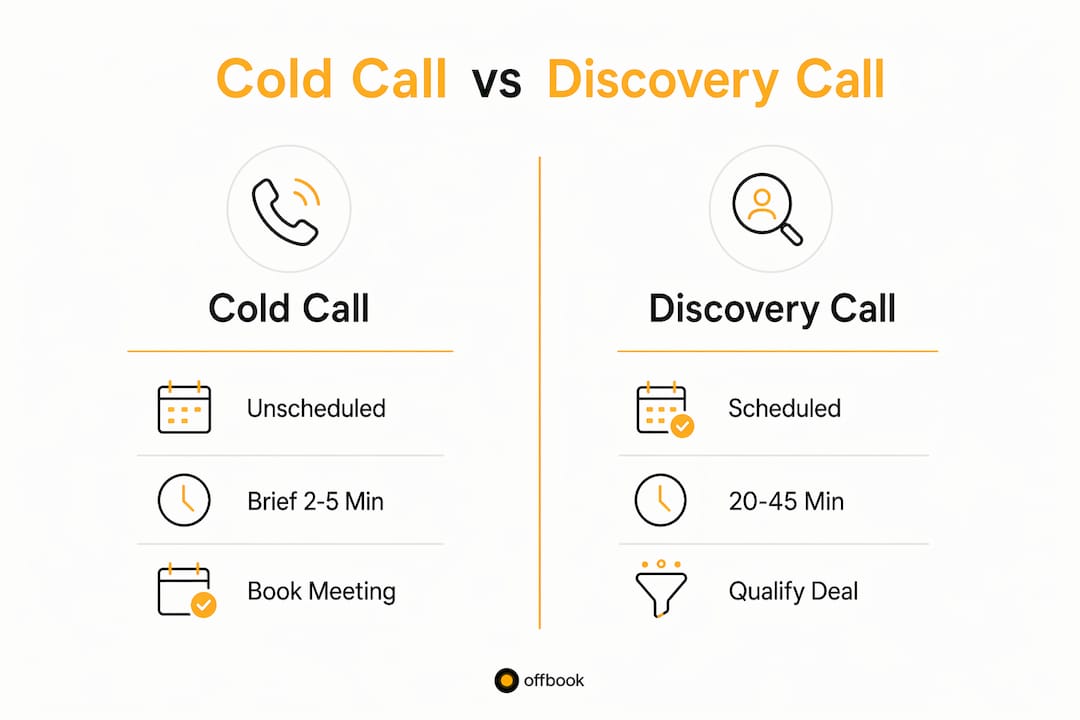
A cold call is unscheduled, brief outreach lasting 2–5 minutes, designed to generate interest and secure permission for a follow-up meeting. A discovery call is scheduled, runs 20–45 minutes, and is structured to diagnose pain points and qualify whether a prospect is a real fit. That difference in duration alone tells you everything about what each call is supposed to accomplish.
The cold call is a door knock. You are interrupting someone’s day, and you have roughly 90 seconds to give them a reason to open the door. The discovery call is the conversation that happens once they let you in. You have earned the time, and now your job is to listen, probe, and assess.

The goals are also fundamentally different. Cold calls aim to generate interest and book a meeting. Discovery calls aim to qualify the lead, understand the buying process, and determine whether the opportunity is worth pursuing. Mixing these goals on the same call is where most reps go wrong.
Key structural differences at a glance
| Dimension | Cold call | Discovery call |
|---|---|---|
| Timing | Unscheduled, unsolicited | Scheduled, agreed upon |
| Duration | 2–5 minutes | 20–45 minutes |
| Prospect warmth | Cold, no prior relationship | Warm, has shown interest |
| Primary goal | Book a meeting | Qualify and diagnose needs |
| Question depth | 3–5 surface questions | Deep, structured probing |
| Frameworks used | None (MEDDIC/BANT reserved) | MEDDIC, MEDDPICC, BANT |
| Funnel stage | Top of funnel | Mid funnel |
Why mixing these calls kills your conversion rate
Conflating cold and discovery calls causes approximately 60% of potential meetings to be lost due to over-questioning or pitching too early. That number reflects a structural problem, not a skill gap. Reps who treat a cold call like a discovery call are spending goodwill the prospect has not yet extended.
Cold calls operate on what sales trainers call permission economics. Every question you ask on a cold call spends a small piece of the prospect’s limited attention and patience. Ask too many, and you burn through that budget before you ever get to your ask. The prospect hangs up, and you never get the meeting.
The same problem runs in reverse on discovery calls. Reps who treat a discovery call like a pitch miss the entire point of the conversation. Pitching too early wastes the chance to gather vital information about the prospect’s buying process, budget, and decision-makers. You end up selling to the wrong person, at the wrong price, with the wrong message.
Here are the most common ways reps conflate the two calls:
- Running BANT or MEDDIC qualification on a cold call before the meeting is even booked
- Pitching product features during a discovery call instead of asking about pain
- Asking budget questions on a cold call, which signals you care more about the deal than the prospect’s problem
- Treating a discovery call as a demo, skipping the diagnostic phase entirely
“Attempting to run full deal-qualification frameworks like BANT or MEDDIC during cold calls can cause lost meetings. These frameworks belong exclusively in the booked discovery call where buyer engagement is confirmed.”
Pro Tip: If you catch yourself asking more than three questions on a cold call, stop. Your only job is to earn the next conversation, not to qualify the deal.
How to run cold calls and discovery calls effectively
Cold call best practices
The cold call’s only job is to earn a meeting. Every decision you make on that call should serve that single goal. Limit your questions to 3–5 and focus each one on uncovering just enough pain to justify a follow-up conversation.
Research the prospect before you dial. Sales consultant Steve Richard has long argued that cold calling should evolve from generic scripts to personalized “warm calling” that resonates with the prospect’s actual priorities. Reviewing a prospect’s LinkedIn profile, recent company news, or a job posting takes five minutes and can transform a cold call into a relevant conversation.
A strong cold call follows this structure:
- Open with a pattern interrupt. Skip the “How are you today?” opener. State your name, your company, and a specific reason you are calling this person.
- Deliver a one-sentence value hook. Connect your solution to a problem you have reason to believe they face, based on your research.
- Ask one diagnostic question. Something like: “Is [specific challenge] something your team is dealing with right now?” This surfaces pain without interrogating.
- Handle the objection. Most prospects will push back. Have one prepared response that acknowledges their concern and pivots to the meeting ask.
- Ask for the meeting, not the sale. “Would it make sense to spend 20 minutes next week to see if this is relevant for you?” is the close.
For B2B SaaS outbound strategies, the same principle applies: personalize the outreach, limit the ask, and earn the next step.
Pro Tip: Never ask about budget, timeline, or decision-making authority on a cold call. Those questions belong in the discovery call. Asking them early signals you are qualifying for your benefit, not solving for theirs.
Discovery call best practices
The discovery call is where you do the real work of sales. Your prospect has agreed to give you 20–45 minutes. Use that time to understand their world, not to talk about yours.
The biggest mistake on discovery calls is treating them as pitches rather than consultative conversations. The rep who talks the most on a discovery call learns the least. A good rule of thumb: your prospect should be speaking for at least 60% of the call.
Structure your discovery call around a proven framework. MEDDIC (Metrics, Economic Buyer, Decision Criteria, Decision Process, Identify Pain, Champion) and MEDDPICC are the gold standards for B2B SaaS. These frameworks force you to ask the questions that actually predict whether a deal will close. For a detailed breakdown of how to structure this conversation, the discovery call structure guide from Offbook covers each phase in depth.
The number of stakeholders involved in B2B purchases has grown significantly, with buying groups now involving anywhere from 11 to 20 decision-makers in complex deals. That reality makes structured discovery calls non-negotiable. You need to map the buying committee, not just charm one contact.
Good discovery questions follow a progression from broad to specific:
- “What prompted you to take this meeting today?”
- “Walk me through how you are currently handling [problem area].”
- “What does that cost you in time or revenue each quarter?”
- “Who else on your team feels the impact of this?”
- “What would need to be true for you to make a change in the next 90 days?”
For more on how these questions drive deals forward, the discovery questions guide from Offbook is worth reading before your next call.
How both calls fit into the B2B sales funnel
Cold calling is a top-of-funnel activity targeting cold prospects, while discovery calling is a mid-funnel qualification step with warm leads that generates higher conversion rates. Understanding where each call sits in the funnel prevents you from applying the wrong tool at the wrong stage.
| Funnel stage | Call type | Primary goal | Next step |
|---|---|---|---|
| Top of funnel | Cold call | Generate interest, book meeting | Schedule discovery call |
| Mid funnel | Discovery call | Qualify fit, diagnose pain | Demo or proposal |
| Late funnel | Follow-up call | Handle objections, advance deal | Close or next stakeholder |
The handoff between a cold call and a discovery call is a critical moment. A strong cold call sets the agenda for the discovery call. Before you hang up, confirm the meeting time, send a calendar invite immediately, and share a brief agenda so the prospect knows what to expect. Reps who skip this step show up to discovery calls where the prospect has forgotten why they agreed to the meeting.
For B2B outbound teams, the funnel mapping also clarifies which metrics belong to which call type. Cold call success is measured by meeting booked rate. Discovery call success is measured by opportunity created rate and qualification score. Tracking both separately gives you a clear view of where your pipeline is leaking.
After the discovery call, the follow-up is just as important as the call itself. The post-discovery follow-up guide from Offbook covers how to keep momentum without being pushy.
Key Takeaways
Cold calls earn the meeting; discovery calls qualify the deal. Treating them as the same conversation is the single most common reason B2B sales pipelines stall.
| Point | Details |
|---|---|
| Cold call definition | A 2–5 minute unsolicited call designed only to book a meeting, not to qualify or pitch. |
| Discovery call definition | A 20–45 minute scheduled conversation to diagnose pain and qualify prospect fit using frameworks like MEDDIC. |
| Question limits matter | Cold calls should include no more than 3–5 questions; deeper probing belongs in the discovery call. |
| Funnel placement | Cold calls are top-of-funnel lead generation; discovery calls are mid-funnel qualification. |
| Mixing calls costs deals | Conflating the two call types causes approximately 60% of potential meetings to be lost. |
What I have learned from getting this wrong
The first time I lost a deal I should have won, it was because I ran a full MEDDIC qualification on a cold call. The prospect answered my first two questions, then went quiet. By the time I asked about budget, they said they had to jump to another meeting. I never heard from them again.
That experience taught me something that no sales training manual states clearly enough: the cold call is not a smaller discovery call. It is a completely different conversation with a completely different contract. The prospect has not agreed to be qualified. They have not agreed to anything yet. Your job is to earn that agreement, not to assume it.
The shift to “warm calling,” where you research the prospect’s context before dialing, changes the dynamic entirely. When you open a cold call by referencing a specific challenge the prospect’s company is facing, you are no longer a stranger interrupting their day. You are someone who did their homework. That distinction matters more than any script.
On the discovery side, the mistake I see most often is reps who are so eager to pitch that they skip the diagnostic phase. They hear one pain point and immediately jump to features. The prospect feels sold to rather than understood, and the deal stalls. The best discovery calls I have run felt more like consulting sessions than sales calls. The prospect did most of the talking. I left knowing exactly what they needed and whether we could deliver it.
The startup sales practices that actually work in 2026 all share one trait: they treat each call type as a distinct discipline with its own rules, its own goals, and its own success metrics.
— Neil
How Offbook helps you run better cold and discovery calls
Sales reps know what they should do on a call. The problem is executing it in real time, under pressure, when the prospect goes off script.
Offbook is real-time AI call coaching built for B2B SaaS teams. It listens to your calls and surfaces live prompts on your screen, without a bot ever joining the meeting. On cold calls, it cues you when you are asking too many questions or drifting from your meeting ask. On discovery calls, it tracks your MEDDIC or MEDDPICC coverage and flags qualification gaps as the conversation unfolds. Offbook also generates pre-call briefs so you walk into every cold call with the prospect research already done. For founder-led teams at the seed and Series A stage, it is the difference between a rep who knows the playbook and one who runs it.
FAQ
What is a cold call in B2B sales?
A cold call is an unsolicited, unscheduled outreach call lasting 2–5 minutes, designed to generate interest and book a meeting with a prospect who has had no prior contact with the seller.
What is a discovery call?
A discovery call is a scheduled 20–45 minute conversation where a sales rep diagnoses a prospect’s pain points, qualifies their fit, and maps the buying process using structured frameworks like MEDDIC or BANT.
How many questions should you ask on a cold call?
Cold calls should include no more than 3–5 questions. Asking more exhausts the prospect’s attention before you reach your meeting ask, which causes most cold calls to fail.
When should you transition from a cold call to a discovery call?
The transition happens the moment the prospect agrees to a meeting. The cold call ends with a booked calendar invite. The discovery call is where qualification and deeper probing begin.
Can you run MEDDIC or BANT on a cold call?
No. Running MEDDIC or BANT on a cold call causes lost meetings because the prospect has not yet agreed to be qualified. These frameworks belong exclusively in the booked discovery call.