Competitive Deal Strategies for B2B Reps: Win More
Discover how to sell in competitive deals strategies and win more. Learn essential tactics to outsmart rivals and boost your success rate.
Published: August 3, 2026
Author: OffBook Editorial Team

Five moves separate reps who consistently win contested deals from those who lose on price. Inoculate early by naming likely competitor objections before the buyer hears them from a rival. Multi-thread across at least three stakeholders — multi-threading increases win rates by around 130% in deals over $50K. Build a value wedge by mapping your sharpest differentiator to a stated buyer priority, not a feature list. Handle every competitor mention with ARR: Address the claim, Reframe it around outcomes, Redirect to your proof. Operationalize all of it with a one-page battlecard your team actually opens.
Before your next competitive call, add these three CRM tasks:
- Pull the battlecard for the named competitor and flag one landmine question to plant in discovery.
- Confirm you have contacts at champion, economic buyer, and technical evaluator levels.
- Prepare one ROI data point tied to the buyer’s stated top priority.
Table of Contents
- How do you map the competitive landscape before a contested deal?
- How do you find competitor weaknesses and build a value wedge?
- How does the ARR framework handle competitor objections on the spot?
- Why does making your competitive move early in the deal cycle matter?
- Why you shouldn’t bash competitors, and how to ask permission to compare
- What proof actually moves competitive evaluations?
- How do you operationalize competitive selling across a revenue team?
- What pricing guardrails protect margin in a competitive deal?
- What metrics predict competitive deal health?
- How does real-time call coaching change execution on competitive calls?
- A 7-step playbook you can run on any competitive deal
- How do customer insights and feedback sharpen competitive proposals?
- Post-deal follow-up and relationship management for future deals
- Key Takeaways
- What top reps actually do when deals get crowded
- Real-time coaching helps you execute this playbook when it counts
- Useful sources and further reading
How do you map the competitive landscape before a contested deal?
Start with signals, not assumptions. Intent data platforms surface accounts actively researching categories. Technographic tools show what the prospect already runs. Review sites like G2 and Gartner Peer Insights reveal recurring complaints about incumbents — those themes become your targeting criteria.
In discovery, separate requirements from outcomes. A requirement is “we need SSO.” An outcome is “our IT team spends 12 hours a week on access provisioning and that needs to stop.” Outcomes are where your value wedge lives. Ask: “What does success look like 90 days after go-live?” and “What would have to be true for this to be considered a failure?” Those two questions expose evaluation criteria the RFP never mentions.
Minimum stakeholder map for any competitive deal:
| Role | What They Care About | How to Find Them |
|---|---|---|
| Champion | Career impact, internal credibility | First call referral, LinkedIn org chart |
| Economic buyer | Budget, ROI, risk | Ask champion directly; check press releases |
| Technical evaluator | Integration, security, implementation risk | IT or engineering lead on the champion’s team |
| End-user influencer | Daily workflow, ease of use | Ask for a pilot group contact in discovery |
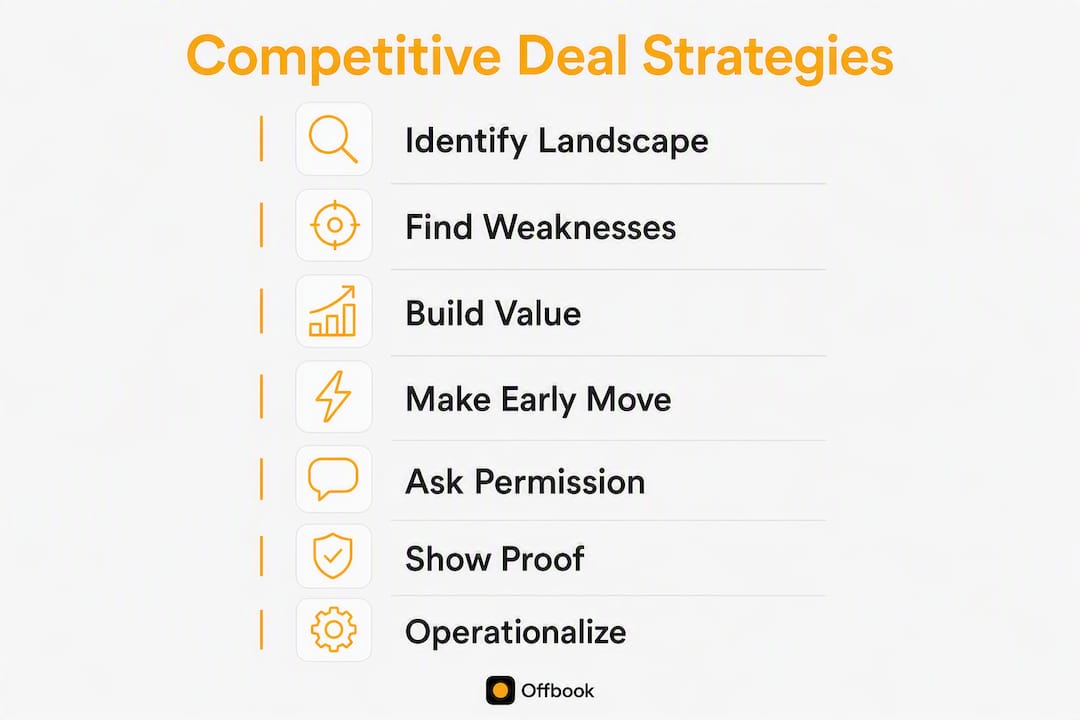
For prospect research tactics that build a sharper competitive map, the key is combining review themes with technographic data before the first call — not after.
How do you find competitor weaknesses and build a value wedge?
Real weaknesses live in public evidence: one-star reviews on G2, support forum threads, partner ecosystem gaps, and reference debriefs from customers who switched. Look for patterns across at least five reviews before treating a complaint as a structural weakness. One angry post is noise; five posts about the same onboarding problem is a wedge.

Map that weakness to a buyer priority. If the incumbent’s reviews consistently flag slow implementation and your buyer said “we need to be live before Q3,” that’s your wedge. The formula: their constraint + your buyer’s stated priority = your value wedge.
Landmine questions do this without you ever naming the competitor. Plant them in discovery:
- “How important is it that your team can self-serve configuration changes without filing a support ticket?”
- “What’s your current average time from contract to go-live, and how does that compare to what you need?”
- “If the vendor you choose can’t integrate with [specific tool], what’s the workaround cost?”
The buyer surfaces the gap themselves. You never attacked anyone.
On the “who it’s not for” question: being honest about fit builds more trust than overselling. A line like “We’re probably not the right fit if your team needs X” signals confidence and disarms skepticism faster than any feature comparison.
How does the ARR framework handle competitor objections on the spot?
ARR stands for Address, Reframe, Redirect. It’s the standard reactive framework for handling competitor mentions without conceding ground or going silent.
- Address: Acknowledge the competitor’s claim directly. Don’t dodge it. “Yes, [Competitor] does have a strong reporting module.”
- Reframe: Shift the frame to outcomes, not features. “The question most teams in your position end up asking is whether the reporting actually changes how fast they can act on the data.”
- Redirect: Point to your proof. “Our customers in [similar vertical] cut their reporting-to-decision cycle from five days to same-day. Want me to connect you with one of them?”
When to inoculate vs. when to use ARR reactively:
Use inoculation when you know a competitor is already in the deal. Bring it up yourself before the buyer does: “You’re probably also looking at [Competitor]. One thing teams often discover mid-evaluation is [known weakness]. Worth keeping an eye on as you go through demos.” Use ARR reactively when a competitor surfaces unexpectedly mid-call.
Pro Tip: In mature markets, mentioning competitors early tends to lower win rates. Save competitor discussion for the formal evaluation stage unless the buyer brings it up first. In new or emerging categories, naming a competitor early can actually increase close rates by clarifying the space.
Why does making your competitive move early in the deal cycle matter?
The rep who defines the evaluation criteria wins the evaluation. If you wait until the formal RFP to differentiate, you’re scoring against a rubric someone else wrote. The first three meetings are where that rubric gets set.

| Meeting | Goal | Key Move |
|---|---|---|
| Meeting 1 | Surface outcomes, not requirements | Ask the two outcome questions from discovery |
| Meeting 2 | Expand the rubric | Introduce criteria the incumbent can’t meet |
| Meeting 3 | Arm the champion | Deliver a one-page brief they can share internally |
Champion enablement is the most underused move in competitive deals. Your internal advocate needs assets they can forward without explanation: a one-page comparison of outcomes (not features), a two-sentence answer to “why switch now,” and a reference name they can drop in an internal meeting. Give them those three things by meeting three and you have a voice in every room you’re not in.
For deal advancement techniques that keep momentum through a multi-stakeholder cycle, the sequence matters as much as the content.
Why you shouldn’t bash competitors, and how to ask permission to compare
Attacking a competitor on a sales call almost always backfires. The buyer has often already invested time with that vendor, and criticizing them triggers a defensive response. You’re no longer selling — you’re managing a debate.
The better move is to acknowledge competitor strengths briefly, then pivot to your differentiator. This signals confidence, not desperation.
Permission script to open a competitive comparison:
“Would it be helpful if I walked you through how we’re different from [Competitor], including where they’re genuinely strong and where teams like yours tend to find gaps? I want to give you an honest picture.”
That sentence does three things: it positions you as credible, it sets up the comparison on your terms, and it gets explicit consent so the buyer doesn’t feel ambushed.
Dos and don’ts:
- Do name a competitor strength before pivoting to your wedge.
- Do use third-party evidence (reviews, analyst reports) rather than your own claims.
- Don’t use superlatives (“we’re the best at X”) without proof.
- Don’t bring up a competitor’s weakness unprompted in the first meeting.
- Don’t let silence after a competitor mention read as concession — use ARR immediately.
The internal rationale for this approach: buyers remember how you made them feel about the process. A rep who ran a fair, honest comparison is the one they trust to be a fair, honest vendor.
What proof actually moves competitive evaluations?
Three formats consistently shift evaluations: a quantified ROI model, a scripted reference call, and a sequenced demo. Generic case studies rarely move the needle. Specific numbers tied to the buyer’s own stated priorities do.
Compact ROI calculation template:
| Cost of staying | Cost of switching |
|---|---|
| Current process cost (time × rate) | Implementation time + internal resource cost |
| Missed revenue from [stated gap] | Onboarding period productivity dip |
| Risk exposure from [incumbent weakness] | Your annual contract value |
Fill in the buyer’s numbers from discovery. The goal isn’t a perfect model — it’s a conversation starter that makes the cost of inaction visible.
Reference briefing: Call your reference before the prospect does. Tell them exactly what the buyer cares about. A well-briefed reference who speaks to the buyer’s specific evaluation criteria is worth more than three generic testimonials. Script their opening: “The thing that mattered most to us was [buyer’s priority], and here’s how that played out…”
Demo sequencing: Start with the outcome the buyer named as their top priority, not your product’s homepage. Sequence your differentiators second. At three points in the demo, pause and ask: “Does this address what you described earlier?” Those checkpoints invite comparison without naming names and keep the buyer anchored to their own criteria.
For guidance on running effective demo calls in competitive situations, outcome-first sequencing is the single biggest lever.
How do you operationalize competitive selling across a revenue team?
A battlecard only works if reps open it. Many companies using battlecards report higher win rates, but adoption is the constraint — the target is substantial monthly access per rep.
Battlecard fields that matter:
- Why we win: Two sentences, specific to the competitor.
- Competitor strength: Acknowledge it honestly — reps need to know what they’re up against.
- Landmine questions: Three pre-planned discovery prompts that surface the competitor’s gaps.
- Recent wins: One deal summary with the decisive move, updated quarterly.
- Quick-dismiss script: A 30-second response to “we already have [Competitor].”
Keep cards to one page. If a rep can’t find the answer in 10 seconds, they won’t use it mid-call.
Maintenance and feedback loops:
| Activity | Cadence | Owner |
|---|---|---|
| Win/loss debrief | Every closed deal | AE + PMM |
| Battlecard update | Quarterly minimum | PMM |
| Reference library refresh | After each new customer story | CSM |
| Competitive intel share | Monthly Slack/email digest | PMM or Sales Ops |
Feed win/loss learning back into playbooks within two weeks of a deal closing. Memory fades fast, and the decisive move in a won deal is exactly what the next rep needs.
What pricing guardrails protect margin in a competitive deal?
Discounting on price is a last resort, not a first response. The moment you drop price without extracting a concession, you signal that your original number was inflated — and you invite the buyer to push further.
Discount guardrail table:
| Situation | Acceptable response | Not acceptable |
|---|---|---|
| Competitor quoted lower | Reframe on TCO; offer a pilot | Match price without conditions |
| Budget constraint, genuine | Reduce scope; offer phased start | Discount full contract |
| End-of-quarter pressure | Accelerate timeline incentive | Unilateral price cut |
| “Just need a better number” | Ask what would make it work | Immediate concession |
Negotiation scripts that re-anchor on outcomes:
- “Help me understand — is the gap a budget issue or a value question? Because those have different answers.”
- “If we could show that this pays back in [X months], would the investment still be the sticking point?”
- “What would you need to see to feel confident the price is right?”
Escalation checklist: Before approving any exception, confirm: (1) you’ve exhausted scope reduction, (2) the champion has confirmed the economic buyer is the final decision-maker, (3) the discount has a signed-by date attached, and (4) a manager has reviewed the deal margin.
What metrics predict competitive deal health?
Three signals matter most: multi-threading depth, competitor mention timing, and talk-to-listen ratio. A deal with only one contact is single-threaded and fragile. A competitor surfacing for the first time in week six of an eight-week cycle is a red flag, not a normal development.
Key signals and action triggers:
- Single-threaded contact: Immediately identify and reach out to a second stakeholder. Use the champion to make the introduction.
- Competitor mentioned in first meeting: In a mature market, this is normal — don’t over-react. In a new category, it may mean the buyer is using the competitor to anchor price.
- Talk-to-listen ratio above 50% talk: You’re pitching, not discovering. Pull back and ask an open question. The optimal ratio is around 43% talk, 57% listen.
- No demo engagement questions: The buyer isn’t invested. Pause and ask what’s missing.
- Late-stage competitor surfacing: Treat as a risk signal. Immediately schedule a champion call to understand what changed.
For a full list of deal risk indicators worth tracking in your CRM, the signals above are the highest-priority ones to instrument first.
How does real-time call coaching change execution on competitive calls?
The gap between knowing a framework and executing it under pressure is where deals are lost. A rep who has memorized ARR can still go silent when a buyer says “we’re already using [Competitor]” — because in the moment, the cognitive load of listening, thinking, and responding simultaneously is genuinely hard.
Scenario: A buyer mentions a competitor 20 minutes into a discovery call. Without a prompt, the rep either over-explains or deflects. With a live coaching cue surfaced on-screen, the rep sees: “Address their strength → Reframe on outcomes → Redirect to proof.” The response lands in 30 seconds instead of two minutes of fumbling.
Implementation tips for integrating in-call coaching into competitive playbooks:
- Load competitor-specific ARR scripts into your coaching profiles before the call.
- Set a prompt trigger for competitor name mentions so the cue fires automatically.
- Use post-call debriefs to review which prompts fired and whether the rep followed them — that’s your coaching feedback loop.
- Run a 30-minute role-play session with new reps using live prompts before their first competitive call.
The talk-to-listen ratio target of 43/57 is also something in-call coaching can reinforce in real time, flagging when a rep has been talking for more than two minutes without asking a question.
Pro Tip: Always disclose to buyers that you use AI-assisted call tools. A brief consent statement at the start of the call (“I use a note-taking and coaching tool during calls — is that okay with you?”) keeps the conversation above board and builds trust from the first minute.
A 7-step playbook you can run on any competitive deal
| Step | Owner | Deliverable |
|---|---|---|
| 1. Qualify and flag competitive | AE | Competitor named in CRM; battlecard pulled |
| 2. Build stakeholder map | AE | Champion, economic buyer, tech evaluator identified |
| 3. Run outcome-first discovery | AE | Buyer’s top three priorities documented |
| 4. Inoculate and plant landmines | AE | Competitor weakness surfaced by buyer in discovery |
| 5. Deliver proof package | AE + SE | ROI model + reference brief + sequenced demo |
| 6. Negotiate on value, not price | AE | Discount guardrail applied; escalation path confirmed |
| 7. Pilot or POC close | AE + CSM | Pilot scope agreed; success criteria documented |
Step-by-step notes:
- Flag the deal as competitive the moment a competitor is named. Pull the relevant battlecard immediately.
- Use LinkedIn and your champion to map the full buying committee. Never enter step 3 single-threaded.
- Ask outcome questions, not feature questions. Document the answers in your CRM before the next call.
- Plant landmine questions in meeting two. Let the buyer surface the gap — don’t name it yourself.
- Brief your reference before the prospect calls them. Sequence the demo around the buyer’s stated top priority.
- If price comes up, use the re-anchoring scripts. Escalate only after scope reduction has been explored.
- A time-boxed pilot with documented success criteria is often the fastest path to a closed deal in a competitive situation. It reduces the buyer’s perceived risk and gives you a proof point inside their environment.
For startup sales best practices that apply this playbook at the seed and Series A stage, the qualification step is where most early-stage teams underinvest.
How do customer insights and feedback sharpen competitive proposals?
Win/loss interviews are the most underused source of competitive intelligence in B2B sales. A 20-minute call with a buyer who chose a competitor tells you more than a year of analyst reports. Ask: “What would have had to be true for you to choose us?” That answer rewrites your next proposal.
Aggregate feedback across deals to find patterns. If three lost deals in the same vertical cite the same objection, that’s a proposal gap, not a rep gap. Fix it at the template level. Similarly, customers who renewed or expanded are a source of language — the words they use to describe your value are the words your next proposal should use.
Tailor proposals to the buyer’s stated outcomes, not your product’s feature set. A proposal that opens with “Based on what you told us in discovery…” and then mirrors the buyer’s own language back to them closes faster than a templated deck. It signals that you listened, and listening is the rarest thing in a competitive process.
Post-deal follow-up and relationship management for future deals
The deal closing is the start of the competitive relationship, not the end. Buyers who had a good experience become references. References become the most powerful asset in your next competitive deal.
Schedule a 30-day check-in call with every new customer. The goal isn’t upsell — it’s to confirm the success criteria from the pilot are being met. If they’re not, fix it before it becomes a churn risk. If they are, ask for a reference call permission and a brief written testimonial you can use in future proposals.
Retaining the right customers is a competitive advantage in itself. A customer who publicly advocates for you on G2 or in a peer community is doing competitive selling on your behalf, 24 hours a day, without a quota.
Multi-thread post-sale the same way you did pre-sale. If your champion leaves, you need a relationship with the economic buyer and the technical evaluator to protect the renewal. Map your post-sale contacts the same way you mapped the buying committee.
Key Takeaways
Winning competitive B2B deals requires multi-threading across at least three stakeholders, an ARR objection framework executed live, and a value wedge built from real buyer priorities — not feature lists.
| Point | Details |
|---|---|
| Multi-thread early | Contact champion, economic buyer, and technical evaluator before meeting two to avoid single-thread fragility. |
| Use ARR on every competitor mention | Address the claim, reframe on outcomes, redirect to proof — never go silent when a competitor is named. |
| Build the value wedge from buyer language | Map your sharpest differentiator to the buyer’s stated top priority, not your product roadmap. |
| Battlecard adoption drives win rates | Target substantial monthly access per rep; keep cards to one page with landmine questions and a quick-dismiss script. |
| Offbook coaches ARR in real time | Offbook surfaces live on-screen prompts during calls so reps execute ARR under pressure, not just in training. |
What top reps actually do when deals get crowded
The conventional wisdom says competitive deals are won in the demo. They’re not. They’re won in the second meeting, when most reps are still building rapport and the best reps are already rewriting the evaluation rubric.
The move that rarely appears in published playbooks is this: after the first call, send the champion a one-page document titled “What a successful evaluation looks like.” It’s not a proposal. It’s a list of criteria — written in the buyer’s language, drawn from what they said in discovery — that any vendor in this space should be able to meet. You include two or three criteria the incumbent structurally can’t satisfy. The champion forwards it internally as a useful framework. You’ve just shaped the RFP before it’s written.
The other thing top reps do differently is they treat silence as a signal, not a pause. When a buyer goes quiet after a competitor mention, that silence is either confusion or consideration. The rep who fills it with a feature list loses. The rep who asks “What’s your read on that?” wins the next 10 minutes of the call.
Real-time coaching helps you execute this playbook when it counts
Knowing the ARR framework is one thing. Executing it when a buyer drops a competitor name mid-call, while you’re also tracking the conversation and managing your next question, is another problem entirely. That’s the gap Offbook closes.
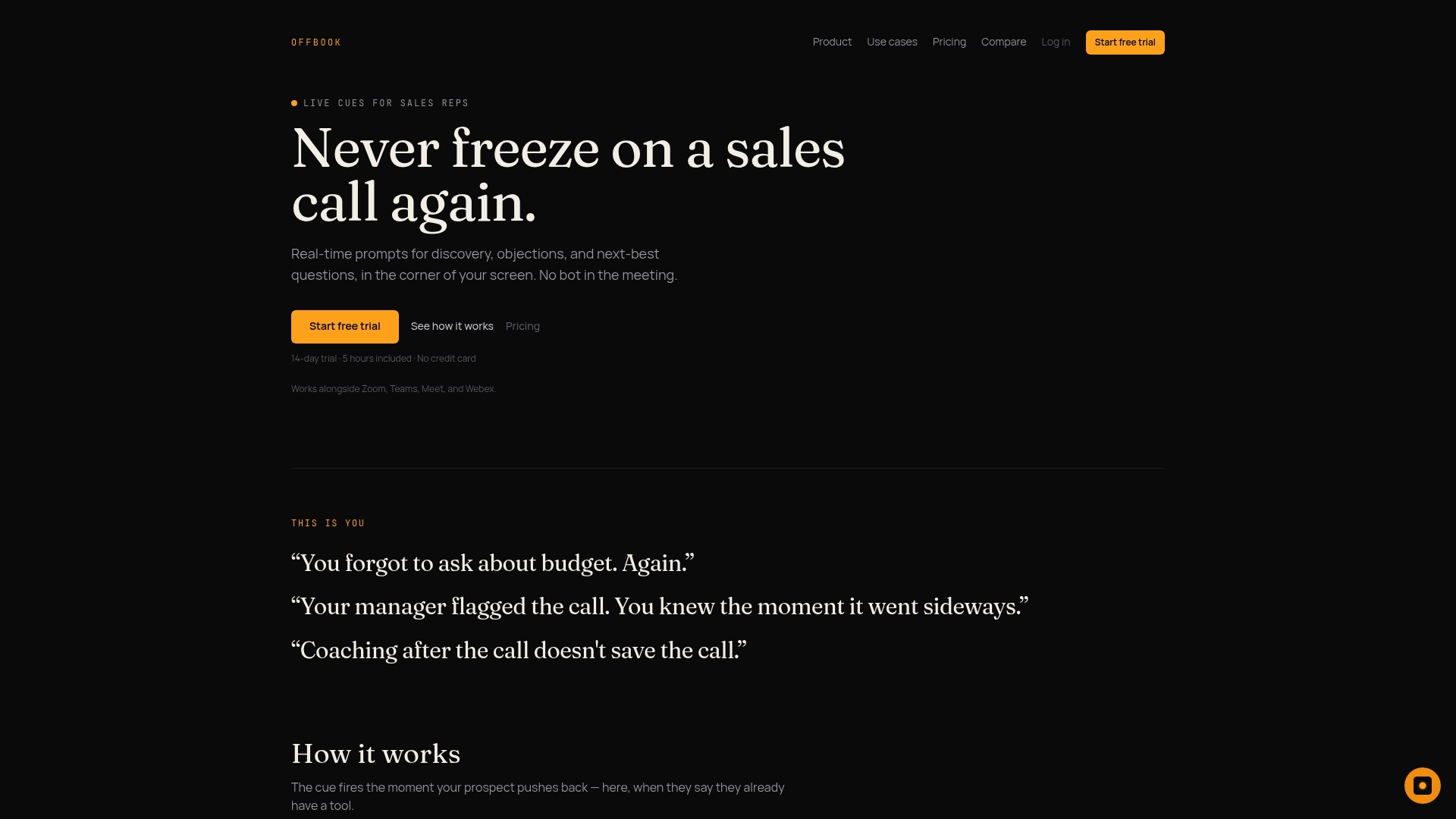
Offbook listens to your video calls and surfaces live on-screen prompts — no bot joins the meeting, no buyer sees anything. When a competitor is mentioned, the relevant ARR script fires. When your talk time runs long, a cue reminds you to ask a question. When a qualification gap appears, MEDDIC prompts surface in real time. For seed and Series A teams running competitive deals without a full enablement function, it’s the difference between a playbook that lives in a doc and one that actually runs on calls.
The fastest way to pilot it: pick your next three competitive opportunities, load the relevant battlecard scripts into Offbook’s coaching profiles, and run the calls. The AI call coaching page has everything you need to get started.
Useful sources and further reading
- ARR framework and competitive selling techniques — Practical scripts for handling competitor mentions, the ARR steps in detail, and guidance on avoiding negative selling. Good for objection-handling training.
- Competitive selling data-backed playbook — Multi-threading win-rate data, talk-to-listen benchmarks, battlecard adoption targets, and timing rules for competitor discussion. The most data-dense source in this article.
- Competitive displacement play — Explains how to expand buyer requirements rather than compete on features. Includes qualification criteria for displacement campaigns and win-rate data.
- How to win a competitive deal as a challenger — Five-move playbook covering landmine questions, reference briefing, demo sequencing, and cost-of-inaction models. Practical templates throughout.
- Eight-figure deal sales advice — Short, direct guidance on honesty as a trust mechanism and the “who it’s not for” framing that builds credibility in competitive situations.
- 14 effective selling strategies — Broad foundational reference covering problem-solving framing, intelligent questioning, and demonstration best practices.
- Salesforce sales strategy guide — Covers account-based, value-based, and solution selling frameworks with pipeline management guidance; useful for aligning competitive tactics to a broader sales process.
- Strategic selling overview — Detailed breakdown of stakeholder mapping, champion identification, and win-win solution design for complex B2B deals.
- HBR: The value of keeping the right customers — Research-backed case for post-sale relationship investment as a competitive advantage, relevant to reference strategy and renewal protection.