B2B Sales Compensation Plans: A 2026 Guide for SaaS Founders
Discover the types of B2B sales compensation plans that boost SaaS startup success. Learn how to attract top talent and drive performance!
Published: July 25, 2026
Author: OffBook Editorial Team

The most effective types of B2B sales compensation plans for founder-led SaaS startups combine a base salary with tiered commission, layered with residual and MBO components. The structure you pick shapes rep behavior, risk allocation, and whether your best people stay past 18 months.
Table of Contents
- What are the main types of B2B sales compensation plans?
- How tiered commission structures change rep behavior
- How to balance risk and incentives across your sales team
- Common pitfalls in sales compensation plan design
- Expert insights on aligning compensation with SaaS sales motions
- Offbook coaches the behaviors your compensation plan is designed to reward
- Key takeaways
What are the main types of B2B sales compensation plans?
Most B2B sales teams run on one of five core models, or a stack of two or three combined.
- Salary plus commission: The most common structure in B2B SaaS. Reps get a fixed base plus a percentage of bookings. Pay mix typically runs equal parts base and commission or slightly weighted toward base. Standard commission rates are set to motivate achieving bookings targets.
- Tiered commission: Commission rates step up at attainment thresholds. A rep might earn a lower commission up to their quota, a higher rate as they exceed quota, and an even greater rate for substantial overperformance. Rewards overperformance without raising the base rate for everyone.
- Straight commission: 100% variable, no base. High upside, high churn risk. Rarely suitable for B2B SaaS given longer sales cycles and consultative selling motions.
- Residual commission: Reps earn ongoing commission on renewals and expansions. Rates run lower than new-business rates, typically 2–5%, but compound into a meaningful book of business over time.
- Bonus-based plans: Fixed payouts tied to milestones, MBO objectives, or quarterly quota attainment. Work best as supplements layered onto a primary commission structure.
For founder-led SaaS teams at seed or Series A, salary plus commission with a tiered accelerator is the default starting point. The 2026 Optymyze guide frames compensation structure as a strategic risk decision, not just a payout formula. Get it wrong and you either overpay underperformers or lose your top closers to a competitor who structured OTE better.
How tiered commission structures change rep behavior
Tiered commission is one of the most behaviorally powerful tools in B2B sales remuneration strategies, and it is frequently underused at early-stage startups.

The mechanics are straightforward. A rep earns a base rate up to quota, then a higher rate on every dollar above it. Common tiers include increasing commission rates as reps exceed their quotas, with accelerators boosting pay for overachievement in enterprise plans.
The behavioral effect is the real story. Flat-rate commission gives a rep no reason to push past quota once they hit it. Tiered commission does the opposite: every additional dollar closed above the threshold is worth more than the last, which kills sandbagging and keeps top performers selling through the end of the quarter.
- Discourages sandbagging: Reps who hold deals to the next period lose the accelerated rate on those deals.
- Rewards stretch performance: A rep at 130% of quota earns disproportionately more than one at 100%, which is exactly the behavior you want to reinforce.
- Creates a visible earnings path: Reps can calculate in real time what closing one more deal is worth, which is a stronger motivator than a vague “great quarter” bonus.
Metrics that typically gate these tiers in SaaS include ARR bookings, net new ARR, and logo count. For expansion-focused teams, net revenue retention can anchor a separate residual tier.
Pro Tip: Design your tiers so the jump from tier one to tier two requires realistic stretch, not heroics. If fewer than 20% of your reps ever hit tier two, the accelerator stops functioning as a motivator and just becomes a line item for your top one or two closers.
How to balance risk and incentives across your sales team
Compensation structure is fundamentally a risk-sharing decision. The question is how much financial uncertainty you push onto the rep versus absorb as a company.
Straight commission compensation has no base salary and is fully variable. That maximizes rep upside but also maximizes churn, especially in B2B SaaS where a new rep may go three to four months before closing their first enterprise deal. Base plus commission, running 50/50 to 70/30, distributes that risk more evenly and makes it possible to recruit reps who are excellent at consultative selling but not willing to bet their rent on a six-month sales cycle.
Draw advances add another layer. A recoverable draw acts as a loan: the company advances a monthly floor, and the rep repays it from future commissions. A non-recoverable draw is a guaranteed floor the company absorbs if quota is missed. Recoverable draws, if misused, drive churn during ramp periods. Non-recoverable draws cost more but produce a safer onboarding experience for new hires.
Pay mix also shifts by role and seniority:
- SDRs: Often 70/30 base-to-variable. Their output (meetings booked) is high-volume but not directly tied to closed revenue.
- Account executives: 50/50 is the standard. The variable component is large enough to motivate but the base covers the reality of longer SaaS cycles.
- Senior AEs and enterprise reps: May skew 60/40 or even 65/35. Higher base reflects territory complexity and longer ramp time.
- Account managers: Typically 70/30 with residual commission on renewals, aligning them with retention rather than new logos.
For SaaS startup sales teams, the right mix depends on how predictable your territory is and how much pipeline variance you expect in the first 12 months.
Common pitfalls in sales compensation plan design
Most compensation mistakes at founder-led startups fall into a small number of repeatable patterns.
Over-relying on a single incentive type is the most common. Using only base commission leaves long-term relationship behaviors unrewarded. Using only SPIFs creates a transactional mindset where reps chase the current push product instead of building pipeline. The most effective plans layer two to four complementary components rather than betting everything on one mechanism.
Running SPIFs constantly is a close second. A SPIF that runs every quarter stops feeling like a special push and becomes background noise. Reserve them for genuine product launches or end-of-period acceleration, not as a substitute for a well-designed base plan.
Other pitfalls worth watching:
- Cliff effects near quota: If a rep earns nothing until they hit 100%, the plan creates anxiety rather than motivation. A graduated payout starting at 70–80% of quota is more effective.
- Undocumented plan layers: Documenting each layer separately, commissions, residuals, draws, and MBO bonuses, keeps finance audits clean and prevents rep disputes.
- Ignoring legal compliance: Commission plans in the U.S. must comply with state wage payment laws. California, for example, requires a written commission agreement signed by both parties. Clawback provisions need to be clearly defined to be enforceable.
- Never reviewing the plan: A plan built for five reps breaks at twenty. Build a quarterly review cadence into the plan from day one.
Pro Tip: Use a CPM calculator to model how different pay mix ratios affect your total compensation cost at various attainment levels before you finalize any plan.
Expert insights on aligning compensation with SaaS sales motions
OTE is the number that actually matters in a recruiting conversation, not base salary. Experienced sales leaders prioritize OTE because total earnings potential motivates top performers more than a fixed paycheck. Quotas are commonly set at multiples of OTE to align rep motivation with company revenue goals, adjusted based on deal size and sales motion.
Layering residual commissions on top of a new-business plan is one of the most underused retention tools at early-stage SaaS companies. When an account manager knows that every renewal they protect adds to a compounding book of business, they behave like an owner of that account rather than a ticket-closer. Combine that with an MBO bonus tied to customer health scores or expansion pipeline, and you get cross-functional behavior that a pure commission plan never produces.
Compensation structure is a strategic decision that shapes which behaviors reps amplify, how risk is distributed between the company and the seller, and how predictable earnings feel from quarter to quarter. The structure you pick is not just a payout formula. It is a statement about what you value and who you want to attract.
Offbook’s work with founder-led SaaS teams consistently shows that compensation plans perform better when reps are coached in real time on the behaviors the plan is designed to reward. A tiered commission plan that rewards MEDDIC-qualified deals closes faster when reps are prompted during the call to surface economic buyer access, decision criteria, and compelling events. The plan sets the incentive; real-time coaching closes the gap between intent and execution.
Pro Tip: Align your compensation review cycle with your sales coaching data. If Offbook’s call analytics show reps consistently missing a qualification step, that is a signal your plan may not be incentivizing the right behaviors at the right stage of the deal.
Offbook coaches the behaviors your compensation plan is designed to reward
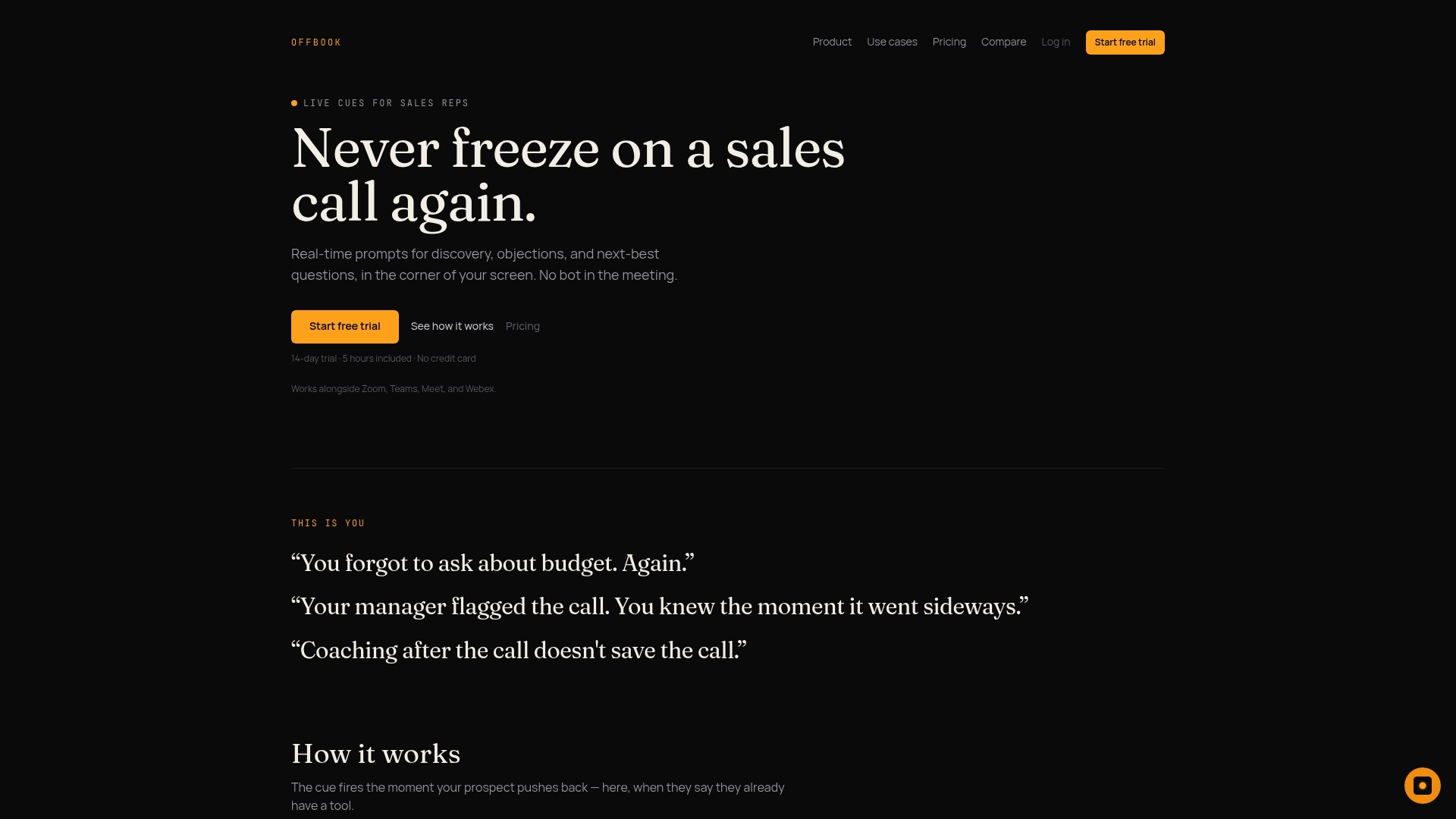
A well-designed compensation plan tells reps what to do. Offbook shows them how to do it, live, on every call. AI call coaching for your sales team surfaces real-time cues for qualification gaps, objection handling, and next steps, all structured around MEDDIC and MEDDPICC. No bot joins the meeting. No post-call review required. The coaching happens in the moment, when it actually changes the outcome.
Key takeaways
The most effective B2B SaaS compensation plans layer salary plus commission with tiered accelerators, residual components, and MBO bonuses, reviewed quarterly as the team scales.
| Point | Details |
|---|---|
| Salary plus commission is the standard | Pay mix typically runs equal parts base and commission or slightly weighted toward base. |
| Tiered commission drives overperformance | Rates step from 8% to quota, 12% for 100–120%, and 16% above 120%, rewarding stretch without raising base rates. |
| OTE outweighs base in recruiting | Quota is typically set at 3–6x OTE to align rep motivation with company revenue goals. |
| Layer multiple incentive types | Plans combining base commission, residuals, and MBO bonuses outperform single-incentive designs. |
| Review plans as you scale | A plan built for five reps breaks at twenty; build a quarterly review cadence from day one. |